


Hey everybody. Welcome back. Thanks for being here.
Our top story today. Somebody has to take the fall, and it’s not going to be the man who started the war. Two days after a brutal midterm defeat, Republicans have picked their scapegoat: Pete Hegseth. The House could vote to impeach him next week, and Republican sources say it will pass. A Trump adviser says he’s on thin ice. While the president says he’s doing a very good job. But with Trump, that’s usually the last thing you hear before somebody gets fired.
We’ll also get into the fight to replace Speaker Mike Johnson, the inside story of a campaign that knew it was losing, the wave that swept statehouses and ended 16 years of Republican control, and how the businessman president lost voters on the economy.
So do me a favor. Like this video, share it with someone who needs to see it, and subscribe so you never miss an episode.
Let’s get to it.
1. Republicans Turn on Hegseth
According to CNN, Republican lawmakers and allies are moving fast to pin Tuesday’s loss on Pete Hegseth. The argument is that Hegseth convinced the president to attack Iran with no exit strategy, oversold how fast it would end, and kept pushing to escalate when the bombing wasn’t working. As one Republican close to the White House put it, “Pete has been either dishonest or incorrect, neither of which are acceptable, about timelines, goals and objectives since the beginning.”
Axios is reporting the same thing. One Trump adviser said Hegseth is “definitely on thin ice.” Another official said somebody has to take the fall, and Pete is moving to the top of the list.
Here’s the problem. Once Democrats take the Senate in January, a senior White House official told Axios, “no one’s getting confirmed.” So if Trump wants a new defense secretary, he has eight weeks to do it.
The exit ramp being floated is an interesting one. Marsha Blackburn just won the governor’s race in Tennessee, and when she takes office in January she gets to appoint her own replacement in the Senate. Trump said Hegseth would be “very popular” there.
But that assumes Hegseth gets to leave on his own schedule. And that’s where Thomas Massie comes into the picture.
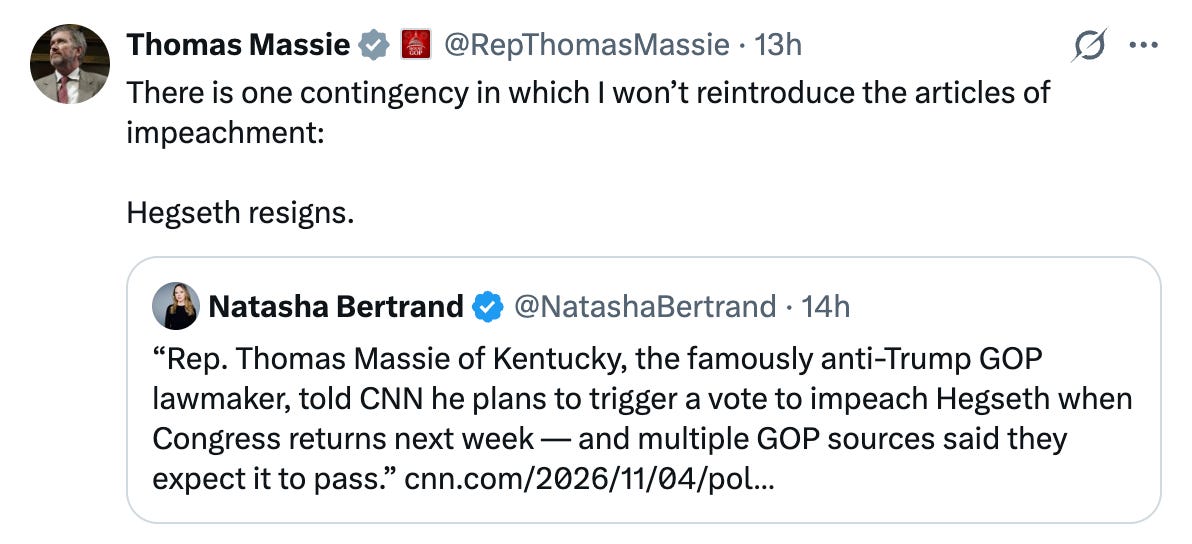
Massie says he’ll trigger an impeachment vote when Congress returns next week, and multiple Republican sources told CNN they expect it to pass.
Hegseth’s spokesman says he “will not back down.” One administration official told CNN that Hegseth probably knows he’s finished, and is holding out for an exit dramatic enough to launch a presidential run.
Look, however it happens, Pete Hegseth needs to go. He’s a talk show host. He has no business running the most powerful military on earth, and the last two years have proven it. The job of the defense secretary is to tell the president hard truths. But all Hegseth has done is tell the president what he wanted to hear. And it has cost this country more than any talk show host will ever understand.
2. Johnson Bails After Midterm Blowout
Yesterday morning Johnson told his staff he will not be running for minority leader. He’ll go back to being a regular member from Louisiana, probably relieved that he no longer has to deal with the White House. Within hours, Steve Scalise and Jim Jordan both announced their candidacy to replace him. The vote is November 10th.
So far, neither of them have put an inch of daylight between themselves and the president. Jordan told supporters: “I am battle-tested on the oversight front and I know the Democrats’ playbook.” Scalise said the president needs a “tested negotiator working alongside him.” This is a conference that just got obliterated, and the men trying to lead it are competing over who can be a stronger shield for Trump.
Some members took the more obvious lesson from Tuesday’s blowout. Don Bacon told the House GOP: “Let’s start being a separate branch of government. We’re not an appendage of the White House.” Another house Republican complained that the leadership “didn’t call him out on things they didn’t like, over fear of retribution. And that’s a real problem.”
The president says he’s staying out of it. In the Senate, John Thune is running for minority leader, unchallenged. His statement blamed the “far-left, socialist wing” and promised to work with Trump to stop “Democrat extremism.” Not one ounce of reflection.
For a while, GOP leadership will keep waving the pom-poms in public. While Trump’s stranglehold has weakened, it’s not gone. But make no mistake, the Republicans left after Tuesday know exactly why they lost. The smart ones will make sure their new leaders understand the need for distance from the president. Even if the leadership projects loyalty, behind the scenes, the cracks that were already forming before the midterms are growing.
3. Trump Strategists Were Bracing for Defeat
First, I want to highlight two Republicans and their honest assessment of the midterms. Here’s Ron DeSantis:
An extinction-level event. And then Ted Cruz:
A Watergate-level repudiation. Neither seemed shocked. Deep down, they knew the wave was coming.
They weren’t the only ones. The Times talked to more than 70 people on the GOP’s midterm team. The story starts six days before the election, on a video call with the president’s top strategists. The Trump pollster Tony Fabrizio kicked the meeting off with a simple question: “Do you want the white pill first, or the black pill first?” James Blair, the man running the midterms, was equally optimistic: “I’m getting my affairs in order. I suggest everybody else do the same.” Then talk of prison food and pardons. Fabrizio joked about getting asylum in Israel.
They knew. And they knew for a while. A slide deck circulated by Blair over the summer admitted that Republicans couldn’t win the House “without an extended cease-fire, Hormuz open and gas prices falling.” The Iran war was mentioned again and again. Even the president asked privately: “If we never went into Iran, what do you think would happen in the midterms?”
The war wasn’t the only self-inflicted wound. We’ve talked about the terrible candidates that Trump picked out of an obsession with loyalty, Ken Paxton chief among them. Even MAGA strategists couldn’t stand to watch them on the campaign trail. On the call I just mentioned, Blair said it best: “I have seen the enemy, and it is us.”
For all his business acumen, Trump also fumbled the money. The 400 million dollar war chest that he called “my money” went unspent until the end of the summer because he wouldn’t sign off on spending requests. TV spots are way more expensive if you don’t reserve in advance, so that delay had real consequences. In Anchorage, his PAC paid $30,000 for a slot that Democrats nabbed for $2,700 months earlier.
Trump dug a grave for the GOP, and they watched him do it. No wonder they lost on Tuesday. A party that can’t stand up to the boss even to save itself will never stand up for the American people. And the voters knew it.
4. Blue Wave Buries Statehouse Republicans
On Tuesday night, the country was zeroed in on Washington DC. Would the Democrats win 218 seats to secure a majority in the House? Would they reach 51 to secure the Senate? The blue tsunami washed over both chambers. And that quickly became the headline.
But that wasn’t the extent of the party’s big night. Democrats also swept into power in statehouses.
In the governors’ offices, they flipped seats in Georgia, Iowa, Nevada, Ohio and Texas, giving the party its first governorship majority since 2010. Iowa and Ohio also elected their first Democratic governors in 16 years. In the legislatures, Democrats have flipped more than 450 Republican seats, and hundreds of races still haven’t been called. Along the way they flipped 12 chambers and broke Republican supermajorities in at least six more.
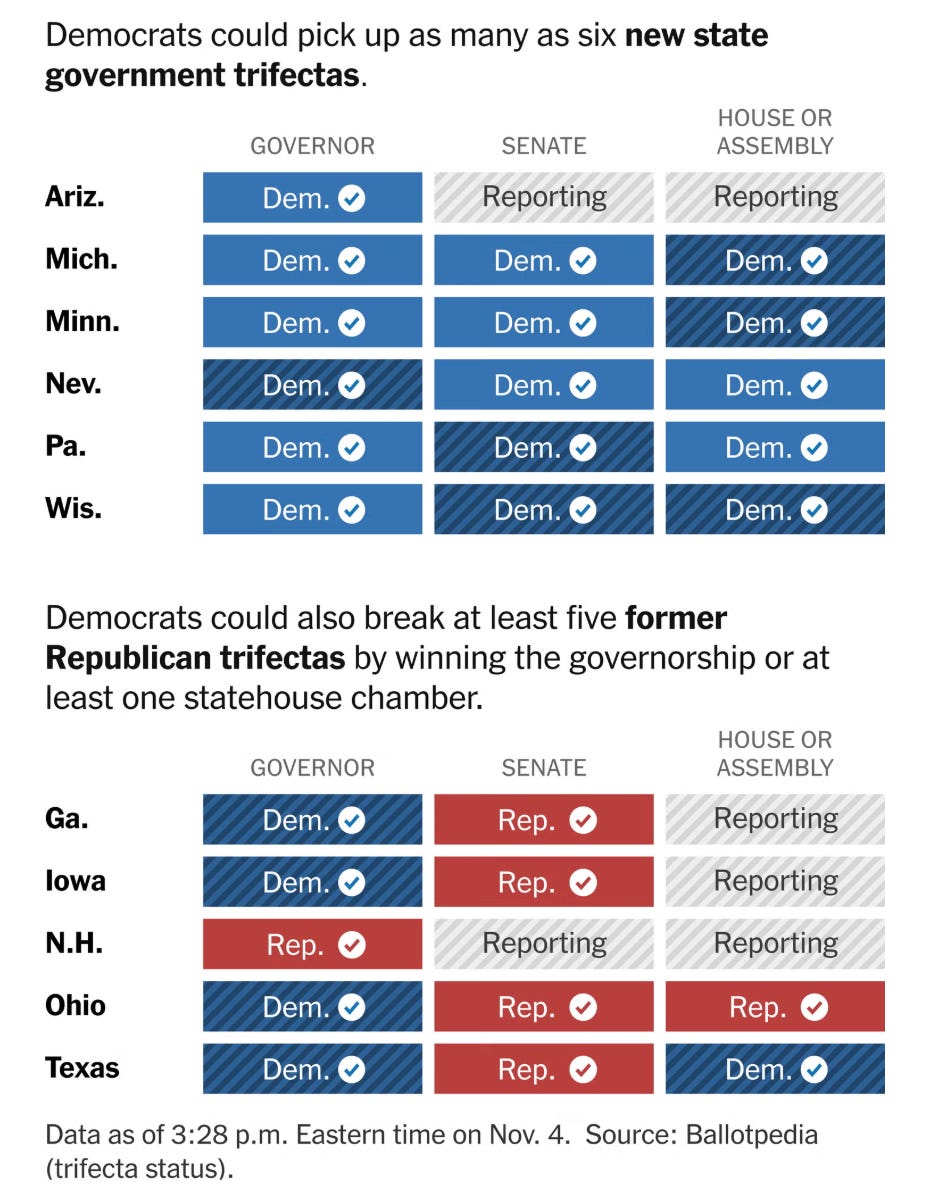
Let’s take a look at how the trifectas shifted. Democrats picked up five new ones: Michigan, Minnesota, Nevada, Pennsylvania and Wisconsin. Four of them are swing states. Democrats also broke Republican trifectas in five states, including Georgia, Iowa and Texas.
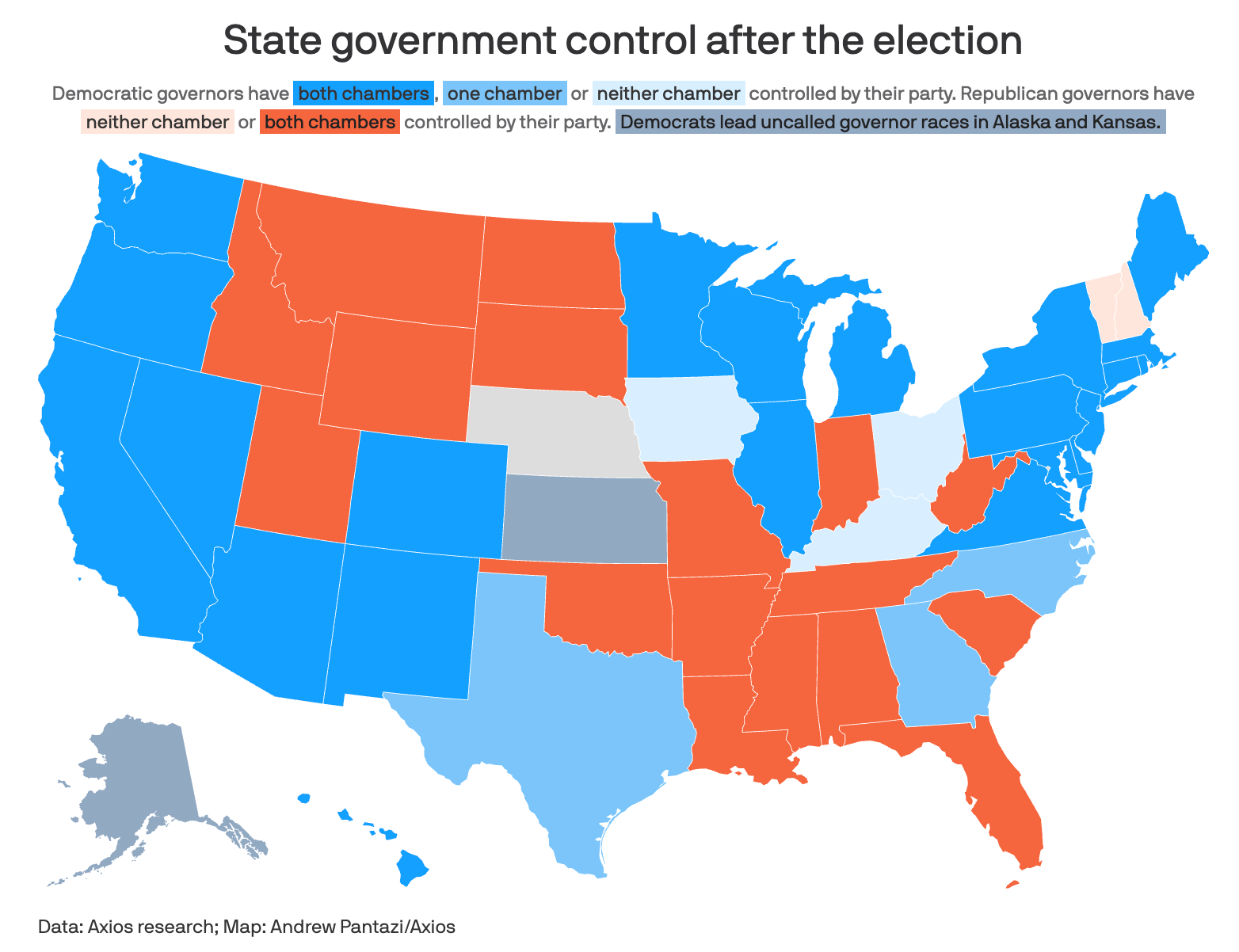
Here’s how that changes the broader map. Before Tuesday night, Republicans had full control of 23 states. Democrats had 16. As of now, it’s Republicans 18, Democrats 21.
The National Conference of State Legislatures calls it the biggest shift since 2010. The Democratic Legislative Campaign Committee calls it the party’s best performance since Watergate.
In Texas, it was the best night for state Democrats in modern history. Texans not only elected a Democrat senator. They also elected Gina Hinojosa, the state’s first Democrat governor since 1994. A Democrat for lieutenant governor. One for attorney general. And they handed Democrats control of the state House.
Even Ron DeSantis called it a huge loss: “Texas has been the most significant Republican state this century. A Democrat sweep of statewide races takes away one of the anchors of the modern GOP.”
Congress will always get the headlines. Because that’s the center of political power. But a lot of real power lives in the statehouses too. They draw the maps. They run the elections. And they write the laws on important issues that are increasingly being left to the states to decide.
Republicans spent 16 years building control, one legislature at a time. And all that hard work disappeared in one night.
5. Voters Punish Trump’s Economy
During his campaign, Trump promised voters he would fix the economy. And they believed him. But here’s the reality. Trump is a businessman who filed for business bankruptcy six times. Over the past two years, voters came to realize he was sinking the U.S. economy too.
And look, we all knew it was going to hurt him in the midterms. But nobody could’ve imagined quite how badly.
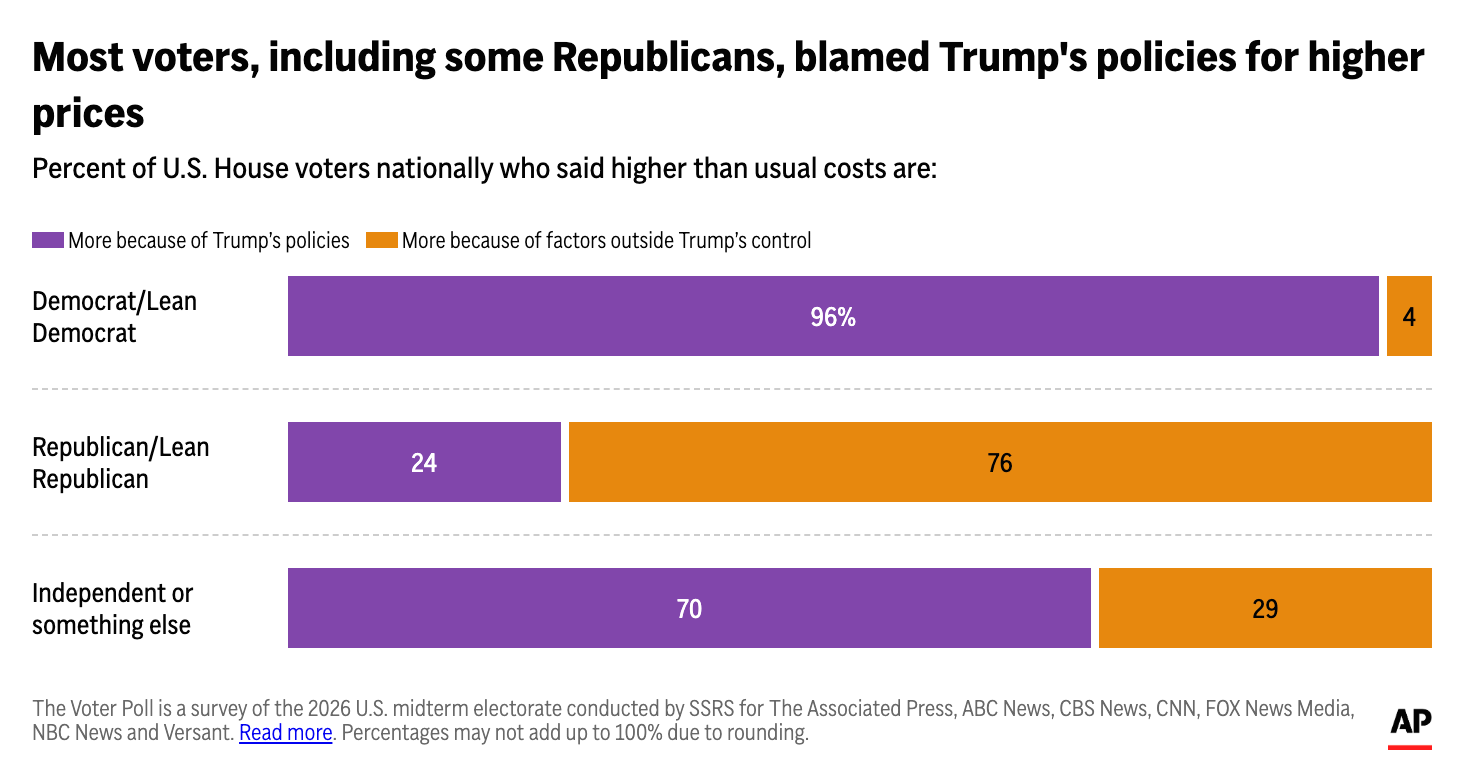
The AP Voter Poll surveyed about 100,000 midterm voters. About two-thirds said Trump’s own policies are responsible for driving prices up, including 70 percent of independents. In 2022, only about half of voters said the same about Biden.
What’s more, about seven in ten said the economy now favors the wealthy. Meanwhile, about six in ten making under 50,000 dollars a year said they’re worse off than two years ago. The message they wanted to send was clear. Trump is enabling the rich, while abandoning everyday Americans. And they aren’t happy about it.
Those numbers showed up in the results. Trump got stomped so badly that even he had to admit that the Iran war had driven up the cost of living. But the war is only part of the damage he has done to our economy.
Long before the first bomb fell, his tariffs were already raising the price of just about everything Americans buy. He picked trade fights with our closest allies and changed the rules every other week. Businesses couldn’t plan, and families paid for it.
So Trump ran as a businessman who would fix the economy. Voters gave him two years to prove himself. And he failed. Spectacularly. The American people felt the pain of his decisions in their pocketbooks. Then they delivered him the greatest midterm rout since Watergate.
Some other stories that caught my eye:
Democrats’ Senate takeover is about to end Trump’s push to remake the federal courts. Once Democrats take control in January, Politico reports, the lame-duck president will be able to confirm few judges, if any. Trump has already appointed nearly 300 judges over his two terms. Republicans still planned to push a handful more through before the year ends. That includes two nominees who played controversial roles in targeting former FBI Director James Comey. But that now seems unlikely. The bigger loss is the Supreme Court. Justices Thomas and Alito, the court’s two oldest members, have signaled they won’t step down now. Florida Gov. Ron DeSantis put Republicans’ odds of confirming a successor to either one during Trump’s term at “zero.” The Senate’s “blue slip” rule could make the shift last. It lets senators block judicial nominees from their home states. Newly elected Democrats in Texas, Kansas and South Carolina could hold that veto until 2033.
Three government watchdog groups are suing the Pentagon over a secretive advisory panel run by Elon Musk and Palmer Luckey. CREW, Public Citizen, and the Project on Government Oversight filed the suit in federal court in Washington. They argue that Project Meridian violates the Federal Advisory Committee Act. That law requires advisory panels with outside members to have a charter, open their meetings and records to the public, and stay fairly balanced. CREW president Donald Sherman said the Pentagon is “legally barred from getting advice in secret, by defense contractors with enormous potential conflicts of interest.” Project Meridian has met at least twice at the Pentagon, after which the department failed to release what was discussed or who attended. The Pentagon has said the nonprofit MITRE will oversee the study and review its recommendations with conflict-of-interest safeguards. Hegseth created the panel on September 30 and wants its recommendations by January 28, 2027. Musk’s SpaceX has won more than $8 billion in Pentagon contracts this year alone. Luckey’s company, Anduril, landed a $2 billion Navy contract last month, days after the panel was announced.


