

Hey everybody. Terry Virts here, filling in for Adam again today. Thanks for being here.
Our top story: the Big Beautiful Bill is starting to hurt the people Republicans need in November. The tax cuts hit first. The cuts to programs like Medicaid and food assistance were delayed on purpose, and that delay is running out. The New York Times reports the effects are showing up in people’s mailboxes and grocery bills right as they begin to vote.
We’ll also get into Trump’s speech at the UN, a Republican senator asking for an investigation into Don Jr., the GOP spending big to defend states it shouldn’t have to worry about, and a reminder of what the relationship between a president and the press is supposed to look like.
So do me a favor. Like this video, share it with someone who needs to see it, and subscribe so you never miss an episode.
Let’s get to it.
1. Trump's Big Beautiful Bill Cuts Land Before November
Trump signed the One Big Beautiful Bill on July 4th of last year. The main event was the tax cuts, more than four trillion dollars over ten years, and the biggest share went to the wealthiest Americans. To pay for it, Republicans made cuts to Medicaid, health care subsidies, and food assistance programs.
The tax cuts took effect right away. But the program cuts were scheduled to phase in later, at the end of 2026 and into 2027. You don’t need to be a political genius to see why. Republicans wanted the tax cuts in people’s pockets before November and everything else to land after.
But it didn’t work. The New York Times reports the pain is arriving early. Food stamp work requirements are kicking in and people are being dropped. Health insurance premiums went up for millions when the subsidies expired. Work requirements for Medicaid start in January, with states allowed to start early. And some have.
The people feeling this are not who you’d expect. Much of the pain lands in rural counties and small towns, places that voted for Trump by big margins. Hospitals there are cutting beds and staff because they’re losing Medicaid patients. We covered a rural hospital in Missouri two weeks ago that cut its maternity ward in half.
And this is just the start. More restrictions on food assistance and Medicaid hit October 1st, a week from today. So the number of people feeling this is going to keep growing right up until Election Day, and Republicans don’t have a way to stop it now.
2. World Leaders Stop Clapping for Trump
Yesterday, Trump gave a 40-minute speech to the UN General Assembly. It was pretty much what you would expect: he made exaggerated and bogus claims about his achievements, and called concerns about AI a hoax. He insisted that he’s settled eight wars since taking office, and threatened to “annihilate” Iran.
But the reaction from the assembled diplomats was a little different this time around. Take a look at this clip.
Did you hear that pause? That was supposed to be a big applause line. Trump got crickets. It’s an embarrassing moment, for sure. But it goes deeper than that.
How the UN has reacted to Trump’s speeches over time tells you a lot. Back in 2018, he was still a joke. They laughed at him. But soon they saw how he was willing to turn his power against people that offended him. So they started clapping. They flattered Trump, hoping to avoid his anger. But now they’re watching that leverage crumbling as the American people turn on him. They see the same polls we do, and know MAGA is on its way out.
World leaders are acting accordingly. Even as Trump plows ahead on AI, they’re gathering to build frameworks without him. Canada is courting the EU and other allies. And NATO is exercising without us. They won’t twist themselves into a pretzel for a lame-duck president.
That silence in the room wasn’t really about America. It was about Trump. The world still wants a strong, reliable United States. They’re just not going to pretend this is it anymore.
3. A Senate Republican Breaks Ranks on Don Jr.
Last week Adam reported on a Russian oligarch close to Putin who spent hundreds of thousands of dollars on Don Jr.’s wedding. He paid for a private island, fireworks, and even helped plan it. Caught red handed when the story broke, Don Jr. paid the man back and tried to sweep the whole thing under the rug.
Senator John Curtis, a Republican from Utah, wasn’t having it. Yesterday, he sent a letter to the Senate Judiciary Committee asking it to subpoena Don Jr. He wants to dig into his business dealings, his relationships with foreign nationals, and any influence he may have peddled.
Curtis’ argument is simple. Republicans spent years investigating Hunter Biden’s foreign ties. They sent subpoena after subpoena looking for dirt on him. Why stop now? Especially after something as egregious as this wedding scandal.
Dick Durbin, the top Democrat on the committee, has joined the request. But the Republican chairman still hasn’t said what he’ll do.
The American people deserve to know whether the president’s son is selling access, and who’s buying. We know Trump couldn’t care less about corruption. But this is a chance for Senate Republicans to follow Curtis’ lead, show some spine, and get to the bottom of this. With ballots going out for November, it may be their last chance.
4. Republicans Play Defense in Trump Country
In the House, Republicans hadn’t anticipated a fight that would expand beyond a few-dozen competitive seats. Now they’re scrambling to make up ground in unexpected races.
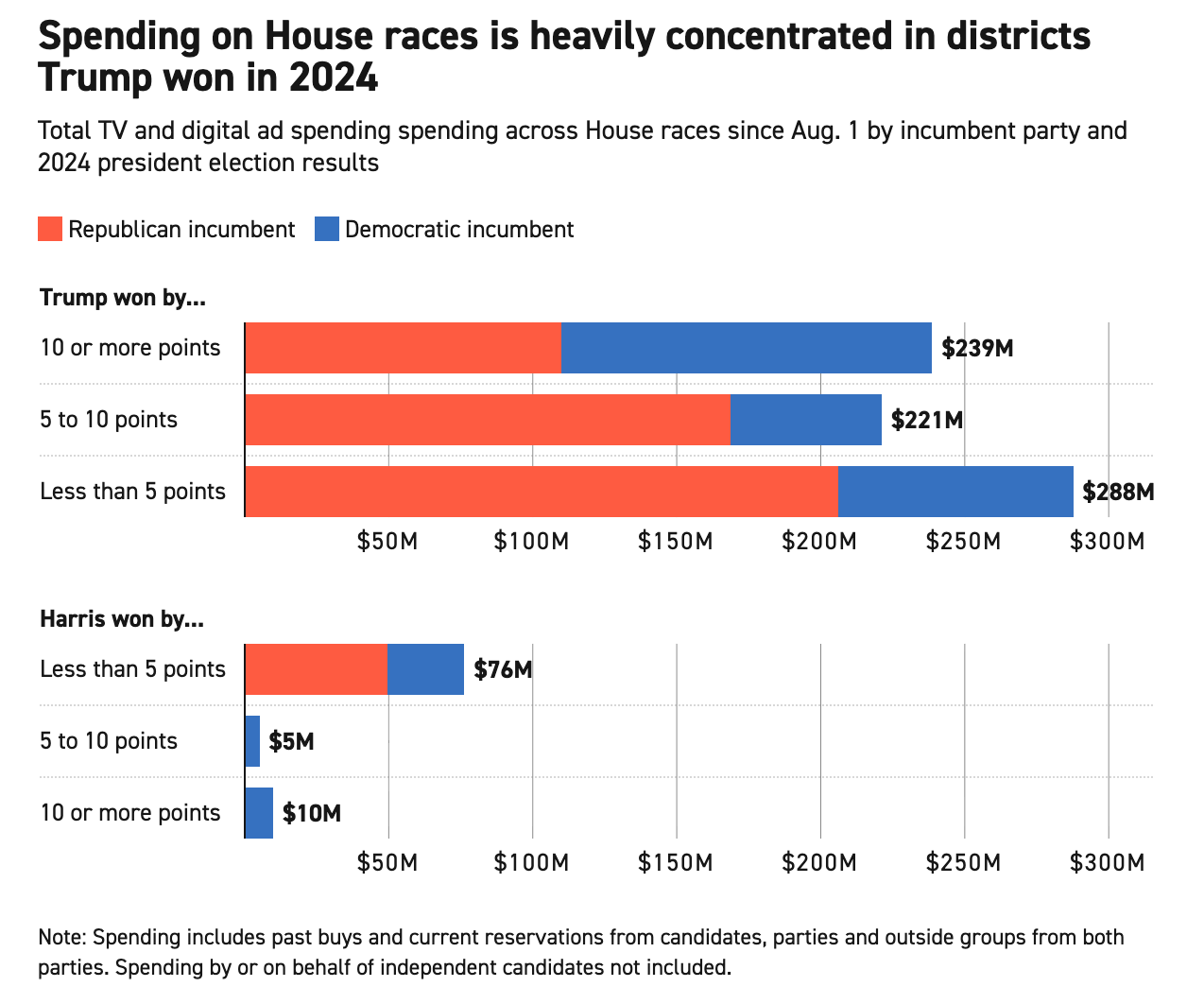
Since the start of August, nearly two-thirds of advertising funds were spent in races with GOP incumbents. And the majority has been spent in districts Trump won by 5 or even 10 points. That amounts to 460 million dollars.
It’s the same story in the Senate. Republicans currently hold a 53-47 majority. And most of the seats up this year are taking place in states Trump won handily. They thought the Senate map was easy. Now they’re on the defensive.
Republicans are pouring cash into North Carolina, where the Washington Post reports that the party is deeply worried about its candidate running against Democrat Roy Cooper, the former governor. Cooper currently leads by 12 points. They are equally desperate in Kansas, where the Washington Post found enthusiasm fading in a state Trump carried by 16 points. The same thing is happening in Alaska, Michigan, Iowa, Georgia, and even Texas.
“We need to stop the contagion,” one senior GOP official explained, when describing the midterm landscape.
How have GOP candidates responded? By distancing themselves from the president. Byron Donalds is running for governor in Florida, and he has been one of Trump’s most loyal allies. But his loyalty only extends so far.
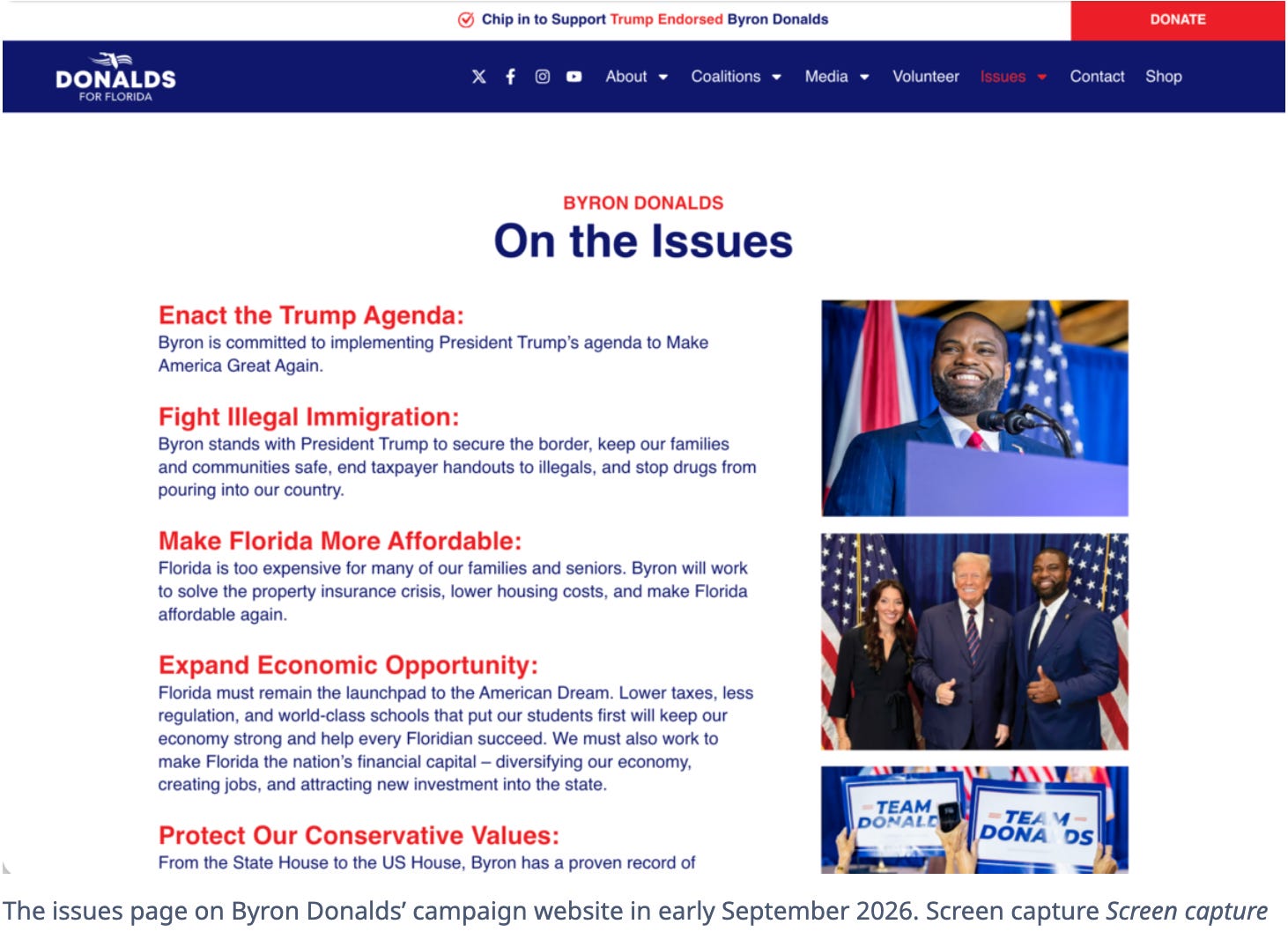
Here is Donalds’ campaign website in early September. It features a photo of him and Trump. And the top slogan promises “Byron is committed to implementing President Trump’s agenda to Make America Great Again.” That commitment didn’t last long.
Here is his same campaign website now. The photo of Trump has been scrubbed. And instead of “Enact the Trump Agenda,” Donalds has a new slogan: “Accountable, Achievable, Affordable.” He seems to have done research about what truly matters to his constituents. And it certainly isn’t Trump.
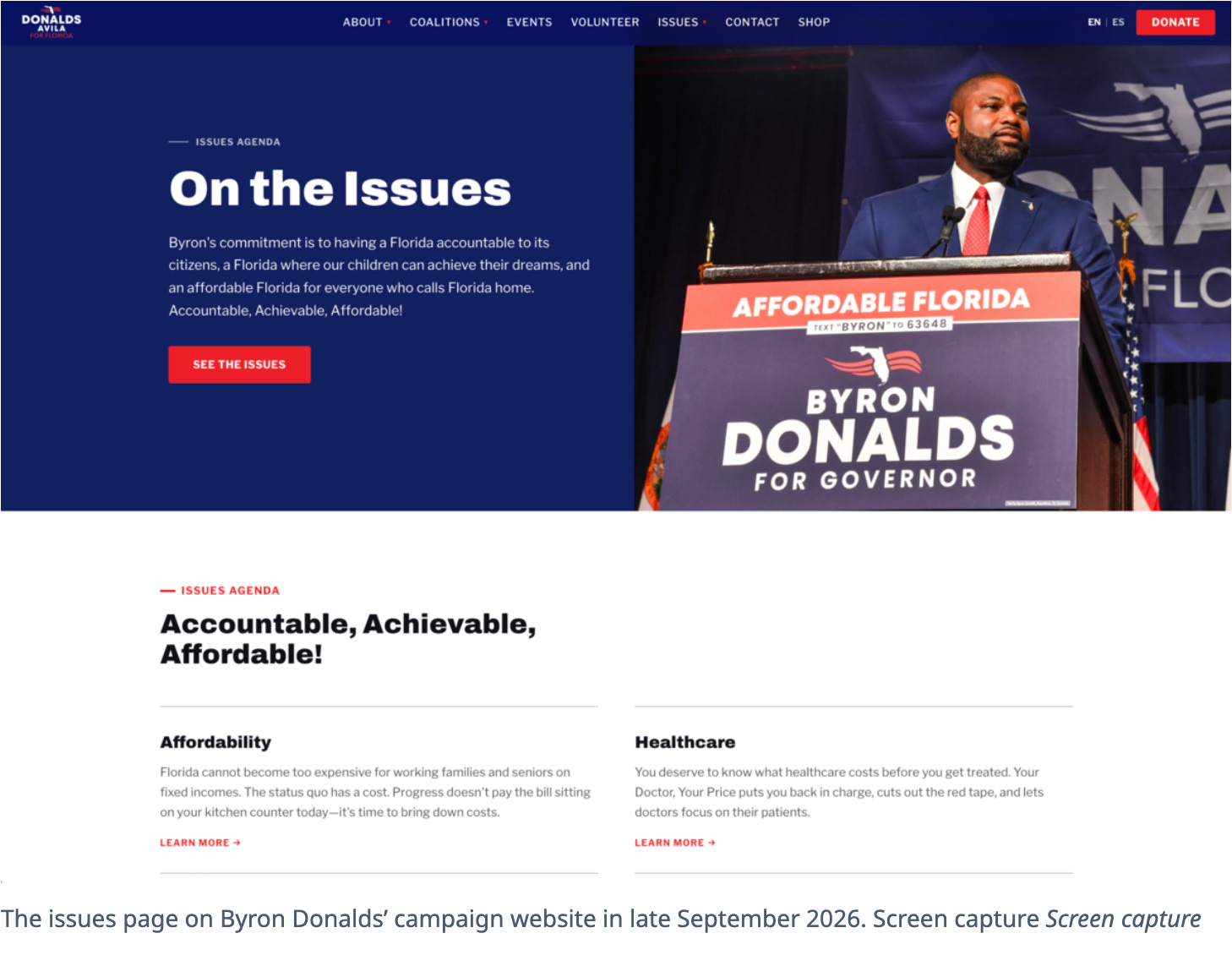
Donalds probably won’t be the last Trump loyalist to make some last-minute changes to their website. When the party is spending hundreds of millions to hold seats it thought were safe, you’ll see a lot more candidates decide they’d rather talk about affordability than about Trump.
5. Obama Showed How a President Handles the Press
We’ve been covering Trump’s war with the press all week. He banned three outlets from the White House. So the networks pulled their cameras. And Trump did not take that well. He went on an angry tirade on Truth Social, launched his own state TV program, and went after a CNN anchor at the UN.
Here is how JD Vance defended the ban:
His argument is clear: Trump has the power to ban any outlet that provides unflattering journalism. But the First Amendment exists to stop the government from punishing reporters for what they write. Freedom of the press isn’t a privilege the president hands out. It’s a right.
We once had presidents who valued that right, who valued the Constitution. Here is President Obama at his final press conference.
What a difference ten years makes. Obama admitted that he did not always appreciate the coverage he received, but he accepted that journalism is meant to hold powerful leaders accountable to the people. He understood his duty to journalists, to the Constitution, and to the American people. And he carried it out with dignity and poise.
It’s worth remembering what this used to look like, so we know what we’re trying to get back to. Trump has repeatedly abused his presidency to dismantle our democracy, but we still have the right to vote. And that remains the ultimate verdict on his power.
This November, let’s use it.
A New York Times investigation published Tuesday found that Project Bullhorn, a Democratic-aligned group, paid more than 100 social media creators up to $30 per video to post about affordability ahead of the midterms. Only about a third of them appeared to live in the states they posted about. One creator who called himself “Austin, Texas born and raised” was actually from Leicestershire, England. Another posed as a struggling young man near Dallas. He later admitted in a since-deleted video that he didn’t even live in Texas. Project Bullhorn declined to comment. A person familiar with the campaign said creators are supposed to live in those states or have close ties to them. The tactic isn’t limited to one party. A pro-DeSantis clipping campaign produced 1,441 videos and more than 6 million views. Some of those accounts were based in Pakistan. Republican Spencer Pratt spent more than $55,000 on clipping firms during his failed run for LA mayor. Early this month, an unidentified nonprofit offered up to $1,500 for videos supporting mail voting. Few of these posts are labeled as paid content. In most cases, the law doesn’t require them to be
The FBI confirmed it is investigating a possible breach of its jobs portal after the cybercrime group ShinyHunters claimed it stole data on “almost all” FBI agents. The group gave 404 Media a sample covering 5,000 supposed agents, including the names, home addresses, phone numbers, and details about agents’ spouses. The FBI said it is “aware of claims regarding unauthorized activity affecting FBIjobs.gov and is currently investigating.” Two people with knowledge of the breach said investigators find the claims credible and see it as a significant counterintelligence failure. Investigators believe the hackers exploited a flaw in Oracle PeopleSoft, HR software ShinyHunters attacked in June. Oracle has since patched that bug, and investigators are still working out whether the group reused it on an unpatched system or found another way in. ShinyHunters says it went after the FBI in retaliation for a May public alert about the group. This is the second major breach of a sensitive FBI system this year. In April, China-linked hackers broke into an FBI wiretap system.


