

Hey everybody. Thanks for being here.
Quick note first. My full write-up from my trip to Ukraine went up on Substack this morning. It’s everything I couldn’t fit into yesterday’s show. And I recorded a video to talk about it all at length. Go check it out at AdamKinzinger.com.
Now to the news.
Our top story today: Yesterday the Supreme Court delivered the final blow to Donald Trump’s efforts to take away your right to vote by mail. He knows what’s coming in November, and this scheme was his best shot at changing it. This is a huge win for democracy and a huge loss for a president desperately trying to save his party in an election just fifty days away.
We’ll also get into Trump calling the warnings about AI a hoax, an update on the war in the Middle East, record fuel prices, and the courts striking down Trump’s cuts to FEMA in the middle of hurricane season.
So do me a favor. Like this video, share it with someone who needs to see it, and subscribe so you never miss an episode.
Let’s get to it.
1. Supreme Court Kills Trump's Ballot Scheme
We’ve been covering this story for weeks, and it’s been hard to follow. But as of last night, it’s over. The Supreme Court has refused to revive the administration’s attempt to rewrite the rules of mail-in voting just weeks before an election.
Under the rule, every state would have had to hand the Postal Service a list of its mail voters’ names and addresses. Any state that didn’t comply wouldn’t get its ballots delivered. A few weeks ago, a whistleblower told us it was built to fail. Republican election officials told the Court it couldn’t be done in time.
And the courts held. That’s the good news.
But the New York Times reports that the White House isn’t stopping. A whistleblower report released yesterday by Senate Democrats revealed something called the Unlawful Voter Initiative. Federal immigration officers have been pulled off their normal jobs and told to hunt for noncitizens on the voter rolls.
And the way they’re doing it is wild. They log into state websites meant for voters to check their own registration, and they type in your personal information, pretending to be you. In some states, that’s likely a crime. Each officer has a quota of forty names a day. That works out to twelve minutes to decide whether you’re a citizen and whether to open a federal law enforcement file on you.
So one scheme finally dies in court, and another one is already running. This White House just won’t stop looking for ways to put a finger on the scale, because they’ve seen the same polls you have. And they know what’s coming in November. They’re scared of your vote. So make sure you use it.
2. Trump Stands Alone on AI
On Saturday, the head of Anthropic published an essay calling for the AI industry to slow down. He argued that new models are advancing faster than regulators can keep up with, creating the potential for a dangerous breakaway. Other industry leaders agreed, even Elon Musk.
And the issue has created some rare unity in the political world. Bernie Sanders and Steve Bannon couldn’t be further apart politically, but they’re speaking today at the same event on AI safety. Bipartisan bills are also beginning to move through Congress.
Pretty much everyone is on the same page here. Except the president. Take a look at his post from last night.
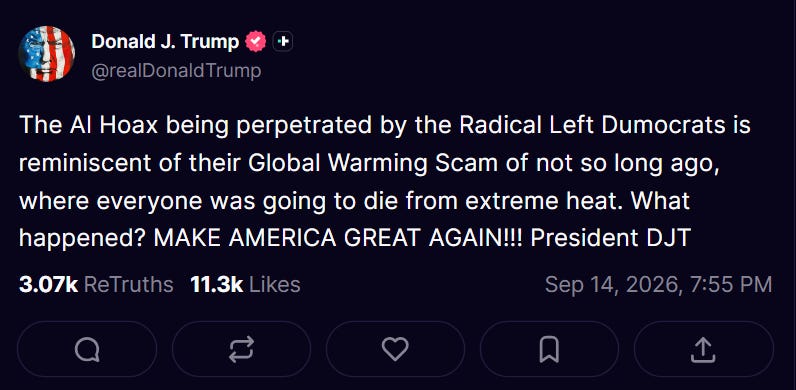
“The AI hoax.” Just like “the global warming scam.” Trump claims the concern over AI is manufactured by the radical left and China. This is just one of many unhinged posts Trump has made on the subject. In another, he assured Americans that his personal genius was the only AI guardrail anyone needs.
He also went after Anthropic’s CEO personally. Knowing Trump, he probably still holds a grudge: earlier this year, Anthropic was cut off by the Pentagon after it refused to let DOD use its tech for mass surveillance.
Trump continued to cry hoax on a call with Nvidia’s CEO. Take a look:
People that don’t want to see AI happen? It’s the exact opposite. These CEOs are more bought into AI than anyone. They’re true believers who know just how powerful the technology is. And because they understand the power of AI, they also understand the dangers that come with it.
Look, this isn’t my area of expertise. But when a CEO with a big financial incentive to fight regulation is begging for it instead, there’s probably a good reason. But Trump would have you believe he’s got it all under control. He said something similar at the beginning of COVID. And that turned out just fine, right?
Rest assured, Trump’s dismissal of the concerns surrounding AI will have big consequences in the midterms. Seventy percent of voters want to pump the brakes on data centers in their towns. Trump is telling them they’re falling for a Chinese hoax. We’ll see how that strategy goes in November.
3. Trump's Iran War Backfires Again
We all know about the Strait of Hormuz by now. But have you heard of Bab-el-Mandeb? It’s a narrow waterway between Yemen and Africa, and about 12 percent of the world’s seaborne oil goes through it.
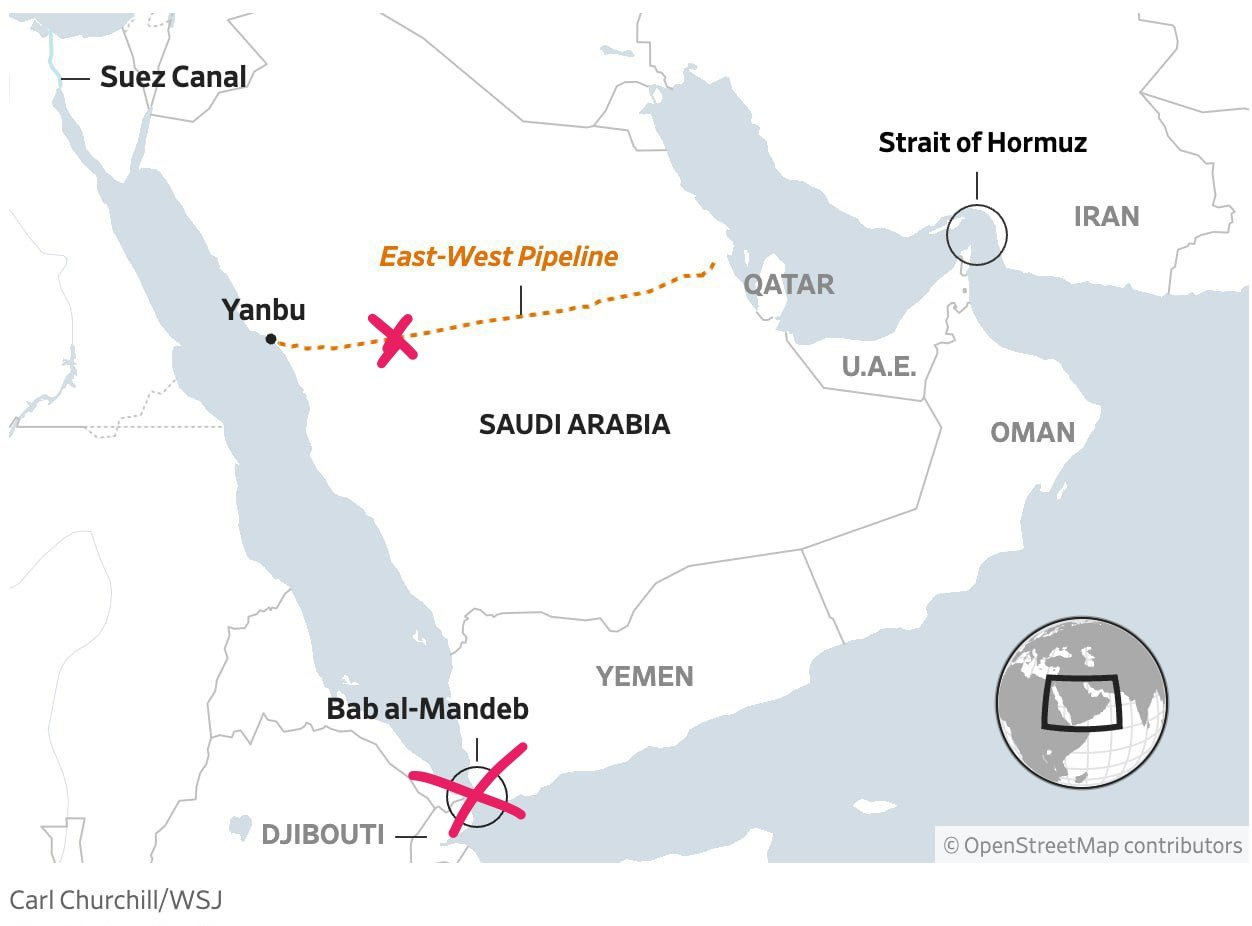
The Houthis recently took control. For a long time, the Iran-backed rebels looked like they were losing: the Saudi air force was hammering them. Yemen’s government was predicting their collapse. But they broke through anyway, taking the towns and islands around the strait.
Politico reports the White House has no good options. Bomb the Houthis and you break the ceasefire Trump signed with them last year. You also open a second front in a deeply unpopular war. But if you don’t do anything, you’ve handed Iran another chokepoint on the world’s oil.
As usual, the administration downplayed the dilemma. Listen to our ambassador to Israel:
No biggie. Just a little skirmish.
Well, here’s the bad news: the Houthis are acting out again because they know the U.S. is stuck. The administration is bogged down in Iran, burning munitions in a war that Americans didn’t want and don’t support. Americans may not tolerate another front, and the Houthis are betting on it.
This is what happens when you go into the Middle East without an exit plan: you start getting pushed around. Oil stops flowing. And Americans pay the price.
4. Trump Has No Answer on Fuel Prices
For seven months, we’ve been warned a fuel crisis was coming if the Iran war dragged on. This week, the people who run the oil industry told the Wall Street Journal it has arrived.
The numbers back up that report. Oil is 109 dollars a barrel, up 20 percent in a month and 60 percent from a year ago. Gas is up 45 percent since the war started.
But the most pressing concern is diesel, which recently passed 6 dollars a gallon for the first time ever. And there’s no substitute. Every truck, train, and tractor runs on diesel. When its price goes up, everything delivered through the supply chain goes up with it. Businesses are already passing that burden along as higher prices on your groceries and fees on your packages.
And it’s hurting the entire economy. On Monday, the 10-year Treasury yield went above five percent for the first time since 2023 because markets expect fuel prices to feed inflation. Meanwhile, the Federal Reserve is expected to raise interest rates tomorrow, the first hike in three years.
Affordability is only getting worse. And while MAGA loyalists will continue to blame Biden, this happened under only one man: President Trump.
So what is he doing about it? Not much of anything, given the White House seems to have run out of ideas. Politico talked to a former Trump economic adviser who said “there’s not much they can do about it.” Another former adviser added, “they’re still looking for magic bullets.”
Trump’s magic bullet? Blame Ukraine. Yesterday, he told Zelensky to stop hitting Russian oil refineries because those strikes are “hurting the world.” But Putin’s strikes on Ukrainian infrastructure? Not a word.
While Trump is protecting the Russian economy, Thomas Massie weighed in on the president’s assessment of his own economy. Have a listen:
Is it the Golden Age if we need gold to buy diesel? The only person who might soon be able to afford it is the man sitting in his gold-plated Oval Office. And he certainly isn’t doing anything to make our lives more affordable.
5. Court Stops Trump From Gutting FEMA
When Kristi Noem ran DHS, she ordered a reduction of FEMA employees from 23,000 to 11,500. FEMA’s supervisors objected to the proposal. So did a federal judge. She ruled that the number of cuts lacked any formal reasoning. Her words: “it appears as if pulled from thin air.”
After Hurricane Katrina in 2005, Congress placed staffing decisions under FEMA’s direction. The point was to prevent a higher department from hollowing out critical disaster agencies. That’s exactly what the judge decided was happening.
And that intervention is crucial in the context of hurricane season last summer. On July 4th, extreme flooding tore through the Texas Hill Country. FEMA had search and rescue teams staged and ready, but Noem had instituted a new rule. She personally had to approve any spending over 100,000 dollars, and those requests went through FEMA’s acting head, who couldn’t be reached for 24 hours. While the paperwork sat, the floods killed more than 130 people.
The safety of the American public depends on a disaster agency that has adequate personnel, resources, and mandate to effectively respond to natural disasters. As we head into the peak of hurricane season, thankfully the courts have once again been on the side of common sense by defending FEMA. And as we head into the midterms, let’s vote out the party that has continued to push a reckless agenda that consistently puts American lives at risk.
On Monday, Trump ordered the EPA to repeal Biden-era limits on carbon dioxide emissions from power plants, the second-largest source of CO2 emissions in the country. For now, power plant standards revert to a weaker 2015 rule, but the agency has proposed eliminating all greenhouse gas standards for power plants entirely. EPA Administrator Lee Zeldin framed it as a cost issue. He claimed the repeal would save $310 billion over two decades, adding, “Americans will see a decrease in electricity prices.” The Biden administration, meanwhile, had predicted its rule would deliver $370 billion in climate and health benefits, saving thousands of lives in the process. The repeal builds on the EPA’s February rollback of the endangerment finding, the legal foundation for most federal climate policy. As the environmental groups have pledged to sue, the public has 45 days to comment before the agency can finalize the broader proposal.
Sen. Mitch McConnell returned to the Senate on Monday, casting his first vote since his fall in June left him hospitalized before months of rehabilitation. The 84-year-old Kentucky Republican called his recovery “a long and often frustrating process,” and admitted he is “still not quite back to 100%.” He still pledged to show up for tough votes when his party will need him most. Just yesterday, for instance, McConnell provided the deciding vote to advance one of President Trump’s district court nominees in Ohio. But his three-month absence effectively shrank the GOP’s 53-47 majority. That often carried significant consequences, including for a stalled farm bill that failed in committee because he and Sen. Tommy Tuberville missed the vote. McConnell’s term ends January 3, with the Senate in session for just eight more weeks before he leaves office after leading Senate Republicans for 18 years.


