


Hey everybody. Happy Friday. Thanks for being here.
Our top story today. Trump sat down with TIME magazine and was asked a simple question. Would he rule out declaring a state of emergency, or invoking the Insurrection Act, around the midterms? His answer: I don’t rule anything out or in. Then he added that he could use it, and a lot of people think he should. This is a president whose party is losing, five weeks before the vote, leaving the door open to putting troops on the streets during an election.
We’ll also get into the Justice Department reopening Watergate to clear Richard Nixon, Trump saying he regrets his own Supreme Court picks, Bill Pulte gutting the watchdog that was supposed to be watching him, and Republicans leaving town with nothing to show for it while Democrats gain ground.
So do me a favor. Like this video, share it with someone who needs to see it, and subscribe so you never miss an episode.
Let’s get to it.
1. Trump Won't Rule Out Troops at the Polls
President Trump had a sit-down interview with TIME. It wasn’t on camera, which is a real shame, because based on the transcript he lost his cool several times. But there was one exchange I wanted to highlight. TIME asked Trump whether he would rule out declaring a state of emergency before the midterms. He said, “I don’t rule anything out or in. We’ll see. You mean the Insurrection Act?” The reporter said yes. Trump said, “No, I’ve never used it. I could use it. A lot of people think I should use it sometimes.”
They also asked if he plans to send ICE agents to polling places. His answer was that he hadn’t thought of it. That’s interesting, because his people certainly have. Steve Bannon said back in February, “You’re damn right we are going to have ICE surround the polls.” His press secretary said she can’t guarantee ICE agents will avoid polling locations. And his DHS secretary said last month ICE could walk right in if they were serving a warrant on someone inside. So even if Trump hasn’t thought about it, which I’m not sure I buy, his administration has.
Let’s be clear about what the Insurrection Act is. It’s a law from 1807 that lets a president send the military into American cities even if the state’s governor objects. It’s meant for actual rebellion. It’s only been used a handful of times in modern history, and never around an election. On top of that, federal law makes it a crime to station armed troops at a polling place.
Look, hopefully none of this ever happens. But the president’s answers aren’t exactly reassuring. And they’re even less reassuring when you look at the people around him. For months, a network of election deniers has been telling Trump he can declare an emergency and take federal control of the vote. But he can’t. That power doesn’t exist.
And it’s hard not to notice the president is running out of options. The Supreme Court shut down his attempt to restrict voting by mail. A judge threw out his attempt to force states into changing their election rules. As the legal doors close, can we trust this president not to open a window?
The party is behind. The polls are dismal. When asked if he’d use the military around an election, the president says “we’ll see.” As MAGA heads for disaster, that’s the only answer he’s got left.
2. DOJ Reopens Watergate to Clear Nixon
That’s right, the department that’s “laser focused” on fraudsters and scammers is spending time and money digging through files from the Vietnam era. The Wall Street Journal reports that DOJ officials have opened a preliminary review into whether the prosecutors who investigated Richard Nixon committed misconduct, more than fifty-two years after his resignation brought an end to the Watergate scandal.
So how did this get started? Well, a former Nixon aide who’s been calling Watergate a setup for decades managed to get a meeting with the DOJ’s internal watchdog. He framed Nixon as a target of “lawfare,” and convinced the DOJ to look into whether he got a raw deal.
This is not just one bitter aide on the fringe. The conspiracy theory is a widely held belief among administration officials. JD Vance echoed the claims at an event last June, comparing Nixon’s fall to what the deep state tried to do to Donald Trump.
Yesterday, Congressman Riley Moore made the same argument at a Nixon Foundation event. Have a listen.
That last line is revealing. Once again, this is all about Trump. MAGA doesn’t care whether Nixon was treated unjustly in 1974; to them, the Republican party began in 2016. But Watergate is the one example of a president being held to account by both his party and his country. Sure, Nixon wasn’t convicted. But that was because Republican senators walked into the Oval Office and told him the jig was up, and he needed to resign. They did the one thing MAGA could never do: speak truth to power.
They don’t want the American people to remember that there was once accountability for the most powerful man in America. So they’re trying to rewrite history. Because if you believe Watergate was a hoax, you lose faith in what comes after. The Russia investigation. January 6th. And the various inquiries that will come once Democrats retake the house.
So make no mistake. This review is not clearing Richard Nixon’s name. He’s been dead for three decades. The man they’re really trying to exonerate is Donald Trump. And he is most definitely a crook.
3. Trump Turns on His Own Justices
In the same TIME interview we talked about earlier, Trump was asked about the three justices he picked for the Supreme Court: Gorsuch, Kavanaugh, and Barrett. He sounded like a disappointed father, telling the interviewer “I gave them the position of a lifetime, and they vote against me often.”
Trump is clearly a tough grader. By my scorecard, those justices have given him plenty of wins. Trump has come out on top in major cases on abortion and presidential immunity, and countless smaller ones on the so-called emergency docket.
But he seems to be stuck on two major losses: birthright citizenship and tariffs, two legal hail marys which were lucky to reach the court in the first place. On tariffs, he was especially annoyed that the justices made him return the 400 billion dollars his government collected illegally.
TIME asked him if he was looking for loyalty. He said, “I do like loyalty, yeah.” But then he caught himself, clarifying: “No, I don’t want loyalty. I want good decisions.” Of course, in Trump’s mind, no decision against him is a good one.
I don’t have to tell you how twisted this view of the court is. Judges get lifetime appointments so no loyalty is necessary, and a president should never try to influence or intimidate the justices like Trump did when he showed up at the court in April. But civics was never this president’s strong suit.
The court starts its new term next week. They’ll be looking at whether ICE can lock up immigrants with American spouses and children for months without a hearing, among other cases on the docket. Many of them will come down to the three justices Trump just trashed.
We can only hope they’re just as disloyal as Trump thinks, because every disappointment for him is a big win for the country.
4. Pulte Guts the Office Investigating Him
Pulte runs the Federal Housing Finance Agency. Last year, just like plenty of other Trump appointees, he turned that job into a political weapon. Pulte dug through the mortgage records of the president’s enemies, before sending criminal referrals to the Justice Department.
The investigation brought by Pulte didn’t go far. A judge threw out the indictment, ruling that the prosecutor who brought it forward had been illegally appointed. What’s more, Reuters reported that the housing director had also broken the ethics rules to make those referrals in the first place.
Now he’s trying to block an investigation into that abuse.
The New York Times reports that Pulte has slashed the budget of his agency’s inspector general. That’s the independent office that oversees the agency and investigates mortgage fraud. And it had reportedly opened a case against him.
That’s bad news for Pulte. This office has won more than 1,200 criminal convictions and recovered nearly 75 billion dollars. He could have been next. So he cut its budget to 20 million dollars. That’s 64 percent less than what the White House itself asked for.
The acting inspector general told Congress that means his office will have to cut as much as 80 percent of its staff, including around 40 special agents. And that the slashed funding “eliminates our capacity” to investigate mortgage, bank, and fraud schemes.
Pulte claims that the office’s budget was bloated compared to other agencies. Who is he kidding? This is the man who declared war on mortgage fraud. Now he’s gutting the office that fights it.
We all know what’s going on here. He broke the rules to target Trump’s enemies. Then he cut off the people investigating him for it.
Both Schumer and Jeffries have called for Pulte’s resignation. But for this administration, destroying the watchdog isn’t a scandal. That’s what they hired him to do.
5. GOP Goes Home, Democrats Gain Ground
Congress has left until after the election. The New York Times says it left with a whimper, and for Republicans, that’s being generous.
Senate Republicans spent their last week fighting to pass something, anything, that they could call an affordability bill. A data center measure. A price transparency bill. Neither got through. Perhaps the GOP has finally accepted that their president has created an affordability crisis.
Either way, it’s far too late. Even Senator Lisa Murkowski was honest about it: “If we had done enough, our constituents wouldn’t still be raising it.” And, she added, “it wouldn’t be the number one thing every campaign is talking about.” Another Republican Senator echoed that remark: “If you’re not worried, you’re living in a cave.”
As for House Republicans? Well, they didn’t even try. Remember that Speaker Johnson decided he would rather send the House home to avoid a vote on Hegseth’s impeachment and the Epstein files than fix the country’s problems.
So while Republicans went home with nothing, Democrats went to work. After 2024, Republicans built a real registration edge in swing states. According to TargetSmart, they netted roughly 100,000 voters each in Pennsylvania and North Carolina.
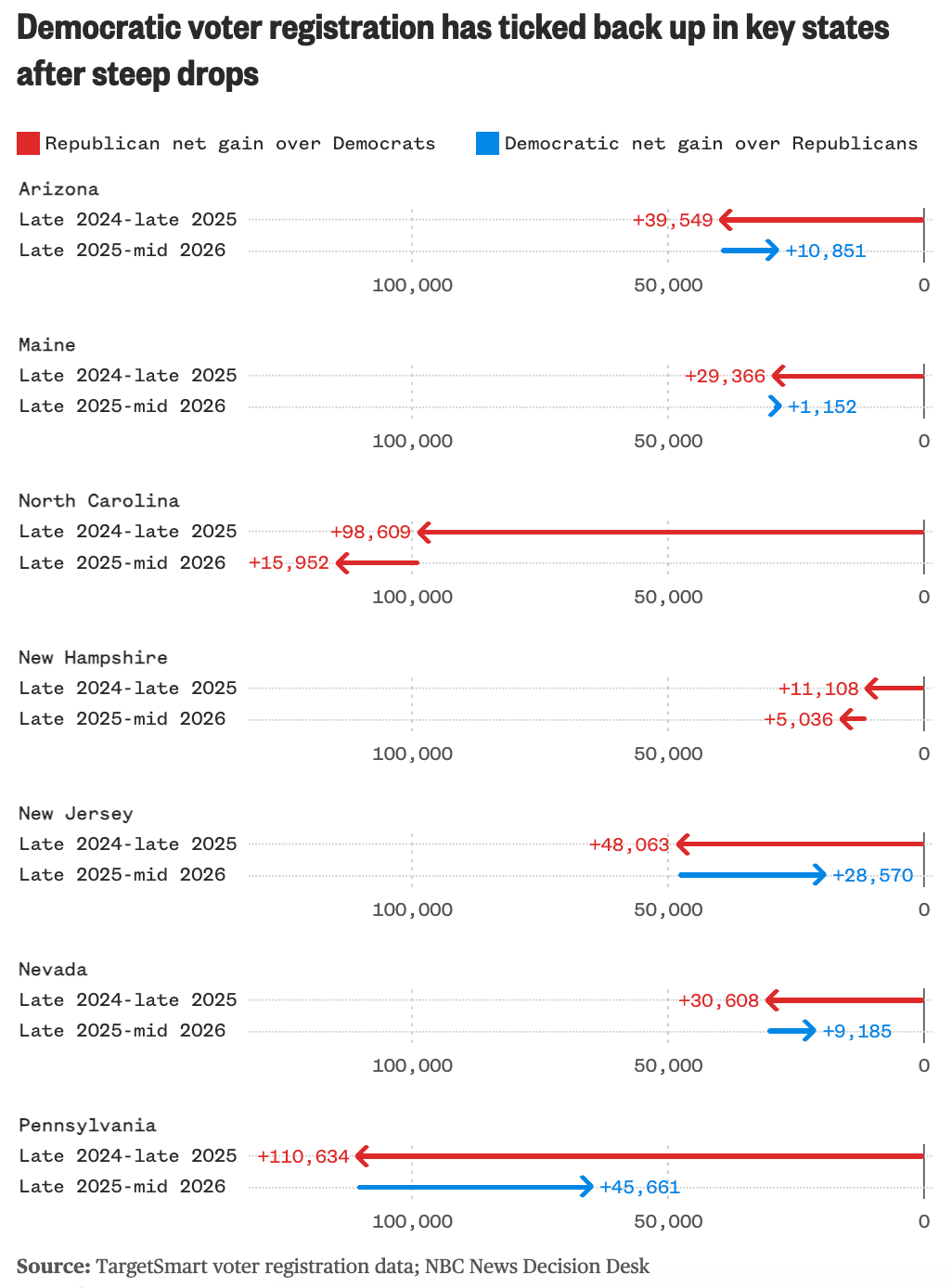
But NBC News reports that Democrats are now cutting into that lead. The party has picked up roughly 46,000 net voters in Pennsylvania and 29,000 in New Jersey since late last year. They’re also gaining in Nevada and Arizona.
While voter registration isn’t a perfect prediction of voter choice, the recent movement toward Democrats on this front offers another reason to be optimistic heading into the midterms. Six of the study’s seven states will host competitive races for the Senate, the governorship, or both.
Listen, Republicans had months to show voters they were listening to concerns about Trump’s agenda. Instead, they shut out constituents and left town with nothing to show. At the same time, Democrats were capitalizing on Republicans’ broken promises. We’ll see which strategy worked come November.
Some other stories that caught my eye:
The Labor Department reports that the U.S. economy added just 29,000 jobs in September, despite forecasts for 84,000, while unemployment ticked up to 4.2 percent. While health care, construction and manufacturing added jobs, most other sectors, particularly in white-collar fields, barely grew or shrank. Layoffs remain low, but openings are scarce. That combination hits recent college graduates hardest as companies hand entry-level tasks to AI. Labor economist Nicole Bachaud said to expect “more volatility in the labor market this year,” with fast-changing factors scrambling both hiring plans and worker movement. But wages are the bigger worry. Average hourly pay rose just 3 percent over the past year to $37.81. That’s slower than inflation, which has outpaced wages for months as the war in Iran drives up gas prices. The Federal Reserve raised interest rates in September to fight inflation, and economists expect that to cool hiring further into 2027.
The Wall Street Journal reports that the Pentagon is sending a third aircraft carrier strike group and another Marine expeditionary unit to the Middle East, adding roughly 10,000 troops to the region. The USS Theodore Roosevelt left for the region on Sunday, while the USS Makin Island group followed on Monday, carrying Marines from the 13th Marine Expeditionary Unit. Both will arrive by the end of November, the same month Trump has told aides he expects to resume bombing Iran. And in a recent TIME interview, Trump said he could restart strikes after the midterms if no deal is in place. Days earlier, he rejected Iran’s offer of a seven-day ceasefire. That deal would have reopened the Strait of Hormuz, which normally carries about a fifth of the world’s oil, in exchange for lifting the U.S. blockade of Iranian ports. If the USS George Washington stays, the region will have three carriers for the first time since April. More than 50,000 U.S. troops are already there.


