


Hey everybody. Happy Monday. Thanks for being here.
Our top story today. With seven weeks left until Democrats take control of Congress, Trump wants to get as many judges through as he possibly can. And it’s not going the way he planned. Democrats can slow things down on the Senate floor and they’ve said they will. But Democrats aren’t his only problem. Republicans are getting in the way too. Senators from his own party are blocking his picks in their own home states, and so far it’s working.
We’ll also get into Stephen Miller’s first week as White House chief of staff, what Joe Rogan said about Trump that Republicans really don’t want to hear, where the money you paid in tariffs actually ended up, and a poll showing Trump’s D.C. makeover is even less popular than he is.
So do me a favor. Like this video, share it with someone who needs to see it, and subscribe so you never miss an episode.
Let’s get to it.
1. Republicans Stall Trump’s Judge Blitz
Ever since the midterms, the White House has been racing to confirm as many judges as it can before Democrats take over the Senate on January 3rd. There are 23 nominees still waiting, and the White House says it expects every one of them to be confirmed by the end of the year.
Democrats can’t vote these nominees down, but they can slow things down. Without a deal, a single appeals court nominee can take up 30 hours on the Senate floor, and Democrats have said they’ll use every tool they have. But everybody saw that coming.
What the White House didn’t see coming was its own party. By tradition, senators get a say over the judges in their home state. For trial court judges there’s a form called a blue slip, and if the home-state senator doesn’t send it back, the nominee doesn’t get a hearing. It’s a courtesy, not a law. And Republican senators are now using it on their own president.
Start with Arkansas. Last week the White House withdrew its pick for a federal appeals court, a judge best known for a ruling that gutted private enforcement of the Voting Rights Act. Why? The state’s two Republican senators, Tom Cotton and John Boozman, wanted someone else. So the White House gave them the guy they wanted.
Then there’s Texas. The White House nominated Elliot Gaiser for a judgeship in Dallas. He’s from Ohio, and he runs the Office of Legal Counsel at the Justice Department. John Cornyn won’t commit to returning his blue slip, which means no hearing this week. Remember, Cornyn just lost his primary to the Trump-backed Ken Paxton. He has nothing left to lose.
And in Oklahoma, Senator Alan Armstrong signed off on a nominee and then took it back. He says the state sent the White House a list of qualified candidates and got ignored. Armstrong leaves at the end of the month, so that one could still change.
Backing all of them up is Thom Tillis, who’s retiring and sits on the Judiciary Committee. He says the White House’s pitch is “this is our guy, I hope you’ll get on board.” His answer was “that’s not how it works here.” Which is funny, because for two years that’s exactly how it worked.
Look, most of these guys are headed for the exits. Cornyn lost his primary, Tillis is retiring, and Armstrong is gone in two weeks. We’ve seen plenty of that kind of courage, and frankly it comes a little late. But Cotton and Boozman are different. They’re sticking around. For years the rule in this party was that you don’t cross Trump if you want a future. That rule is starting to crack.
2. Miller Opens The Floodgates
The Journal has the inside scoop on how the new White House chief of staff spent his first week on the job. First he set up his desk, which prominently features one of Trump’s red veto hats. Talk about a vision for the future.
Then the meetings: marathon one-on-ones with every cabinet secretary and agency head. Can’t say I envy them.
He also sent out two memos. One of them was the lobbyist ban we covered last week. In the other, he poached Rubio’s top policy adviser, installing him as his own deputy. Miller also spent much of his week mediating between Lutnick and Bessent over the Nvidia mess. He was apparently so busy that he had to hand off the daily immigration call he attended religiously for two years.
We already have some idea about how Miller will approach the job. A chief of staff is usually a gatekeeper, controlling who gets facetime with the president. Miller has told associates he won’t do that. Under his tenure, the Oval will stay what aides have called “Grand Central Terminal.” That means people cycling in and out, exposing the president to as many ideas and disagreements as possible. But Miller will use his influence to steer the White House back to the MAGA movement’s roots. That means doubling down on immigration and reviving executive actions that died under Susie Wiles, especially on MAHA and young men’s issues.
Above any ideological commitment comes loyalty, of course. When the president introduced him as his new chief of staff, Miller wasted no time, telling Trump: “I pledge you, Mr. President, my absolute loyalty, my unwavering commitment and my total devotion to your success and the success of this country.”
Here’s my read. Every chief of staff before Miller tried to manage Trump in one way or another. Miller isn’t even going to try. He’s opening the floodgates. But remember, this is someone who started the job by pledging his total devotion like he’s working for Kim Jong Un. He’s not there to tell the president no, and he’s not going to bring in anyone who will. So while Miller wants more voices at the table, I doubt he wants more adults in the room.
3. Rogan Blames Trump For Wipeout
Some pundits called 2024 the podcast election. Much was made of the podcasters who featured Trump on their shows and helped win over young men to his cause. Many commentators focused on Joe Rogan, who has the biggest podcast in the country, and endorsed Trump on the eve of the election after interviewing him for almost three hours. He was even at the White House in April. This is what he thinks of the administration now:
There you have it.
One of the reasons Rogan has so much influence is that he’s not a politics guy. He’s a commentator for the UFC and a comedian. His podcast reflects that: he talks to all kinds of people about all kinds of subjects. So when he interviewed and endorsed Trump in 2024, it wasn’t just political junkies who were listening. He reached an audience of normal people who don’t usually engage with politics: exactly the demographic that swings elections.
But in two short years, Trump lost Rogan and his audience. The exit polls match the issues Rogan mentioned: 63 percent called Iran the wrong decision, and 60 percent said the deportations went too far. They also reflect how Rogan’s audience shifted. Young men swung almost 40 points toward Democrats in two years.
Some of the other podcasters credited with winning over young men in 2024 have stayed quiet on the midterms and politics in general. That tells you a lot. In 2024, Trump got these podcasters and their audience interested in politics. They believed in him. But after the war in Iran and the deportation campaigns, they were disappointed. Not always enough to come out and denounce him. But enough to stay home on Election Day, or vote the other way.
You can lose the political class and the commentators. You can lose the academics and the media. But lose Joe Rogan, and your coalition is gone.
4. Trump’s Illegal Tax Funds Corporate Bonuses
Earlier this year, the Supreme Court struck down most of the president’s tariffs, ruling he had no authority to impose them under an emergency powers law. Now the government has to refund the money, roughly 175 billion dollars.
Here’s the catch: the refunds don’t go to you. They go to the companies that paid the import tax at the border, even though many raised prices to cover it. The Tax Foundation estimates the tariffs cost a typical household about a thousand dollars last year. But households won’t see a dime of that back.
Even Treasury Secretary Scott Bessent admitted as much:
Then he blamed the Democrats who sued. Because the blame game is practically his job at this point.
If he truly wants to put his talent to good use, he could direct it at corporate America. ProPublica went through securities filings to see how companies are spending their refunds. What it found won’t surprise anybody.
Take the case of Stanley Black & Decker. It got back at least 298 million. In 2024, its CEO at the time told investors “there would be price increases associated with tariffs.” Now its filing says the refund gain was “partially offset by directly attributable costs for variable incentive compensation.” That’s a fancy way to say bonuses. The company won’t say who gets them.
It’s not the only one, either. At least nine companies disclosed using refunds for bonuses. Dozens more simply booked them as earnings, as if price gouging consumers is well-earned profit.
So let’s follow the money. The president imposed an illegal tax. The Court threw it out. You still paid it at the checkout. The refund went to the company that charged you. Now some of those companies are turning it into executive bonuses. Doesn’t seem very fair to me.
5. Americans Reject Trump’s D.C. Makeover
During his second term, Trump has pushed to remake D.C. in his own image. A gold-plated Oval Office, a 600 million dollar ballroom, a towering military arch, a sparkling golf course, and the list goes on and on. It’s everything the president and his billionaire friends could want and more.
But the public is less enthused. In a new Reuters/Ipsos poll, 67 percent of Americans said new and renovated D.C. monuments should be a low priority or no priority at all. 66 percent of independents agreed. Even Republicans were split.
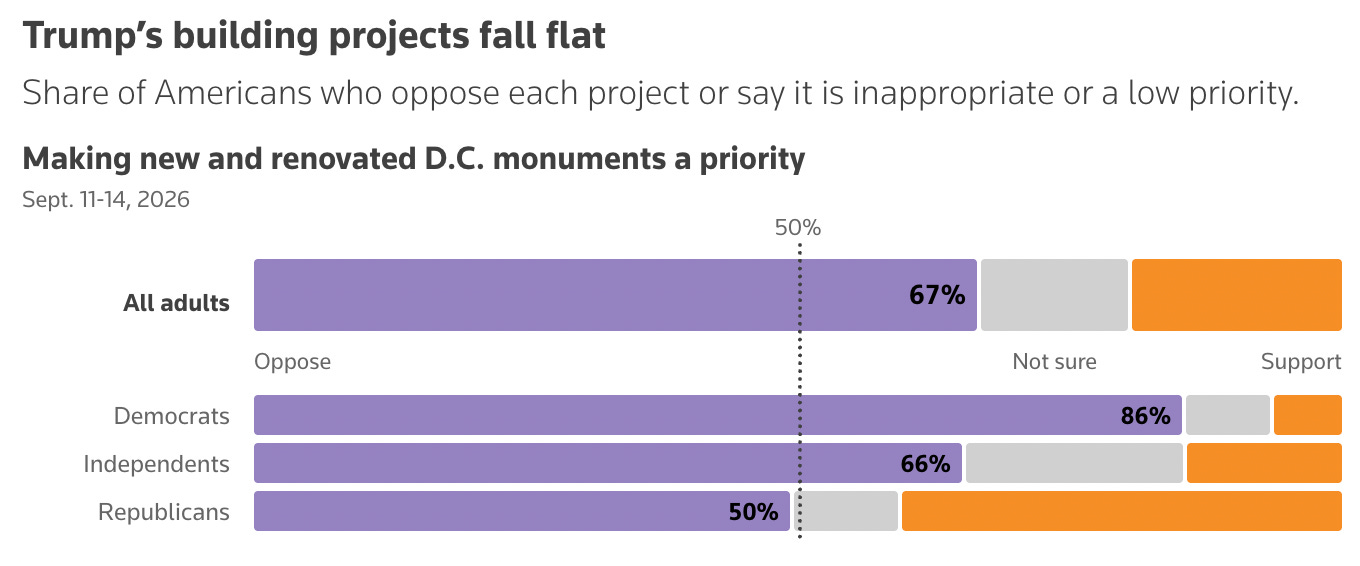
The Kennedy Center numbers are even worse. 80 percent of Americans oppose withholding renovation money unless Trump gets “recognition.” That includes 64 percent of Republicans.
Why is his makeover so unpopular? Start with the man himself. His approval rating sits at 32 percent. If most of the country doesn’t like the president, they won’t like seeing his image stamped across a historic city.
But there’s more that explains this poll. Everyday Americans are increasingly struggling to make ends meet. That’s the reality. But it’s not the reality that Trump lives in. Instead of addressing those concerns, the president has directed time and money towards vanity projects that make his bubble more comfortable. Everything has to be about himself.
This morning, amidst the FAA concerns, a reporter even called him out for it. Have a listen:
That’s Trump’s playbook response to a reasonable question. First, he doubles down. He defends the beauty of his White House and his helipad, while Americans are concerned about airline safety. Next, he calls the reporter pathetic and says she has no talent. That’s code for: you asked a good question, and I don’t have an answer.
But here’s the thing. The president knows his makeover is unpopular. He just doesn’t care. According to CNN, his administration is racing to push his projects through federal approvals over the next 60 days, before Democrats take control of Congress in January. One Trump ally even said, “it is going to be like a storm.”
And look, I’m sure that deep down every president wants to be remembered. But a legacy isn’t something you build out of marble. It comes down to whether you made people’s lives better or worse. Unfortunately for Trump, Americans are going to remember what his chaotic decisions did to their grocery bills and their gas prices. Not his helipad.
Some other stories that caught my eye:
Russia has opened its winter campaign against Ukraine’s power grid weeks earlier than expected, and Kyiv is taking the worst of it. Seventy-two hours before peace talks resumed in Abu Dhabi last week, Moscow launched 36 ballistic missiles and 172 drones. Every missile was aimed at Kyiv and the surrounding region. Very few were shot down. The strikes cut high-voltage lines feeding the capital and left 40 percent of its residential high-rises without heat. The bombing is part of a broader energy campaign Putin ordered on Sept. 1. By the end of October, Russian forces had attacked grid infrastructure more than 350 times and damaged over 800 pieces of critical equipment. President Volodymyr Zelensky said Russia wants “to come to the table holding our energy system hostage.” During the peace talks, Moscow laid out hard-line demands that Ukraine and its European allies are unlikely to accept. Analysts say that signals Russia believes the bombing will strengthen its hand by spring.
The Pentagon is weighing its own criminal case against Lt. Gen. Brett Sylvia, the senior general Pete Hegseth fired last month over alleged leaks. A U.S. official alleges Sylvia admitted passing secret information to a reporter over Signal and then deleting the chat. The Post has not verified that claim. The Washington Post reported that Hegseth has handed the matter to the acting Army Secretary “for appropriate disposition.” The case had already been referred to the Justice Department, so Sylvia now faces legal jeopardy on two fronts. He has not been charged and has not commented publicly. Hegseth’s spokesman Sean Parnell framed the firing as a promise kept: “We vowed to find you, and we meant it.” The military rarely court-martials generals, and almost never with a sitting defense secretary pushing the case this hard. Legal experts say Sylvia’s lawyers will almost certainly argue unlawful command influence. One retired Army officer and law professor made it clear: in this administration, “the process is the punishment.”


