


Hey everyone, all I can say is “wow.” The positive response to yesterday’s show absolutely blew me away. So we’re back again today with more news and analysis, giving you what you need to know about the top stories of the day.
Today brings us more big news, the most impactful being that President Trump is seriously considering sending ground troops to Iran. Also breaking, after yesterday’s Supreme Court Ruling, a Republican governor has already decided to cancel an election that was days away from starting. Gas prices are tripping up Republicans on TV and Trump is threatening to further unravel the post-Cold War deterrence apparatus in Europe.
If you want more of this breaking news coverage, please consider becoming a paid or free subscriber. By subscribing, you send a clear message that this kind of independent media matters.
Ok, let’s dive right in.
1. TODAY: Trump Weighs Major Iran War Escalation Of Sending In U.S. Ground Troops
President Donald Trump is reportedly set to consider a major escalation in the Iran War: sending in ground troops, specifically to take control of the Strait of Hormuz. Top military commanders Admiral Brad Cooper and Joint Chiefs Chairman General Dan Caine are briefing President Trump today on three new military options against Iran — including one that would put American ground forces inside the country.
Per Axios, the menu Trump is reviewing this afternoon includes a “short and powerful” wave of strikes on Iranian infrastructure, a special forces operation to seize Iran’s stockpile of highly enriched uranium, and a takeover of part of the Strait of Hormuz to reopen it to commercial shipping — an operation that could include ground forces.
Trump told voters, repeatedly and in public, that this would be a fast, contained war. Here’s Trump in his April 1 prime-time address:
We are now nine weeks into a war that has already cost $25 billion and killed 14 American service members, and the administration is now actively considering escalation to boots on Iranian soil.
The 60-day clock under the 1973 War Powers Resolution runs out tomorrow, May 1. Congress has not authorized this war. Republicans have blocked four bipartisan Senate attempts to invoke the resolution, but several GOP senators including Susan Collins and Thom Tillis have signaled they will not support the war beyond May 1 without a vote. We will soon see if they put their words to action or simply release another “concerned” statement.
2. A Republican Governor Is About to Cancel an Election That’s Already Started
Louisiana Gov. Jeff Landry is preparing to issue an executive order suspending at least the U.S. House contests in the state’s May 16 primary, even though absentee ballots have been returned and early voting begins in two days.
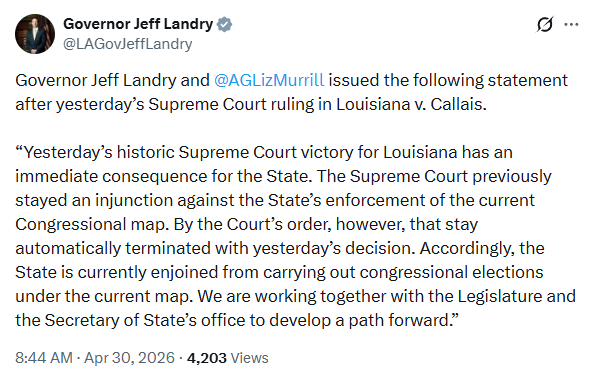
The move follows yesterday’s Supreme Court ruling striking down Louisiana’s congressional map as an unconstitutional racial gerrymander. Landry has been personally calling congressional Republicans to tell them the order is coming, possibly Friday, and Rep. Cleo Fields — the Black Democrat whose district sits at the center of the case — confirmed Landry told him directly. The plan: pause the election, let the GOP-supermajority legislature redraw the map before the June 1 session ends, then run primaries on whatever lines they produce.
This is what voter disenfranchisement looks like when it’s wearing a suit. Ballots have already been cast. Overseas military and civilian voters mailed in their ballots weeks ago. A governor is now preparing to throw those votes out so his party’s legislature can redraw the map to eliminate a majority-Black district and pick up a House seat. House Majority Leader Steve Scalise is one of the incumbents who stands to benefit. Yesterday the Court said states can do this. Today Louisiana is doing it.
Watch for the lawsuit — Fields said he expects a court challenge, and there are serious legal questions about whether a governor can unilaterally suspend a federal primary mid-vote. Watch whether the Senate primary gets pulled along with the House races. And watch Tennessee, Georgia, and Missouri, where Republican lawmakers spent yesterday afternoon publicly calling for their own new mid-decade maps. Louisiana is the first domino.
“People have already voted,” Fields said. “Early ballots have been submitted.” Those are the stakes, in nine words.
3. Pentagon Insiders Raise Alarm That Iran War Has Hollowed Out Our Military Readiness
An internal Pentagon assessments and congressional sources are warning that the Iran war has significantly depleted America’s weapons stockpile and weakened U.S. military readiness for other potential conflicts, per NYT.
The numbers are stark. The U.S. has burned through roughly 1,100 long-range stealth cruise missiles built specifically for a war with China. That’s close to the total number remaining in the stockpile. More than 1,000 Tomahawk cruise missiles were used — about ten times the military’s annual purchase. Over 1,200 Patriot interceptor missiles were fired at more than $4 million each. To backfill the shortage, the Pentagon pulled Patriot missiles from the THAAD system in South Korea and moved the USS Abraham Lincoln from the South China Sea to the Middle East before the war even started. Chart via CSIS.
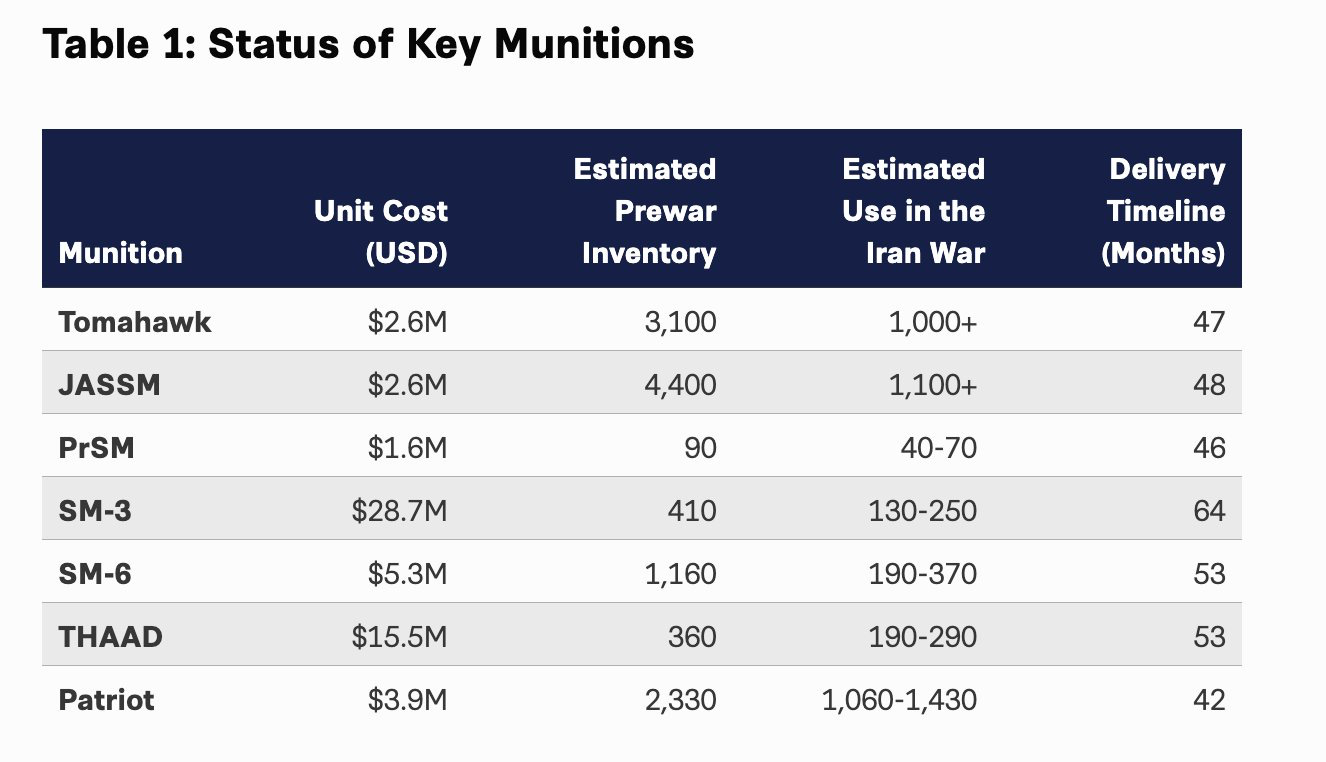
Independent estimates put the total cost between $28 and $35 billion, approaching $1 billion per day at peak intensity, with $5.6 billion in munitions spent in the first two days alone. State-backed Chinese outlets have been actively reporting on the depletion of U.S. missile stockpiles.
Analysts warn it could take four or more years to replenish the depleted systems even if the war stopped today. Meanwhile, Hegseth has fired the Army chief of staff, the Navy secretary, and a string of senior commanders in the middle of active combat operations. Experts worry that the experience lost due to these firings will be difficult, if not impossible to replace in time to impact the war in Iran.
If serving in the military and Congress taught me anything, it is that deterrence works because adversaries believe you can respond anywhere, at any time. When you burn your China-war stockpile fighting Iran, strip your Pacific carrier group, and fire your generals mid-war, you are not projecting strength. You are advertising a window of vulnerability. And our adversaries are taking notes.
4. Gas Prices Are Skyrocketing And Republicans Keep Getting Caught Lying About It On Live TV
House Majority Leader Steve Scalise was corrected on air by a CNBC anchor after falsely claiming gas prices were nearly $6 a gallon two years ago, and Sen. Tim Scott has been caught making similar false comparisons as Republicans scramble to defend the Trump economy ahead of the midterms.
Gas prices are currently 27% higher than a year ago, according to AAA, averaging $4.30 per gallon nationally. Scalise told CNBC’s Squawk Box that gas was “almost $6 a gallon” two years ago and is now “in the threes.” CNBC anchor Joe Kernen stopped him cold: “Two years ago in April of 2024, we were at about $3.65, so we’re actually above where we were then.” Here’s the full exchange:
The actual national peak under Biden was $5.01, briefly, in June 2022 — not the sustained $6 figure Republicans keep invoking to reframe today’s $4.30.
And here is Senator Tim Scott, who seems to be living in another reality:
Trump’s approval rating on the economy has fallen to a career low of 31%, and roughly two-thirds of Americans say his policies have worsened economic conditions, up 10 points since January. And with the summer driving season approaching and the Iran war unresolved, it is only going to get worse.
The administration’s own messaging has been a mess — Energy Secretary Wright said gas under $3 may not happen until 2027, Trump called him “totally wrong,” and Treasury Secretary Bessent has shifted his goalposts multiple times. Watch for whether any Republican incumbents in competitive districts start breaking from the party line on the war as gas prices become the defining economic issue of the midterms.
Mike Murphy, a longtime Republican strategist, put it plainly: “Trump’s original deal with the American people was ‘I’m a boorish lout and kind of embarrassing, but I know how to run the economy.’ And they believed that.” That deal is fraying in real time at the gas pump, and no amount of bad math on cable news is going to fix it.
5. Trump Got Off the Phone With Putin and Immediately Threatened to Remove U.S. Troops From NATO’s Front Line
Hours after a 90-minute phone call with Vladimir Putin on Wednesday, President Trump posted on Truth Social that the U.S. is “studying and reviewing the possible reduction of Troops in Germany.”
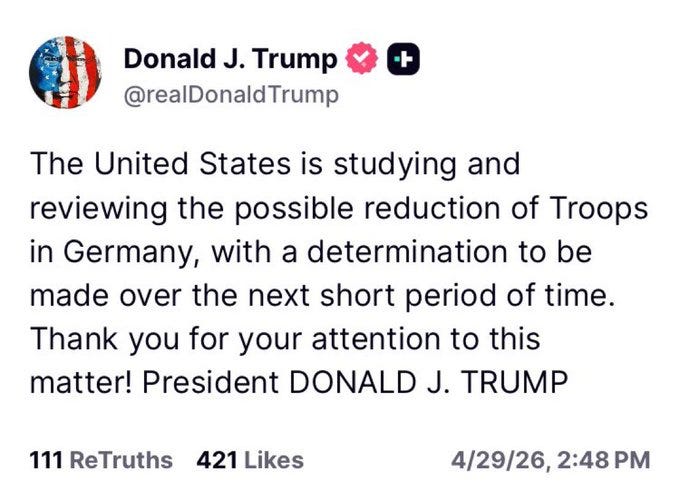
The U.S. has more than 36,000 active duty troops stationed in Germany, along with nearly 1,500 reservists and 11,500 civilians. Germany hosts the headquarters of both U.S. European Command and Africa Command, and Ramstein Air Base is a critical hub for American military operations across Europe and Africa. The immediate trigger was a feud with German Chancellor Friedrich Merz, who said the U.S. “clearly has no strategy” in Iran and suggested America is being “humiliated” by Iranian negotiators. Trump tried this once before, announcing plans to pull 12,000 troops from Germany in 2020 — it drew bipartisan pushback and Biden reversed it.
The Kremlin confirmed the call was held at Moscow’s initiative, lasted over 90 minutes, and that Putin expressed support for Trump’s Iran ceasefire extension while offering Russian assistance in diplomatic efforts. Putin calls. Trump says things were “very good.” Trump then publicly floats weakening America’s military footprint on NATO’s eastern flank. That sequence is not subtle, and national security experts from both parties are treating it accordingly.
Watch for congressional reaction, especially from Republican senators who pushed back on the 2020 Germany pullback. A 2023 law prevents Trump from withdrawing the U.S. from NATO without congressional approval, but troop reductions carry no such legal constraint. The central question is whether this is a pressure tactic against Merz or a policy move being encouraged from Moscow.
When asked about the call, Trump told reporters he had asked Putin to consider “a little bit of a ceasefire” in Ukraine and added “I think he might do that.” A superpower president asking an authoritarian aggressor for “a little bit” of anything is not a negotiating posture.
Some other stories that caught my eye:
Amazon reportedly considers rebooting The Apprentice for Prime Video, with Donald Trump Jr. as the potential host. The talks were first reported by the Wall Street Journal, which cited Amazon MGM Studios head Mike Hopkins as among those spearheading the idea. This would be the latest in a pattern of Amazon putting the Trump family in the spotlight, following the company’s $75 million investment in Melania Trump’s documentary. Discussions reportedly began internally around the time Trump was being sworn in. Amazon is pushing back on the characterization. A spokesperson told outlets the show is “not in active development” and that any reporting on hosts or details is “purely speculative.”
In a shocking announcement, Maine Governor Janet Mills dropped out of the Maine Democratic Senate primary Thursday morning, just five weeks before the June 9 vote, citing a lack of financial resources. Senate Minority Leader Chuck Schumer had worked hard to recruit Mills into the race, making her exit a real blow to the party establishment. She was consistently outpolled and outraised by Graham Platner, a military veteran and oyster farmer who built a loyal following as a progressive insurgent. Platner faced early controversy, including a tattoo recognized as a Nazi symbol and inflammatory old social media posts, and many observers expected him to be the one forced out. His willingness to address those controversies directly ended up helping him rather than sinking him. Maine is a must-win for Democrats, who need a net gain of four seats to take back the Senate, and Collins has proven a tough opponent in every previous race.
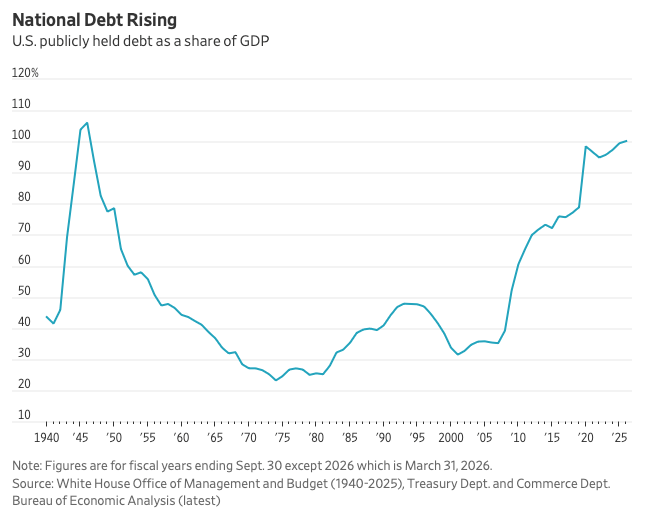
The Congressional Budget Office confirmed this year that U.S. debt held by the public has crossed 101 percent of GDP in 2026, with the deficit projected to hit $1.9 trillion this fiscal year alone. The last time debt reached this level was just after World War II, and that came with a war effort that rebuilt the global economy. The federal government now spends more on interest payments than it does on Medicare, national defense, Medicaid, and veterans benefits combined, with interest consuming nearly one-fifth of all federal revenue. The next crisis, whenever it comes, finds the U.S. Treasury with less room to respond than at any point in modern history. CBO projects debt reaching 120 percent of GDP by 2036, and the reconciliation bill currently moving through Congress is estimated to add another $2.4 trillion on top of that. At some point the math stops being a problem for future politicians and starts being a crisis for current Americans, and we are closer to that line than Washington is willing to admit. Chart via WSJ.
ICE agent Jonathan Ross, who fatally shot 37-year-old unarmed mother Renee Good in Minneapolis on January 7, has been quietly relocated to another state and returned to active investigative duties, according to an exclusive report by PunchUp. Senior DHS officials say Ross is effectively shielded from ICE’s own internal accountability process because that review cannot begin until the FBI investigation concludes — and the FBI investigation has stalled. An FBI supervisor resigned from the Minneapolis field office after reporting she was pressured to reclassify her civil rights inquiry into Ross as a probe of an alleged assault on a federal officer by Good herself. Whistleblower accounts obtained by senators describe FBI Director Kash Patel directing agents to reframe warrant language to portray Good as a suspect rather than a victim. Senior DHS officials also told PunchUp that the White House directed the exclusion of Minnesota state investigators from the federal crime scene, preventing the standard joint review process that career officials said would have produced a more credible outcome. Ross was placed on administrative leave for three days.


