


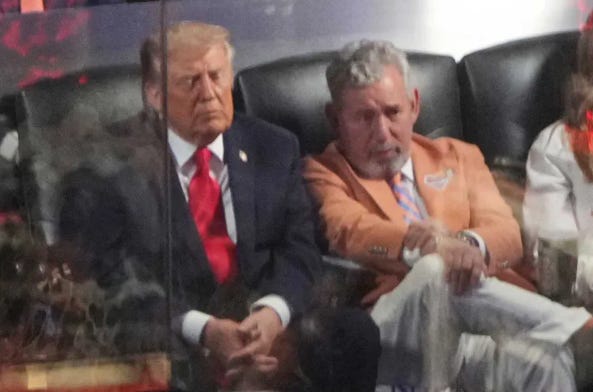
Moments before tip off at Game 3 of the NBA Finals Monday evening, the cameras inside Madison Square Garden found Donald Trump in James Dolan’s private suite, high above the court, as Avery Wilson began to sing the national anthem. The president stood with his granddaughter Kai beside him, his right hand raised in a slow salute, his jaw set in the particular way it gets when he is trying to look presidential. And then, as it always does, the crowd told the truth.
The boos started the moment his face appeared on the jumbotron and did not stop for a full minute. Not scattered boos. A sustained, unified wall of sound from 19,812 people who had paid thousands of dollars to watch a basketball game and found themselves, instead, sending a message to the man who had turned their neighborhood into a security checkpoint for the evening. The watch party outside the arena had been canceled. Several blocks of midtown Manhattan had been closed. Thousands of fans had been rerouted, delayed, and searched extensively. The city had been inconvenienced for a man the city did not want there. And it said so, loudly, the only way it could.
The jeers ended when the flag filled the screen. They returned when Trump’s face appeared again. And they evaporated entirely when Jalen Brunson was shown standing on the court, because the crowd had not come to Madison Square Garden on a Monday night to make a political statement. They had come to watch the Knicks. Donald Trump made that impossible.
Somewhere in the second half, the cameras caught the president with his eyes closed. His head had dropped slightly. His shoulders had settled in the way that bodies settle when the muscles holding them upright have given up the effort. The White House, which has developed considerable experience explaining away photographs of this kind, later described it as a long blink. It was not a long blink. It was a 79-year-old man who had fallen asleep at a basketball game he had forced his way into.
The Knicks lost for the first time in the series. The crowd was deflated. The building emptied. And somewhere in the motorcade back to JFK, the president prepared to tell the world what had happened.
Standing on the tarmac before boarding Air Force One, Trump was asked directly about the reception he had received. He did not hesitate. “I thought it was great,” he said. “I mean, I thought it was amazing, actually. You mean when they had the camera on me? I thought it was very good, yeah. It was certainly amazing. It was, I think, mostly cheers. It was loud and it was very enthusiastic.”
I want to be careful here, because the temptation when reporting something like this is to treat it as simply another lie in an administration that tells many of them. But I do not think that is what Monday night was. Lies, by definition, require some awareness of the truth being obscured. What Trump described on that tarmac did not sound like a man who knew he had been booed and was covering it up. It sounded like a man who had genuinely processed the evening differently from everyone else in the building. The pool reporter from The Washington Times, not exactly a hostile outlet, wrote that Trump was thunderously booed. The video is unambiguous. The audio is clear. None of that appears to have registered.
At 2:11 in the morning, unable to sleep, Trump posted to Truth Social. He shared a clip from a conservative news site showing his motorcade driving through the city, with a handful of supporters cheering along the route. A Fox News contributor had captioned it: “NYC loves Donald Trump.” In the same clip, plainly audible, New Yorkers were booing as the motorcade rolled past. He posted it anyway, because to him, that was the night. That was what had happened. The cheers were real. The boos did not exist in any way that required acknowledgment.
I have been writing about this presidency for a long time now, and the question I find myself returning to, more than any other, is not whether Trump lies. He does, constantly, and the documentation of that is overwhelming. The question that keeps me up at night is something more unsettling: how much of what he says does he actually believe? Because there is a meaningful difference between a president who knows the truth and hides it, and a president who has lost the capacity to distinguish between what he experiences and what he wishes he had experienced. The first is a problem of character. The second is something else.
Consider what that operating system looks like applied to the decisions that actually matter. The CIA delivered an assessment telling the White House that Iran has restored 90 percent of its missile capability after two months of war and $30 billion in spending. Trump called the reporting virtual treason. His approval rating has collapsed to the low thirties. He describes a country that loves him. Inflation hit 3.8 percent in April. His economic team told CNBC that Americans are simply overwhelmed by winning. Nineteen thousand people booed him during the national anthem at Madison Square Garden. He went home and posted that New York City loves him.
This is not a new pattern. But something about Monday night made it impossible to look away from, precisely because sports arenas are one of the last places in American life where reality is genuinely non-negotiable. The score is the score. The crowd noise is the crowd noise. You cannot spin a jumbotron. Thousands of people had their phones out. The audio exists on a thousand separate recordings, uploaded to a thousand separate accounts within minutes of it happening. There is no version of that evening in which the president was not booed, and no version of his response to it that made sense given what everyone in that building heard and felt.
What I keep coming back to is the granddaughter. Kai Trump sat beside her grandfather in that suite for the whole of it. She heard what the crowd said when his face appeared on the screen. She watched the game. She watched him close his eyes. She was there on the tarmac when he described the night as mostly cheers. And she is seventeen years old, growing up inside the particular reality her grandfather has constructed, learning from the closest possible distance what it looks like when a man decides that the world around him must conform to his version of events rather than the other way around.
I don’t know what she took away from Monday night. I hope it was something honest. Because the rest of us don’t have the option of looking away from what it means when the person making decisions about a war, an economy, and a democracy comes home from a basketball game and tells the world it was mostly cheers.
It wasn’t. And we all heard it.
One thing we can be sure of: nobody in Trump’s orbit will tell him the truth. The Emperor Has No Clothes.
And god forbid if Biden had acted the same way the media would be screaming about it nonstop. Why aren’t his clear actions of a man descending into dementia being reported?