



For more than a week, James Talarico, the Democrat leading the Senate race in Texas, was off the campaign trail. His campaign said he had the flu. That wasn’t good enough for his opponents. Ken Paxton’s campaign put out a press release demanding “proof of life.” “MISSING” graphics spread across social media.
Then, over the weekend, the right-wing influencer Nick Sortor posted what was supposed to be the knockout blow: “BREAKING EXCLUSIVE: Ohio mental hospital CONFIRMS James Talarico was discharged from the facility earlier this week. The ‘flu’ thing was a BIG FAT LIE.”
It had a recording. It had the name of a real psychiatric hospital outside Cincinnati. It had Elon Musk amplifying it to his enormous following. Before long, it had doctored images of Talarico in a straitjacket.
The only thing it didn’t have was the truth.
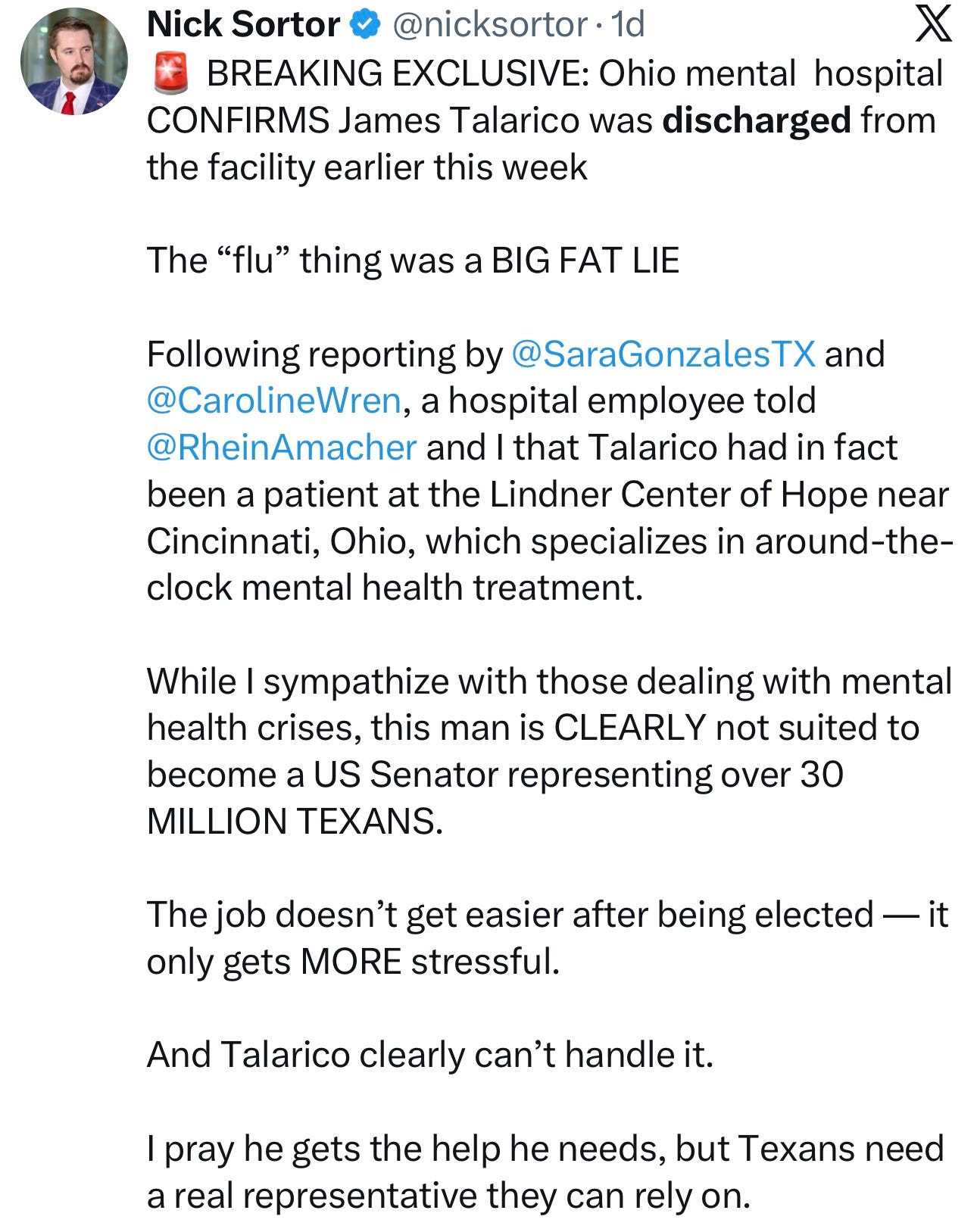
The recording was of an unidentified woman, presented as a hospital employee. Nobody could say who she was or how she’d know anything about a patient’s status. The hospital itself then released a statement saying that Talarico “has never received treatment from Lindner Center of Hope.” Talarico said he’s never even been to Ohio. By the time the “exclusive” dropped, he was already back in Austin, shaking hands with voters at a music festival.
The lie was bad enough. But the longer I thought about the whole episode, the angrier I got about what Paxton and his allies were really saying.
The Lie Underneath the Lie
Let me be fair about one thing first. Voters have every right to ask about the health of someone running for the United States Senate. But the opposition inventing an answer is something else entirely.
And look at the answer Paxton’s allies invented.
The whole smear depended on one assumption: that if James Talarico had gotten help for his mental health, it would be a scandal. Something to hide. Something shameful. Proof that he wasn’t fit to serve.
So let me say clearly what they wouldn’t. James Talarico had the flu. But if he’d been struggling with something harder, and he’d done the responsible thing and gotten help, that wouldn’t disqualify him from anything. It would tell you something good about him.
Here’s what bothers me most. The GOP was aiming to smear one Democrat in Texas. But millions of other people who will never be mentioned in a story about James Talarico got the message loud and clear.
Including the veteran who’s been sitting with a phone number for weeks, trying to decide whether to call.
Or the farmer coming off a brutal year who was raised to believe that real men handle it themselves.
Or the young guy who’s been told his whole life to tough it out.
Or the teenager scrolling through her feed, watching grown adults treat psychiatric care like a punchline.
The CDC estimates that over 58 million Americans live with mental health issues, yet only about half of them seek treatment.
Every one of them got the same lesson this week: if you’re struggling, you’d better keep it to yourself, because look what they’ll do to you if anyone finds out.
I spent years in the military, and I watched the services work hard to convince people in uniform that asking for help is a sign of strength, not weakness. It’s been slow, painful work, and it has saved lives. Too many service members and veterans have suffered in silence because they were afraid of exactly this kind of whisper campaign, afraid that getting help would cost them their careers or their reputations. Stories like this undo that work in an afternoon.
And here’s the part the influencers who pushed this ought to think hard about. A lot of the people in their own audiences are the people I just described. They insulted their own people to score a point against a Democrat.
We’ve been here as a country before. In 1972, Thomas Eagleton was dropped as George McGovern’s running mate after it came out that he had been hospitalized for depression. He lasted eighteen days on the ticket. The voters of Missouri, by the way, kept sending him back to the Senate for years afterward.
Fifty years later, GOP politicians and their henchmen are still running the same smear campaign. The only difference is that this time, the diagnosis was made up.
Why It Spread So Fast
It’s worth asking how a story with facts this thin traveled this far, this fast.
For decades, conservative media built its identity around one argument: the mainstream press is biased against you. Some of those complaints were legitimate. But somewhere along the way, the goal stopped being a fairer press and became an audience that exists in an echo chamber.
The end result? If the mainstream press says it, it’s probably a lie. If someone on our side says it, especially if it’s framed as what “they” don’t want you to know, it’s probably true.
And once the audience believes that, the grifters know exactly how to exploit it. Being wrong costs them almost nothing. Being first gets them clicks, followers, and money. So even after the hospital’s denial, some right-wing outlets kept the story going, picking apart Talarico’s account of a doctor’s visit like it was the Zapruder footage.
That’s how a nasty campaign lie reaches an enormous audience without a fact in sight. And that’s how the subtle cruelty goes national.
What Strength Actually Looks Like
Here’s the good news: as a country, we’ve come a long way on this. More people talk openly about anxiety and depression than ever before. The armed services talk about it far more openly than they did when I first put on a uniform.
Professional athletes, members of Congress, people you know from your own church or your kid’s school are publicly sharing that they got help and it saved them. That progress was hard-won, and it’s worth protecting.
So don’t let a few influencers chasing clicks drag us backward. If you’ve been struggling, make the call. If someone you love has been quiet lately, check on them, and mean it. And if someone you know tells you they got help, tell them you’re proud of them, because they did one of the bravest things a person can do.
James Talarico had the flu. But somewhere out there, someone who saw that smear campaign this week is wondering whether it’s safe to ask for help for a much harder problem.
It is. Getting help isn’t a scandal. It’s strength.
Let’s make sure they hear that from us louder than they heard the lie.
— Adam
I find it very comforting that you have the human quality to think of how many OTHERS were adversely affected by this lie. Talarico had the flu and he is a thick skinned politician. Regular people are not.
Thanks for the Eagleton mention. Came to mind immediately, on seeing this slop.