

NOTE: THIS ARTICLE IS A PARODY. IF WHAT’S HAPPENING IN OUR COUNTRY UNDER TRUMP IS GOING TO BE SO RIDICULOUS, WE NEED TO MOCK IT AS SUCH. THE BELOW IS MY HONEST ATTEMPT. I HOPE YOU ENJOY.
First, the part that is, unfortunately, not a parody…
Last week, the United States government announced that it would mint a one-dollar coin bearing Donald Trump’s face, thereby combining the modesty of a Roman emperor with the reliable investment performance of Trump merchandise.
Treasury Secretary Scott Bessent called the coin a celebration of liberty, patriotism and American values. It had a gold-like finish but contained no gold or precious metal, making it perhaps the most faithful Trump product ever conceived: gaudy, officially promoted and composed entirely of cheap material.
And if the above is real life but feels like a parody of the USA as we know it, below is where my parody article of Trump kicks in…
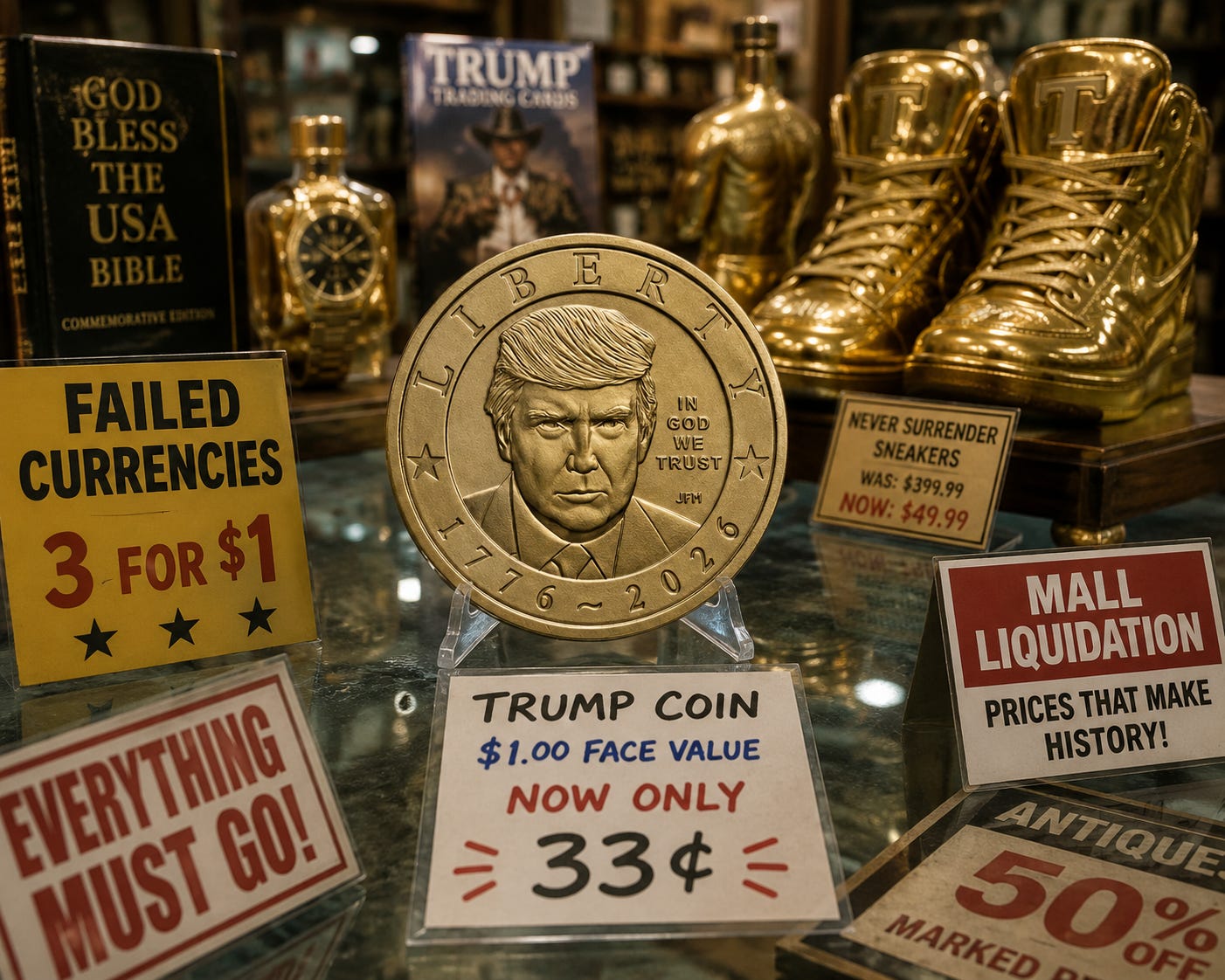
More than a century later, in 2146, an 87-year-old woman named Mildred Pruitt found a Trump Coin in a plastic tub at Yesterday’s Treasures Antique Mall outside Palm Beach, now located 12 miles inland for reasons the proprietor preferred not to discuss.
The tub was labeled: FAILED CURRENCIES: 3 FOR $1.
Mildred recognized the name vaguely. Trump had been either a president, a hotel or a dietary supplement. History classes had been unclear.
She enjoyed presidential memorabilia, though not enough to study it. She owned an Eisenhower campaign button, a Kennedy inaugural pamphlet and a Jimmy Carter peanut-shaped bottle opener that had survived three generations because nobody had ever felt strongly enough about it to throw it away.
She picked up the coin. Trump’s portrait occupied one side. The Great Seal of the United States occupied the other.
“So which side represents the country?” she asked.
“The eagle,” the dealer said. “The other side is why the coin is in this bin.”
The coin was priced at 33 cents.
“But it says one dollar.”
“That’s Trumpflation.”
Trumpflation, the dealer explained, was an economic phenomenon discovered in the 2040s, when appraisers noticed that objects bearing Trump’s name, image or likeness lost value faster than ordinary consumer goods. Traditional inflation made everything cost more. Trumpflation made anything bearing Trump’s name worth less.
Economists eventually developed a formula. The resale value of an object declined according to three factors: the number of square inches occupied by Trump’s face, the amount of simulated gold and the frequency with which the packaging used the words “official,” “limited edition” or “patriot.”
A normal souvenir coin might retain 40 percent of its value. A coin featuring Trump’s profile retained 12 percent. Any object showing him facing forward had to be accompanied by a cash payment before an auction house would remove it from your property.
The dealer led Mildred to Booth 45-47. It was overflowing with “gold.”
Gold shoes. Gold watches. Gold coins. Bibles with gold lettering. Bottles of cologne shaped like a broad-shouldered Trump. Guitars bearing his name. Digital trading cards showing him as a cowboy, superhero and astronaut, although the tightness of the spacesuit suggested NASA had not been consulted.
Mildred picked up a pair of metallic high-tops.
“Were these ceremonial shoes for the burial of a pharaoh?”
“They were called Never Surrender sneakers.”
“Did he surrender?”
“To several creditors and most of the autocrats of the day.”
Next she found a bottle labeled Victory 45-47. The cap was a tiny golden Trump.
“Perfume?”
“Cologne.”
“What did it smell like?”
“Blind confidence, hairspray, and several bankruptcies.”
Beside it sat a diamond-encrusted watch whose original price tag read $100,000. A disclaimer warned that it was intended as a collectible, not an investment.
“That seems unusually honest,” Mildred said.
“The lawyers wrote that part.”
She moved to the religious section. There she found the God Bless the USA Bible, which combined Scripture with American founding documents and song lyrics, as though the Sermon on the Mount had been revised by the entertainment director of a casino cruise.
“Was Trump a theologian?” Mildred asked.
“Not exactly.”
“A prophet?”
“Mostly of events that had happened five minutes earlier.”
“A martyr?”
“According to his fundraising emails.”
The dealer explained that Trump had sold Bibles, sneakers, perfume, watches, guitars, silver coins, photo books, digital trading cards and cryptocurrency while seeking or holding the presidency. The NFTs depicted him performing a variety of physically demanding jobs he would not otherwise have considered.
“So he had many careers?” Mildred asked.
“No. He had many costumes.”
She found a coin stamped $TRUMP.
“Is this money?”
“It was crypto.”
“What could you buy with it?”
“More crypto.”
The dealer directed her to a glass cabinet known among collectors as the Trump Last Supper. Inside were bottles of Trump Vodka, Trump Water and Trump Wine, along with an empty Trump Steaks box.
“He put his name on the whole meal,” Mildred said.
“Except the vegetables.”
The steaks had once been sold through the Sharper Image, a store best remembered for selling electric neck massagers and chairs that massaged you while you fell asleep at the mall. Trump Vodka promised “Success Distilled,” although the success proved difficult to distribute and soon disappeared from American shelves. Trump Water allowed hotel guests to remain within the brand even while swallowing. Trump Wine came from a winery owned by his son, which was appropriate: Trump’s favorite vintage was always inherited.
The empty steak box was the most valuable object in the cabinet because, unlike the steaks, it had aged well.
Mildred kept digging.
She found Trump ties, Trump suits, Trump shirts, Trump cuff links, Trump eyeglasses, Trump deodorant, Trump underwear, Trump mattresses, Trump linens, Trump furniture, Trump coffee and, inexplicably, a Trump-branded urine test.
She stared at the test.
“He put his name on this?”
“He branded what went into the body, what covered the body, what the body slept on and finally what came out of the body. It was vertical integration.”
The urine test occupied a special place in the history of Trumpflation. Scholars generally agreed that the phenomenon began there, because attaching the Trump name to human waste left economists with no remaining benchmark.
“Was there anything he didn’t brand?” Mildred asked.
“Humility.”
The dealer showed her the commercial ruins: Trump Shuttle, Trump Mortgage, Trump Magazine, Trump University, Trump casinos, Trump Mobile, Trump: The Game, a travel website called GoTrump and a vitamin business called the Trump Network. They had offered transportation, education, finance, journalism, telecommunications, gambling, recreation, travel and nutritional guidance—nearly every service required to construct a civilization, provided the civilization did not need any of them to work for very long.
Trump University was not a university. Trump Mortgage arrived shortly before a mortgage crisis. Trump casinos went bankrupt despite operating businesses in which customers mathematically lose. Trump: The Game sold poorly, even though its central premise—buy property, crush your rivals and put your name on everything—was the closest Trump came to authorizing an autobiography.
“Why did people buy all this?” Mildred asked.
The dealer shrugged. “Some admired him. Some thought the objects would become valuable. Some wanted to own a piece of history.”
“And did they?”
“In the sense that a landfill is part of history.”
Mildred began to understand. Trump had not been an astronaut, superhero, vintner, theologian, fashion designer, educator, banker, game inventor, perfumer or regional steak distributor. He was simply a man incapable of encountering a blank surface without experiencing the urge to put his name on it.
Scarcity normally created value. Trump created abundance. He pursued every available noun in the English language. A steak was not fully a steak until it became a Trump Steak. Water had circulated through oceans, glaciers and clouds for billions of years without adequate branding. The Bible had endured for centuries before someone noticed that its cover lacked a licensing opportunity.
Eventually, he was no longer content to brand buildings, mattresses and meat. He began branding the United States itself. His name appeared on government buildings and public institutions. Then his face appeared on American currency.
The salesman had finally discovered the largest blank surface in the country: the country.
That was when Trumpflation became irreversible. There were simply too many Trumps. His likeness had become the commemorative equivalent of kudzu. The face intended to signify wealth, power, glamour, masculinity, patriotism, faith and victory instead produced the eerie sadness of finding a child’s name written on every toy in a room, as if he feared that anything not labeled might belong to someone else.
In the end, Trump achieved the dream that had animated his entire public life. He became unavoidable. And therefore worthless.
Mildred carried the coin to the register.
“I’ll give you 25 cents,” she said.
“It’s already marked down to 33.”
She turned it over and examined the eagle.
“So half of it is worth something.”
The dealer considered this.
“Sixteen cents.”
Mildred pointed to Trump’s portrait.
“Fifteen.”
Mildred bought it and took it home. Her kitchen table had been wobbling for weeks, so she slipped the Trump dollar beneath its shortest leg.
The table stopped rocking.
After 120 years, the coin had finally fulfilled the promise of its original announcement. It had become a lasting symbol of American stability.
Great parody, Adam! My two favorite lines that sum him up perfectly:
"[A] landfill is part of history.”
"His likeness had become the commemorative equivalent of kudzu."
I love it. Especially the Kudzu comparison. 🤣🤣