


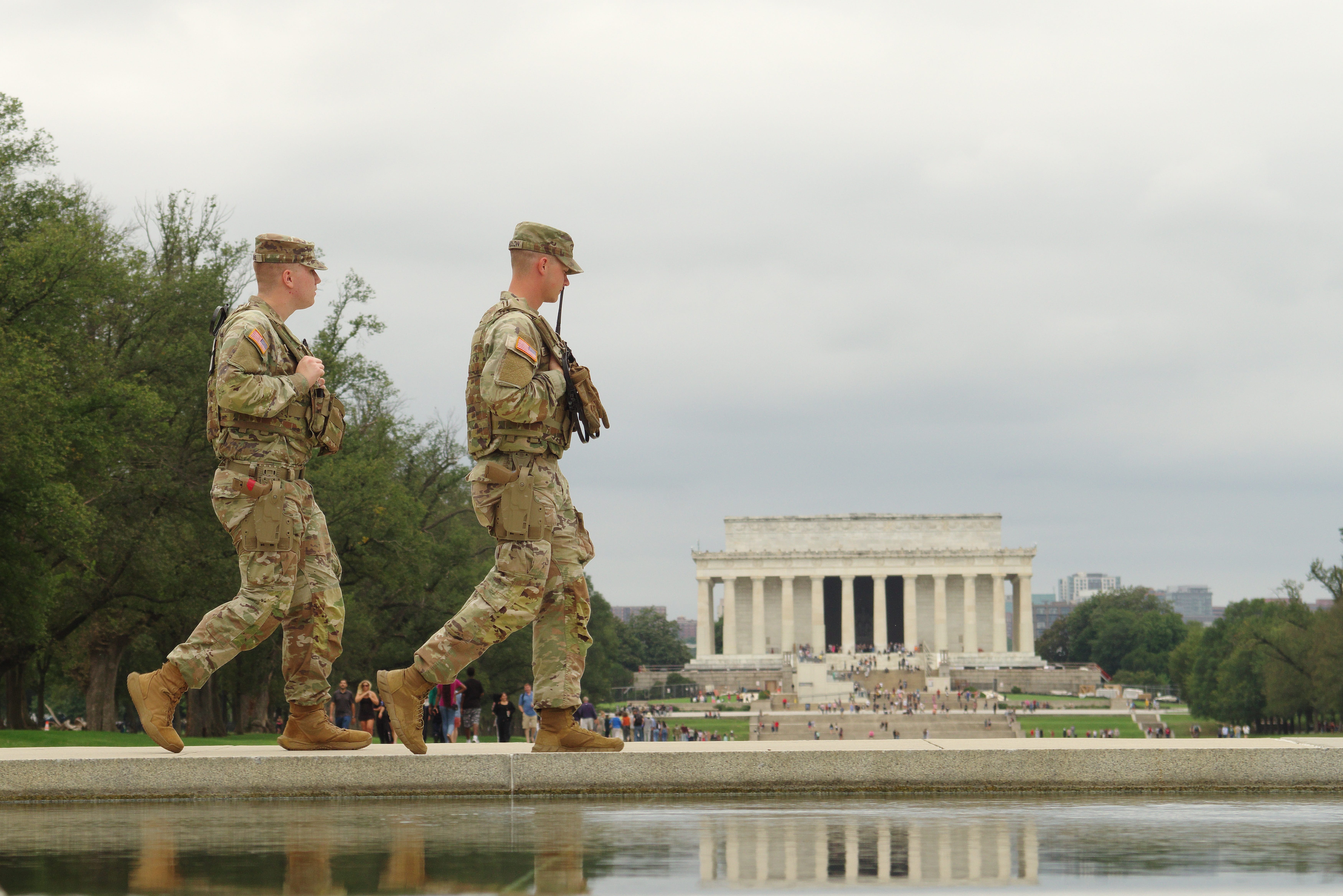
One year ago today, Donald Trump walked into the White House briefing room and announced that he was sending hundreds of National Guard troops into Washington. He called it “Liberation Day in D.C.” and promised to restore “law, order and public safety” to a city he described as plagued by “crime, bloodshed, bedlam and squalor.” Then-Attorney General Pam Bondi went further: “Crime in D.C. is ending and ending today.”
A year later, thousands of Guard troops remain in Washington, and Trump plans to keep them there for the rest of his presidency. Their deployment is now scheduled to last until January 20, 2029, the day he leaves office. Apparently, “today” lasts three and a half years.
It’s true that crime has fallen. Total reported crime has fallen 20 percent so far this year, and homicides are down about 31 percent. But Trump sent in the Guard after Washington had already experienced a substantial drop in crime. It’s fine if the administration wants to give the troops some of the credit. That still doesn’t explain why they need to remain in the city for another two and a half years.
The Pentagon says the mission will continue until January 20, 2029, “or until terminated by the President.” More than 4,600 military personnel from D.C. and 24 states and territories were still deployed as of last week. Keeping the troops in Washington through 2029 is expected to cost about $1.4 billion. The Pentagon is planning for a long stay: the administration signed a $292 million contract to move Guard members from hotels into apartments around Washington. If this deployment is really about crime, it should end when the crime emergency ends. Instead, it is scheduled to end when Trump leaves office.
I spent 20 years in the Air Force and Air National Guard, and one reason this personally upsets me is that Guardsmen aren’t a reserve pool of federal employees for a president to use whenever he wants. They have military jobs to train for, not to mention civilian careers and families they leave behind when they are activated. Calling them up for a genuine emergency is part of the bargain. Keeping them in Washington for years to patrol neighborhoods, shovel snow and perform routine city work is absolutely not the mission they signed up for.
I’m sure some of their work was useful to the city, but that’s what makes the situation so easy to get used to. Their deployment, which at first seemed outrageous, now seems almost boring.
Americans have long been wary of using the military for domestic purposes, and for good reason. Civilian police and the military do different jobs and have different relationships to the citizens they serve. People stop noticing when the lines between the two blue over months and years.
Trump has been doing his best to expand his use of the Guard for years. During the protests in 2020, he wanted as many as 10,000 troops deployed in the Washington area. Early in his second term, he has tried to send Guard troops into several Democratic-led cities, with some deployments blocked or limited by courts.
Here’s the run with the current situation: Washington is easier because D.C. is not a state. The president directly controls the D.C. National Guard, and Congress has a lot of control over the city.
That’s why Trump can do things with the National Guard in Washington that he cannot do in a state. Not only does he directly control the D.C. Guard, but the 700,000 people who live there have no governor who can tell him no. A federal judge ruled last November that the deployment was unlawful, but an appeals court let it continue and said Trump was likely to prevail because presidents have more control over the National Guard in D.C. than in the states. Even if the courts decide Trump has this power, that doesn’t mean he should use it this way.
Dwight Eisenhower also sent troops into an American city, but for a clearly defined purpose. In 1957, Arkansas Governor Orval Faubus called up the Arkansas National Guard and ordered it to keep nine black students out of Little Rock Central High School. After Faubus withdrew the Guard and a segregationist mob threatened the students, Eisenhower intervened.
He took control of the same Arkansas National Guard, put it under federal command and reversed its mission. He also sent troops from the 101st Airborne Division to Little Rock to protect the students and enforce the federal court’s desegregation order. He also made clear when the troops could leave: if resistance to the court orders stopped, “the further presence of Federal troops will be unnecessary.”
Trump has done the opposite. Crime in Washington has fallen, but the Guard remains. Troops who were sent in to deal with crime were eventually tasked with shoveling snow and working on beautification projects. And, for reasons that Trump has yet to explain, the deployment is scheduled to end not when some public-safety goal is met, but when Trump leaves office.
Arthur Schlesinger Jr. popularized the phrase “imperial presidency” in his 1973 book of that name. He was concerned about presidents acquiring power during a crisis and how that power sticks around, especially when Congress fails to exert its constitutional role.
Trump has accelerated that habit. According to the Associated Press, 30 of his first 150 executive orders in his second term invoked some form of emergency authority, far outpacing recent presidents. Under Trump, everything is deemed an emergency, whether it’s trade, immigration, or crime in Washington. These so-called “emergencies” are useful pretexts for him to expand his power.
What makes this particularly alarming is that the Guard is scheduled to remain in Washington through the 2028 presidential election. I am not predicting that Trump will order troops to interfere with it. But I did serve on the committee that investigated January 6. We learned what happens when a president decides that losing power is unacceptable and refuses to accept defeat.
The country learned, in real time, that many of our safeguards depended on people behaving better than the law required. Normalizing thousands of troops in the capital through another presidential election and transfer of power is a bad arrangement even if the troops never do anything improper.
The good news is that Americans do not have to accept this as normal. If and when Democrats take back Congress, they can limit how long the president can keep troops in the capital without congressional approval, and the public can keep asking a simple question that Trump won’t answer: What are these troops still doing here? Bad precedents become lasting ones only when everyone decides to live with them. We don’t have to.
We in the nation's capital have just passed our one-year anniversary of military occupation. Hundreds of National Guard roam around mostly public monuments, metro stations and tourist destinations, standing in circle-jerk formation doing....absolutely nothing. They are most certainly *not* fighting crime. Our DC Metropolitan Police Force does that.
Meanwhile, the Reflecting Pool stays fenced and broken, the Kennedy Center's name is still covered by a tarp with the inside gutted, Jackie Kennedy's Rose Garden got paved over with concrete, a helipad is being ripped up on the South Lawn in order to build yet another helipad, and the East Wing lies in a pile of landfill somewhere.
This is what happens when you let in the riffraff in to squat in a once classy neighborhood.
And this is why re-enlistment of the National Guard is at a low level. Our National Guard is comprised of citizen (emphasis) soldiers. They want to serve our country differently than active duty. The toddler in chief using them like Green Army soldiers for his fun is wrong.