

Additional video for paid subscribers follows article.
(Quick note. I put out an article on May 11th The Streamer Class Is Eating a Generation — and one of the guys I discuss is named “Chud The Builder.” Yesterday, he got into a confrontation and shot a black man outside a courthouse and was arrested for attempted murder. Chickens came home to roost faster than even I thought. This is a serious problem.)
This week, the New York Times published a classified U.S. intelligence assessment that reveals a deep flaw in Donald Trump’s approach to the Iran War, but also something broader about his antiquated worldview. After two months of conventional bombing, after $29 billion spent, after burning through roughly half of America’s strategic missile stockpile, Iran has restored operational access to 30 of its 33 missile sites along the Strait of Hormuz. It retains approximately 70 percent of its prewar weapons stockpile. It has regained access to 90 percent of its underground missile facilities.
Put simply, what the CIA is saying is that the strategy failed — not because of bad luck or bad execution, but because it was the wrong strategy for the wrong war in the wrong century.
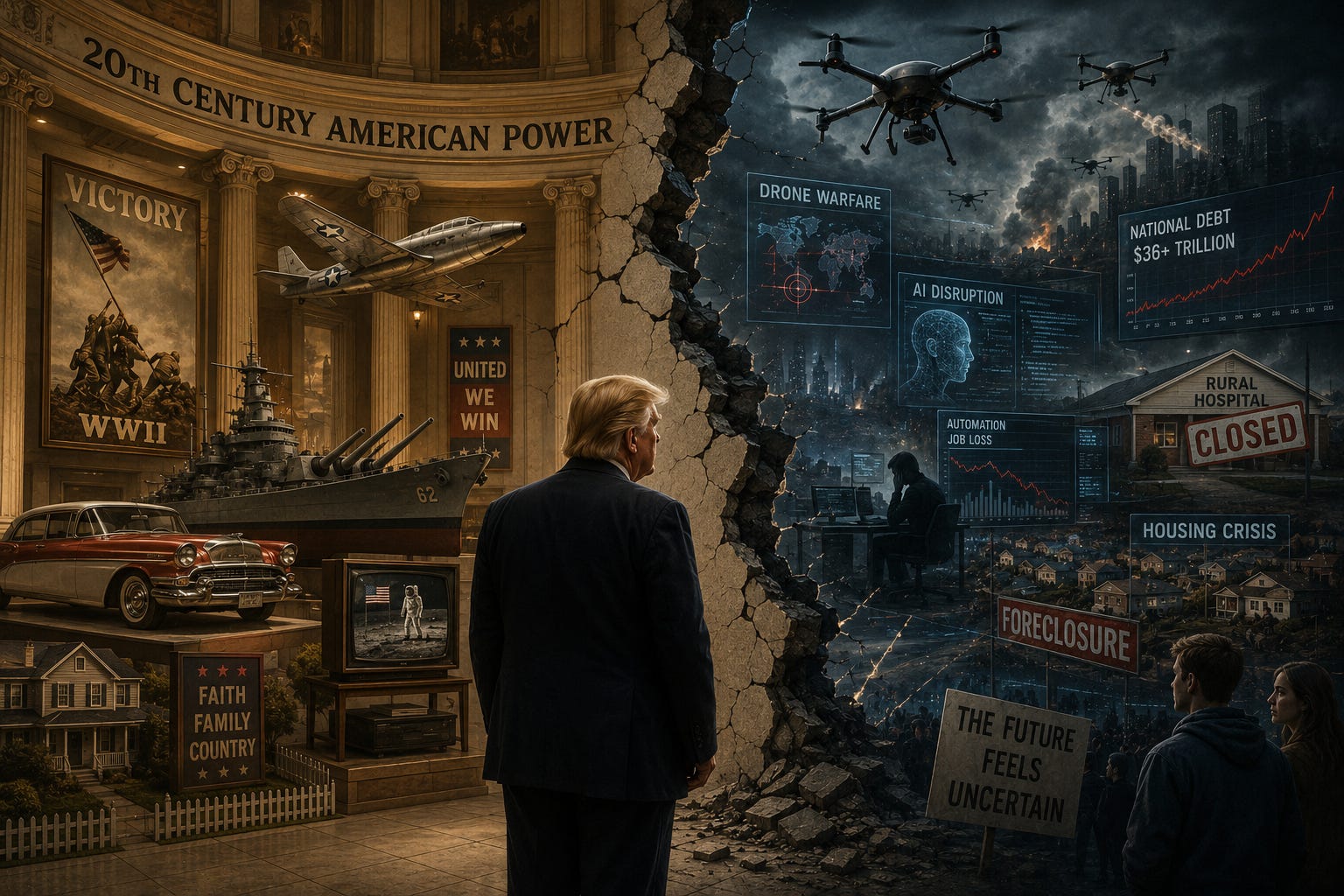
That is the story of this presidency in miniature. Donald Trump is a man frozen in time, running a 21st century country with a 20th century mentality. And the gap between those two things is now showing up everywhere: in the inflation numbers, in the hospital closures, in the housing market, in the lives of young Americans being displaced by AI while Washington argues about who is in charge of regulating it. But nowhere is the cost more visible, or more dangerous, than in the war he started with Iran.
Yesterday’s Battle
Trump has long fantasized about using conventional military might to attack the Iranian regime and force it to abandon its nuclear program. When he took office fifteen months ago, he could have spent that time ramping up drone production to suit the modern way of war. Instead he planned a conventional air campaign — a 2026 version of a World War II bombing campaign — and Iran spent that same time preparing for exactly that.
Iran’s leaders had been studying Ukraine carefully. When Russia invaded with conventional forces — tanks, artillery, massed armor — Ukrainian drone operators dismantled them methodically, using weapons that cost between $20,000 and $50,000 apiece and are powered by motorcycle engines, flown by pilots who never leave the ground. Cheap, precise, maneuverable, and nearly impossible to intercept at scale, drones have become the defining weapon of modern asymmetric warfare. Iran absorbed that lesson. Trump did not.
The result is that the U.S. has been firing million-dollar Tomahawk cruise missiles and Patriot interceptors at Iranian drones that cost fifty thousand dollars. We have burned through more than 1,100 long-range cruise missiles built specifically for a potential war with China. We have stripped missile batteries from South Korea and moved a carrier group from the Pacific. And Iran, the smaller power in this fight, has rebuilt nearly everything we destroyed.
None of this is surprising if you understand where Trump learned about war. He attended the New York Military Academy as a teenager, an institution run by veterans of the Second World War who taught strategy through the lens of Patton and Eisenhower — massed armor, strategic bombing, the projection of industrial-age firepower. That model won a world war. It also ended sixty years ago. There is no evidence Trump has updated it since. He proposed building a class of battleships named after himself. He spent the defense budget on legacy platforms the Pentagon has been trying to retire for a decade. And he launched a war against a country that had spent a year watching Ukraine prove that the era of conventional military dominance was over.
The intelligence community has been trying to say so for weeks. The question is whether anyone with the power to change course is willing to hear it.
Spend Like There’s No Tomorrow
The United States now spends more on interest payments on its national debt than it spends on Medicare. More than it spends on national defense. The annual debt service bill has crossed $970 billion, and it is climbing. I want that the stick: $970 billion…on INTEREST. Wasted payments.
This did not happen overnight, but Trump has accelerated it dramatically. In his first term, he added $7.8 trillion to the national debt during a period of no major war, no deep recession, and no pandemic — until the pandemic arrived and the spending that followed was at least defensible as emergency response. In his second term, he is on pace for a $2 trillion deficit increase this year alone, which will push the national debt above the total value of the American economy. He is proposing to increase the Pentagon’s budget by 43 percent, to $1.5 trillion, while simultaneously cutting taxes for the wealthiest Americans. It’s one thing to increase defense spending, I’m for that, but we have to pay for it.
Trump came of age in an era when you could run those numbers and have them work out. In the postwar decades, the American economy grew at rates approaching 7 percent a year. Lyndon Johnson fought an enormously expensive war in Vietnam, raced to the moon, built the Great Society, and still managed to balance the federal budget in his final year in office, because the economy was growing fast enough to cover the bill. Today’s economy grows at between two and three percent in good years. The math that worked in 1968 does not work in 2026. Trump either does not understand that or does not care.
The Iran war has made all of this worse in ways that will outlast the conflict itself. The Federal Reserve cannot cut interest rates while the war is driving inflation above 3.8 percent, the highest reading since 2023. Financial analysts have changed their forecasts for additional rate cuts, with none in sight this year. That means continued high borrowing costs for mortgages, car loans, and small business financing through the rest of this presidency. The cost of fighting yesterday’s war with yesterday’s weapons is now being paid by families who had nothing to do with the decision to start it.
Healthcare: The Crisis He Refuses to See
On June 15th, Greenwood Leflore Hospital in Mississippi will close. It is a 120-year-old public hospital that serves roughly 300,000 people in one of the poorest, most medically underserved regions in the country. It is closing because of Medicaid funding cuts in Trump’s own budget legislation. There are dozens more hospitals coming behind Greenwood Leflore.
The American healthcare system is the most expensive in the developed world by a significant margin. We spend 17.2 percent of our GDP on healthcare, compared with an average of 11.2 percent for other developed nations. We spend roughly $14,500 per person — twice the per capita cost of our peers. That money does not buy better outcomes. Americans have lower life expectancy, higher rates of chronic disease, and more preventable deaths than citizens of countries that spend far less.
The reasons are well understood: drug prices that are three to four times higher than in comparable countries because Medicare and Medicaid are legally prohibited from negotiating them, hospital costs that run 50 to 100 percent above international norms, and a system that has evolved around expensive high-tech intervention rather than the preventive primary care that produces better long-term health at lower cost.
Trump came of age when employer-sponsored health insurance was genuinely universal among working Americans, when drug prices were low, and when the out-of-pocket cost of a hospital stay was not a financial catastrophe. American families with employer-based insurance today pay an average of nearly $7,000 per year in premiums. Employers pay another $20,000 per family. That cost is a direct drag on wages, business investment, and competitiveness with countries where the government absorbs it. His response to all of this has been to act as though nothing is wrong, to propose cutting Medicaid for millions of Americans, and to advance a budget that will accelerate the collapse of the rural hospital infrastructure that is the only healthcare option for tens of millions of people. Greenwood Leflore will not be the last.
The Housing Wall
The biggest driver of the affordability crisis most Americans feel every day is housing, and it is a crisis that was built over decades by the absence of the kind of federal policy that once made homeownership broadly attainable.
Rents are up roughly a third nationally since the pandemic, rising faster than inflation and at 1.5 times the growth in personal incomes. The monthly cost of owning a home with a mortgage, including taxes, insurance, and other carrying costs, has exceeded $2,000 for the first time in American history. In high-cost markets like California the average payment exceeds $3,000. Homeowners are simultaneously absorbing spikes in utilities and maintenance that compound the pressure.
Trump grew up surrounded by wealth in an era when federal housing policy was the most aggressive in American history. The postwar suburban boom was not a market phenomenon. It was a deliberate government project, financed by federal loan guarantees, built by federally subsidized developers, and populated by veterans whose mortgages were backed by the government at artificially low rates. The country built itself out of the housing shortage of the 1940s through an enormous act of public will. Those programs have since expired or been dismantled, and the private market has not replaced what they did.
The Trump administration’s response to the housing crisis has been to do almost nothing and in some cases to propose making it worse. The 2027 budget would eliminate rental subsidies for 3.7 million people, including nearly 2 million children. Plans for 50-year mortgages were floated and then abandoned. Proposals to let buyers use retirement accounts for down payments were walked back. The incentives that once housed a generation are gone. Trump either does not know they are gone or does not understand why they mattered.
The AI Displacement Nobody in Washington Is Talking About
Every previous wave of automation in American history displaced workers in one sector and created new ones in another. The steam engine put horse-drawn freight carriers out of business and created railroad jobs. Computers eliminated typing pools and created IT departments. The pattern held well enough, across enough decades, that it became an assumption: technology takes some jobs and creates others, and on balance progress wins.
Artificial intelligence is breaking that assumption, and the evidence is already in the employment numbers. Workers aged 22 to 25 have experienced a 16 percent decline in employment attributable to AI displacement — an entire generation beginning their working lives in an economy that is restructuring faster than policy can respond. Last month, an estimated 25 percent of layoffs in white-collar professions including law, media, and financial services were attributed to AI. The technology is not automating physical labor this time. It is automating the cognitive tasks that a college degree was supposed to protect.
The honest answer about what comes next is that nobody knows. AI’s defenders argue that new categories of work will emerge, as they always have. They cannot yet specify what those categories are or whether they will be economically meaningful for the people they are supposed to absorb. What is clear is that the window for getting ahead of this is closing, and the federal government has not begun to engage with it seriously. Instead, culture war absorbs their focus.
The Trump administration’s response has been institutional paralysis. The Commerce Department and the intelligence agencies are still negotiating jurisdiction over AI oversight. There are no mandatory security requirements for AI developers, even as bad actors are using the technology to build malware that can exploit American infrastructure faster than human defenders can respond. Trump came of age when every new technology was an unambiguous good — transistors, microwave ovens, commercial aviation, the interstate highway system. The political reflex from that era is to let innovation run and trust the market to sort out the consequences. That reflex produced enormous prosperity for fifty years. The question is whether it will work for a technology that can replace the people who are supposed to benefit from it.
Add it all up and you have a president who is not simply making bad decisions. He is making categorically wrong-era decisions — applying frameworks that worked in a world that no longer exists to problems that require entirely different thinking.
In Iran, he fought a 21st century asymmetric war with a 20th century air campaign and is now calling the intelligence community traitors for reporting the results. On the federal budget, he is spending at Lyndon Johnson scale in an economy that grows at a third of Johnson’s rate. On healthcare, he is cutting the programs that keep rural hospitals open in communities that have no other option, apparently unaware that the private market he expects to replace them has been declining for thirty years. On housing, he is presiding over the most severe affordability crisis since the postwar shortage without appearing to understand that the programs that solved that shortage were government programs. And on artificial intelligence, he is watching the most consequential economic disruption since industrialization unfold without a policy framework for responding to it.
The Vietnam comparison that haunts this presidency is not simply about a quagmire in a distant country. Vietnam was a catastrophe because American leaders spent years telling the public one thing while the intelligence community was telling them another, until the gap became impossible to paper over and the cost had already been paid in lives and money that could never be recovered. The classified assessment published this week is that moment arriving again.
Every one of the failures discussed above has the same root: a man who learned how the world worked at a specific moment in American history and stopped updating the model. Countries that are run that way do not collapse all at once. They fall behind slowly, and then they look up one day and discover that the gap has become a canyon. We are not there yet. But the intelligence community is not the only one keeping score.
Additional video for paid subscribers. Id encourage you to watch this one…I discuss how we need to just create new solutions:
