
Hey everybody. Welcome back. Thanks for being here.
Our top story today. The Wall Street Journal just busted yet another White House official using his job to line his pockets. This time by taking millions from the industry he was supposed to be regulating. His company was on the payroll of the biggest crypto company in the world the entire time he was writing Trump’s crypto law. When the law passed, they made him CEO. And this White House couldn’t care less.
We’ll also get into two separate stories about Trump’s own people turning on each other, Democrats taking their biggest lead on the economy in nearly twenty years, and James Talarico’s impressive performance during a town hall on CNN last night.
So do me a favor. Like this video, share it with someone who needs to see it, and subscribe so you never miss an episode.
Let’s get to it.
1. White House Crypto Grift Exposed
Bo Hines is a twenty-nine year old who has run for Congress twice in North Carolina and lost both times. He’s never worked in the government. And he’s never held a job in the crypto space. But in January 2025, Trump put him in charge of the White House crypto council.
His first priority was the GENIUS Act, a bill working its way through Congress that would become the first real crypto law in American history. In an industry that had been operating with essentially no rules, this bill was a big deal. Billions of dollars depended on the details, and every company in the business wanted a hand in writing them.
When Trump signed it in July, he looked out at the crowd in the East Room and said, “Where’s Bo Hines?” Hines stood up and took a bow.
But like everything with this administration, there’s a corruption story behind it.
The Wall Street Journal has revealed that Hines owned a third of a consulting company called Nxum. His dad owned another third. When Hines went into the White House, he kept his share of the company.
Weeks after he started at the White House, his company landed a deal with Tether, the biggest crypto company in the world and the one with the most riding on this law. 415,000 dollars a month, paid to a company Bo Hines owned a third of, while he was writing the bill that would regulate them. The total is over six million dollars now.
According to the Journal, when a group of House Republicans were holding the bill up, Hines’s dad wrote that Tether’s CEO was worried and “they want us to obliterate these members that are fighting crypto.” A few hours later, Bo Hines, a White House official, sent his business partners the attack lines. The holdouts were “bought and paid for by democratic shills.” His dad wrote back, “let’s start knocking heads.” Three weeks after that, Trump brought the holdouts into the Oval Office and they caved. One of Hines’s partners texted a friend: “Bo got it done.”
The final bill even gave Tether extra time to comply with the new rules, which its American competitors didn’t need but Tether did.
Hines left the White House in August 2025, and a month later Tether named him CEO of its U.S. division. He bought a bigger house, and his dad bought a private jet.
Tether says Hines recused himself, didn’t know about the deal, and didn’t have to sell a passive investment. But federal law says you can’t work on something you’ve got a financial stake in. People in Hines’s position have always just sold their stake. He didn’t.
And by the way, Senate Democrats reported last month that Iran uses Tether’s coin to get around sanctions and fund Hezbollah. That’s the company that was paying the White House crypto adviser’s firm while he wrote its rules.
But nobody in this White House is going to do anything about it, because this is how the place runs. Trump set the example, and everyone underneath him is just keeping up.
2. MAGA Blood Feud Erupts
This one is hard to follow, so stay with me. Alina Habba was Trump’s personal lawyer and briefly the US attorney in New Jersey. She’s married to a Turkish businessman with interests in Venezuela. Then there’s Ric Grenell. He was Trump’s controversial ambassador to Germany in the first term, and until recently ran the Kennedy Center.
Here’s what went down. In early 2025, Grenell was a special envoy pushing to normalize relations with Maduro before the commando raid plucked him from power. Habba’s husband had Venezuelan contracts that the administration’s pressure campaign was threatening, so he wanted normalization too.
Through this common goal, the two men became friends. Then Grenell persuaded Habba’s husband to donate almost six million bucks to the failing Kennedy Center. The husband assumed that check arrived, because the Kennedy Center treated him like a VIP.
But then the friendship broke. Grenell lost his fight with Marco Rubio when the US seized Maduro. The leader that replaced Maduro revoked the contracts Habba’s husband was trying to keep, but changed her mind when she learned he had a direct line to Trump. The New York Times smelled corruption, and started investigating the contracts. Through that process, Habba somehow learned that the $6 million check her husband had written never arrived at the Kennedy Center. No one knows where it went.
Last Friday, she went to Trump, accusing Grenell of stealing or hiding the money. The President ordered the White House counsel to look into it. As we know, he takes the Kennedy Center personally.
There’s a lot we don’t know about this so-called “MAGA Blood Feud,” and it could turn out to be one big misunderstanding. But it still reveals a lot about the administration.
The federal government is run by wealthy socialites with fragile egos who will always put their business and personal interests before the American people. Those tendencies come right from the top. And if Trump officials can’t even trust each other, how are the American people supposed to trust them?
3. Trump’s State Department Melts Down
In one corner, Christopher Landau, the Deputy Secretary of State. In the other, Paolo Zampolli, a special envoy and friend of Trump. He’s the former modeling agent who introduced Trump to Melania.
The fight goes back to last November, when Landau wrote Zampolli that he had “no authority to engage in ANY issues of foreign policy outside of cultural diplomacy,” and warned that going further could get him fired. But Zampolli kept going. He met the leader of the Bosnian Serb region we talked about last week. Landau had to email the foreign minister to say Zampolli couldn’t speak for the administration. In response, Zampolli asked the inspector general to investigate Landau and accused him of leaking embarrassing stories to the press. At one point, sixteen administration officials were copied on the thread.
Discipline is breaking down, and everyone is looking over their shoulder. Politico recently reported that Trump has even considered replacing his longtime chief of staff Susie Wiles, amid reports of her daughter lobbying for the same pro-Russia government Zampolli was meeting with.
The beef has always been there. But Trump wanted to avoid a repeat of his first term, so he did everything he could to keep a lid on the infighting. That was easier to do when things were going well. But with a disastrous midterm on the horizon, people are getting antsy. And the cracks are turning into fissures.
A lot of the tension comes from the threat of investigation. If Democrats take the House in November, subpoenas will fly, and the true extent of the corruption and chaos in Washington will become clear. If they’re this rattled now, imagine what happens when these people are sitting under oath.
4. Voters Trust Democrats on Economy
That is according to a recent Gallup poll, which has asked the same question since the 1980s: Which party will do a better job keeping the country prosperous? The answer has flipped. Drastically.
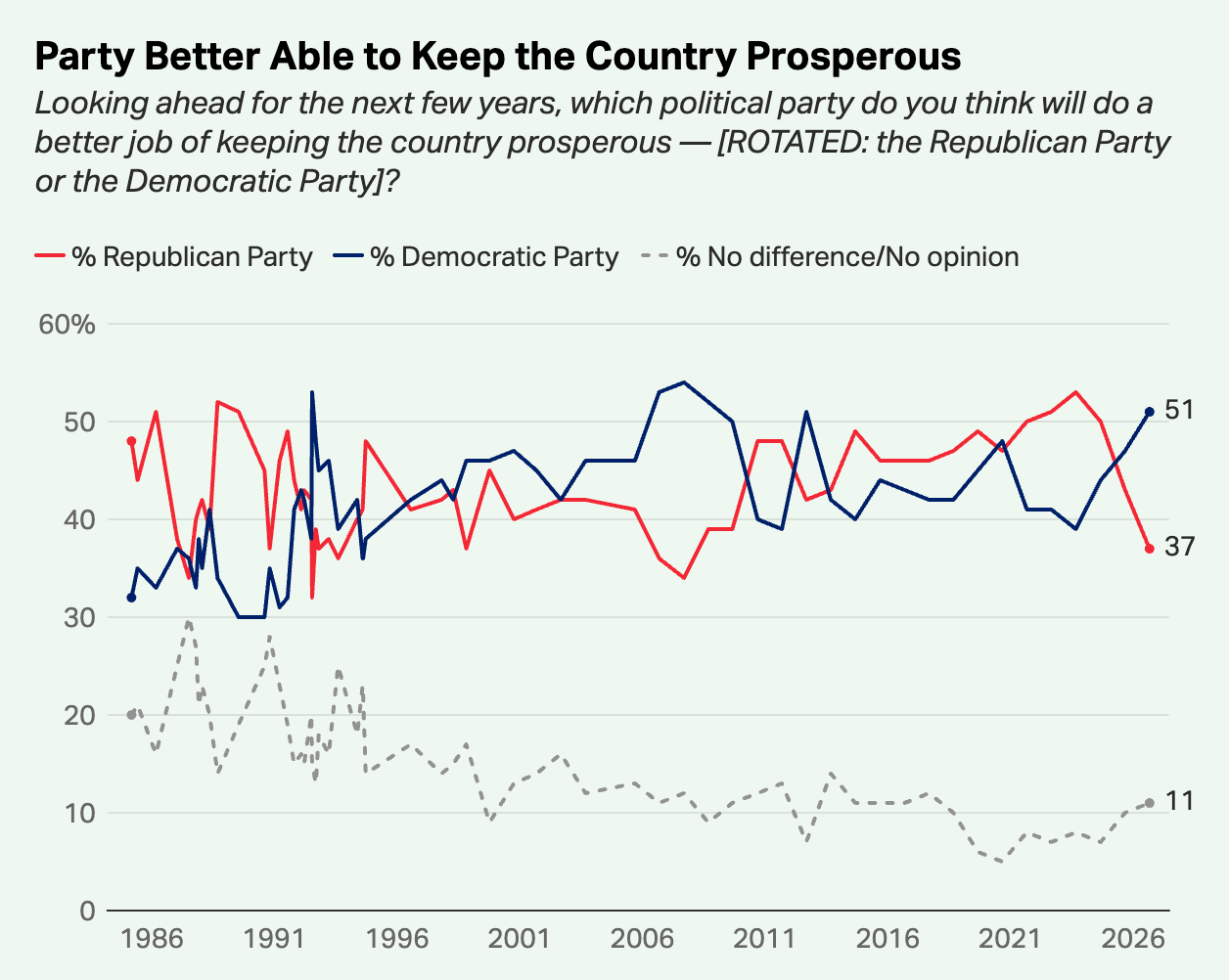
51 percent now pick the Democrats. That’s up from 39 percent in September 2023. The Republicans have gone the other way, falling from 53 percent to 37. That’s a 14-point Democratic lead. And it’s the widest since 2007, right after voters handed Republicans a midterm wipeout.
If that’s a preview of November, it’s no wonder that Republicans are nervous.
And the numbers make sense. For most of the last decade, voters saw the Republicans as the party of fiscal responsibility and business. Not anymore. Since Trump took office, the national debt surged beyond 40 trillion dollars. Borrowing costs have hit a 19-year high. And prices are up 3.7 percent from a year ago.
So what’s Trump’s plan? The oldest trick in the book. Blame the Democrats. Here he is at a rally in Arizona:
The Gallup poll tells us Americans aren’t buying it anymore. Trump can try to blame the Democrats all he wants. But voters are living with his policies right now. And they trust Democrats to get the economy back on track. Not him.
5. Talarico Shows Up and Paxton Doesn’t
Last night in Fort Worth, CNN hosted a Town Hall for the Texas Senate race. The room was packed with about 20 Democrats, 20 independents, and 20 Republicans. But they only heard from one candidate.
Paxton never responded to the invitation. That’s the fifth debate or forum he’s skipped. I guess he’s been too busy partying with his girlfriend and fugitives in Dubai.
But Talarico showed up. And he came prepared. He addressed his recent campaign absence. He took on hot-button issues like abortion, energy, and immigration. And he made the case for reforms that most voters support: banning super PACs, imposing term limits, and ending congressional stock trading.
But the moment that landed hardest came when he spoke to every voter in the room. And really, every voter in America. Have a listen:
The Republican Party has run on anger, fear, and division. In its policies and in its campaigns. The message to Americans is simple: if you’re not with us, you’re against us.
But Talarico is offering something different. He says we’re all on the same team, because we all want to live safe, comfortable lives, and with new leadership we can make that happen.
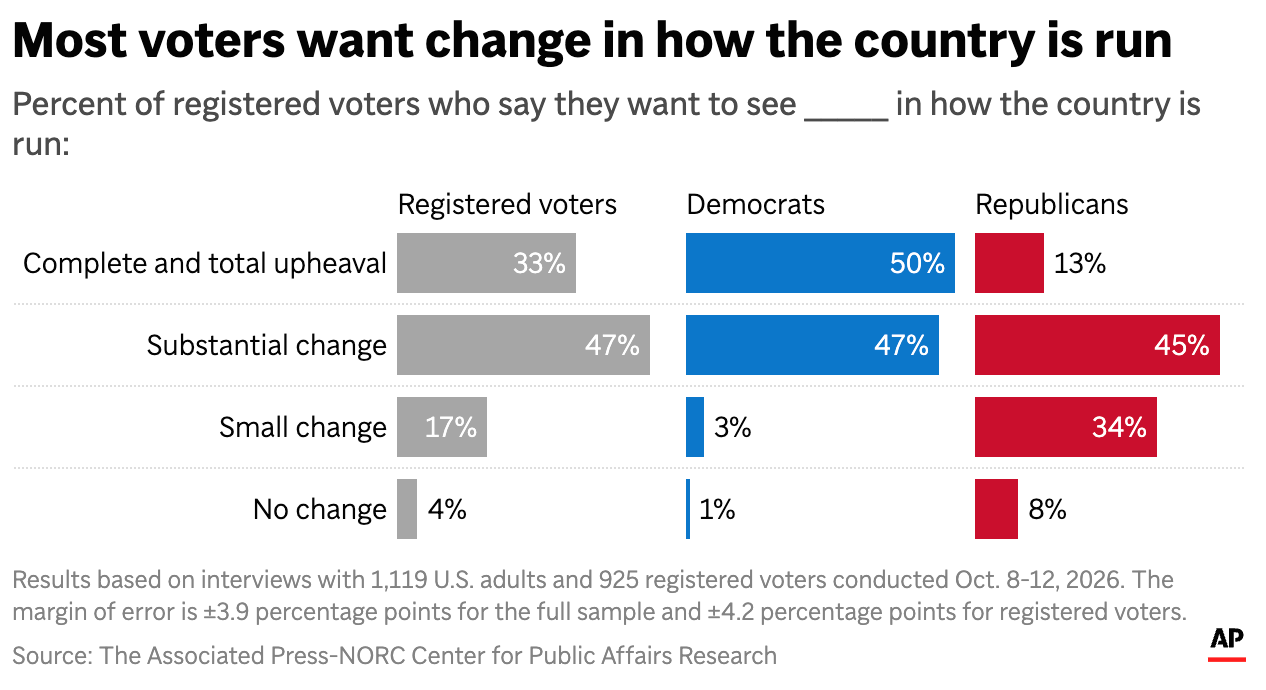
Voters are ready for it, too. A recent AP poll found that 80 percent of registered voters want at least a “substantial change” in how the country is run. That includes 58 percent of Republican voters, whose party controls the House, the Senate, and the White House.
Talarico showed what that leadership looks like. He stood in front of Republicans, Democrats, and Independents and answered their questions. Ken Paxton didn’t even show up. If he won’t face sixty voters in Fort Worth, how is he going to represent thirty million Texans in Washington?
Some other stories that caught my eye:
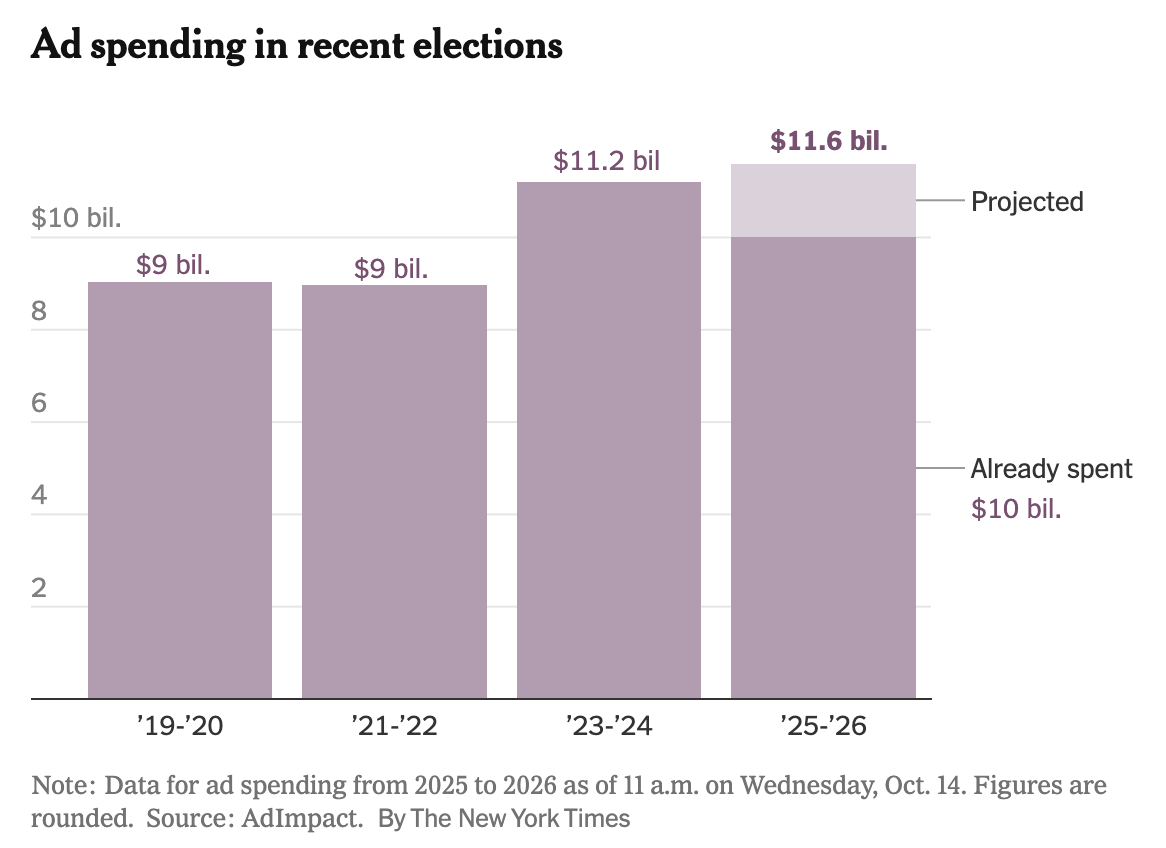
The 2026 midterms just became a $10 billion election, breaking previous midterm records. Political ad spending crossed that mark on Wednesday, according to the media tracking firm AdImpact. And that $10 billion is an undercount because it leaves out hundreds of millions in spending that ad data doesn’t capture.
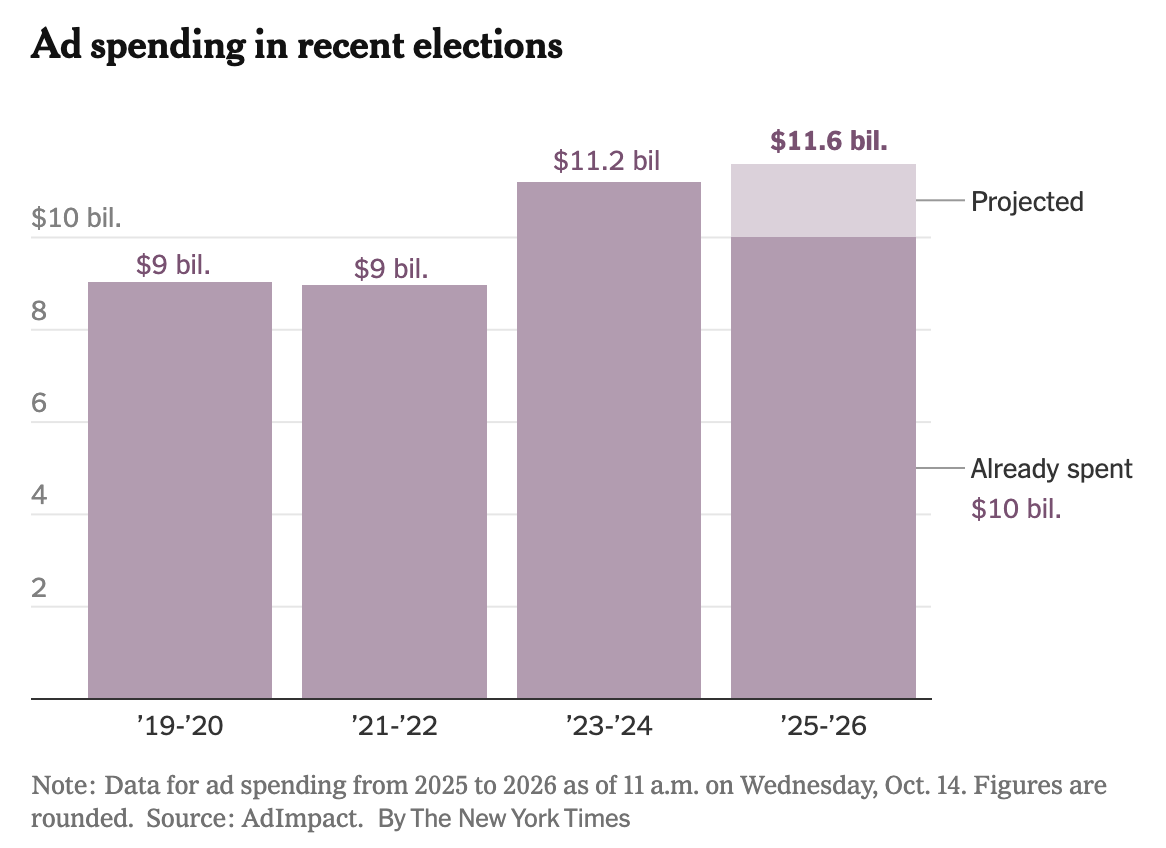
AdImpact projected in June that the final bill would reach $11.6 billion, topping the $11.2 billion spent in 2024 and the $8.9 billion spent in the 2022 midterms. That puts this cycle on pace to cost more than the 2024 presidential race. Republicans currently hold the edge. They are outspending Democrats by about 11 percent, leading by roughly $133 million with less than three weeks to go. The Texas Senate race between Ken Paxton and James Talarico is the most expensive contest in the country at about half a billion dollars, driven by two GOP primary rounds, a Democratic primary, and the general election. The biggest single spender is the Senate Leadership Fund, the top Republican Senate super PAC. It is on track to spend about $310 million alone and around $643 million with its affiliated groups.
Trump’s deal to lift sanctions on Russian diesel won’t do much to bring down prices at the pump. Last week, Trump announced an agreement for Russia to ramp up diesel exports. But the numbers are small. Trump and Russian Deputy Prime Minister Alexander Novak say Russia will export about 75,000 barrels a day in October. Novak claims Russian exports will return to near pre-war levels by the end of the year. Analysts doubt it. Russia was exporting about 693,000 barrels a day this time last year. Ukrainian strikes have since knocked roughly 40 to 50 percent of Russia’s refining capacity offline, and repairs can take months or years. Meanwhile, the war with Iran has cut Middle Eastern diesel exports by about 809,000 barrels a day. That shortfall is the main reason diesel prices are up around 77 percent this year. Oil now sits just above $100 a barrel.