


Hey everybody. Happy Wednesday. Thanks for being here.
Before we get started, a quick note. I’m going to be out for the next few days, and my friend, astronaut Terry Virts, will be filling in. I’m traveling overseas, and for security reasons I can’t say where just yet. I might be able to send back some videos while I’m there. Either way, I’m excited to tell you all about it when I’m back.
Our top story today: two days before the 25th anniversary of September 11th, Trump stood in front of a steel beam from the South Tower and told a story about two firefighters picking him up and running him to safety at Ground Zero. There’s no evidence he was anywhere near Ground Zero that day. There’s no record he was there at all until two days later, when he showed up for TV interviews. Trump just can’t help himself. Once again.
We’ll also get into the GOP convention that Republicans are skipping, the trade war with Canada that just got a lot worse, a court ruling that the IRS broke the law with your tax returns, and the secret DHS unit that’s reading Americans’ financial records and having local cops pull them over.
So do me a favor. Like this video, share it with someone who needs to see it, and subscribe so you never miss an episode.
Let’s get to it.
1. Trump Makes 9/11 About Himself
Look, 9/11 is personal to me. I was 23 that day, and it’s one of the main reasons I joined the Air Force. I know I’m not alone in that. That morning changed the course of millions of American lives. For normal Americans, that day is sacred. But Trump isn’t normal. He’s always treated that day as an opportunity.
Yesterday, Trump spoke at an event on the Ellipse honoring first responders, standing next to a 21-foot piece of steel recovered from the South Tower. It was a solemn setting. Take a look at how he handled that moment:
The earliest photo or video of Trump anywhere near Ground Zero is from September 13th, two days later, when he was doing television interviews. A retired FDNY deputy chief who spent months on the pile has said he never saw Trump there once. In 2016, Trump told a version of this same story, except back then the firefighters just grabbed him and he ran on his own. Now, apparently, they carried him. The story gets bigger and better every time he tells it.
On the actual day of the attacks, with the towers still burning, Trump called into a news station to talk about one of his buildings. Listen to this:
His building was now the tallest in downtown Manhattan. That’s what he wanted people to know on September 11th, 2001. You really can’t make this stuff up.
At that same event yesterday, Trump gave the Presidential Medal of Freedom to a man named Welles Crowther. You might know him as the Man in the Red Bandana. He was 24. He saved at least 18 people in the South Tower, going back up the stairs again and again until the building came down on top of him. His mother and sister were there to accept the medal. Here’s what Trump said in front of them.
I didn’t think it was possible for this man to go any lower.
But for Trump, this anniversary is just a stage. He’s skipping the ceremony at Ground Zero on Friday. The New York Times reported that part of the reason is that the memorial doesn’t let politicians give speeches, and Trump wanted to speak. He denied it, and attacked the reporter. But he’s going to the Pentagon instead, where he can.
It’s disgusting. That day is sacred to this country, and he can’t stop making it about himself. But honestly, none of it should surprise us. He’s the same man he was on September 11th, 2001. Everything is about him. Every story is a lie that makes him the hero. And what he actually cares about, what he’s always cared about, is having the biggest, tallest building. And somehow, he became the President of the United States.
2. Republicans Skip Trump's Convention
The first Republican midterm convention in history kicks off this afternoon in Dallas. Two nights, two Trump speeches. Trumpapalooza promises red meat for the MAGA base and a whole lot of sound and fury. But it’s an open question if anyone will tune in at all: the convention is scheduled to run alongside the NFL’s season opener, and I know which one I’d prefer to watch.
But that’s not even close to the biggest problem. A convention is supposed to showcase your candidates. But when CBS News contacted 60 Republicans running in battleground races, only four said they’re coming. Susan Collins isn’t. The Republican Senate candidates in Iowa, Alaska, and New Hampshire won’t be speaking. Neither will the Senate Majority Leader. Here’s Trump’s response to that:
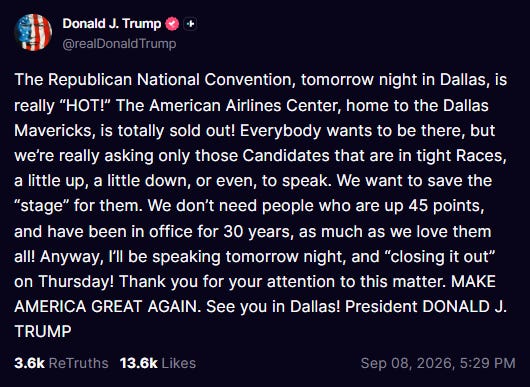
He says they’re saving the stage for candidates in tight races. But those are exactly the people that don’t want to come. They aren’t the only ones. The GOP is even running a public lottery for free tickets, desperate to fill seats.
Other tickets are much pricier. Donors can pay 250,000 dollars to sit at a roundtable with Trump today, and another 88,600 for a photo. The contrast here tells you a lot about the modern GOP. If you’re a Republican, Trump can get you power for the right price. But he can’t get you votes. At this point, he’s political kryptonite, even if Republicans are terrified to say it out loud. Listen to the house whip on Fox:
You can hear the fear in his voice. It’s like he’s reading a hostage statement. But in reality, he just knows Trump is watching.
I’ve been to a few conventions in my time. They’re supposed to show unity. This one shows a party that built everything around one man, and is about to pay the price for it. Those coattails the Whip was talking about may have been useful in 2024. But in 2026, all they’re gonna do is sweep the GOP out of Washington.
3. Trump's Trade War Backfires
We’ve been covering this for a while now. Last month, trade talks with Canada collapsed, and Trump put 50 percent tariffs on about 20 billion dollars of Canadian goods. Canada hit back. At midnight Tuesday, their retaliatory tariffs took effect on roughly 700 American products, everything from steel and dairy to appliances and farm equipment.
Trump’s response came within hours. He signed orders banning most imports of Canadian alcohol, dairy, and motorcycles outright. He also expanded his 50 percent tariffs to dozens more products, and ordered the government to stop buying Canadian goods under federal contracts. On Monday he even threatened to ban Bombardier, a Canadian jet maker, from selling planes in the United States. As usual, he would only be shooting America in the foot: Bombardier employs people in more than 20 states and is opening a new plant in Indiana. A Republican senator from Kansas had to call the White House to remind them of that.
Canada’s prime minister responded with a video message to his country. His point was simple: forty years of economic integration with the United States is over, and Canada is going to find other partners.
We’ve talked about Republicans’ lukewarm reaction to this trade war, but it’s worth going back and listening to what Susan Collins had to say when this whole thing started.
I couldn’t have said it better myself. She later told Politico that the White House had underestimated the impact of the duties. That’s a polite way of saying they didn’t know what they were doing. No wonder she’s skipping Trumpapalooza.
The New York Times reports that this trade war is now shaping the fight for Congress in Maine, Michigan, Ohio, and Alaska. All states with big Senate races and deep ties to Canada.
So there you have it. The President is banning Canadian cheese two months before an election, and the senators who have to answer for it are skipping his convention. He always says trade wars are easy to win. But this one is a loss for everyone, including Republicans.
4. Courts Beat Trump Again
Yesterday, a federal appeals court in Washington ruled unanimously that the IRS broke the law when it handed taxpayer information to ICE.
First, some context. After the Watergate crisis, Congress passed a law stating that tax information is confidential. The IRS can’t share it with other agencies unless an order meets strict conditions. That rule is why Americans trust the IRS with their income, their address, and their Social Security number.
But Trump could not care less. He tossed that trust aside the moment it got in the way of his political agenda.
So what happened? The Wall Street Journal reports that the Trump administration hoped to weaponize the government’s tax data to support immigration enforcement. The IRS initially rejected requests until officials abused an exception in the law, which permits tax authorities to provide information to federal agencies conducting criminal inquiries.
So ICE sent the IRS one request for the home addresses of 1.28 million people. The same ICE employee was listed as the contact for every single name. The IRS handed over about 47,000 records before a judge stopped it.
The appeals court left no room for argument: the policy “indisputably” violates the law. But the Trump administration appealed anyhow, complaining that the injunction was too burdensome. As if we’re supposed to feel sorry for them for breaking the law.
The court didn’t buy it. Keep doing this, they warned, and officials will face civil and criminal penalties.
That confidentiality law has held for fifty years because everyone trusted the deal: you provide the IRS your tax returns; and the IRS preserves that information. Trump broke that trust in support of a deeply unpopular deportation campaign. And the courts once again stood up to his challenge.
5. Secret DHS Unit Spies on Americans
Reports from 404 Media revealed that Border Patrol is running a secretive ‘predictive policing’ intelligence unit under the DHS that associates finances with crime. The unit analyzes the financial activity of Americans, which helps them decide who might be worth searching. Then, they tip off local police to pull them over.
In one case, a man was driving across Montana when a predictive policing unit flagged him. On bodycam, local officers explained they had pulled him over because his license plate was slightly obstructed.
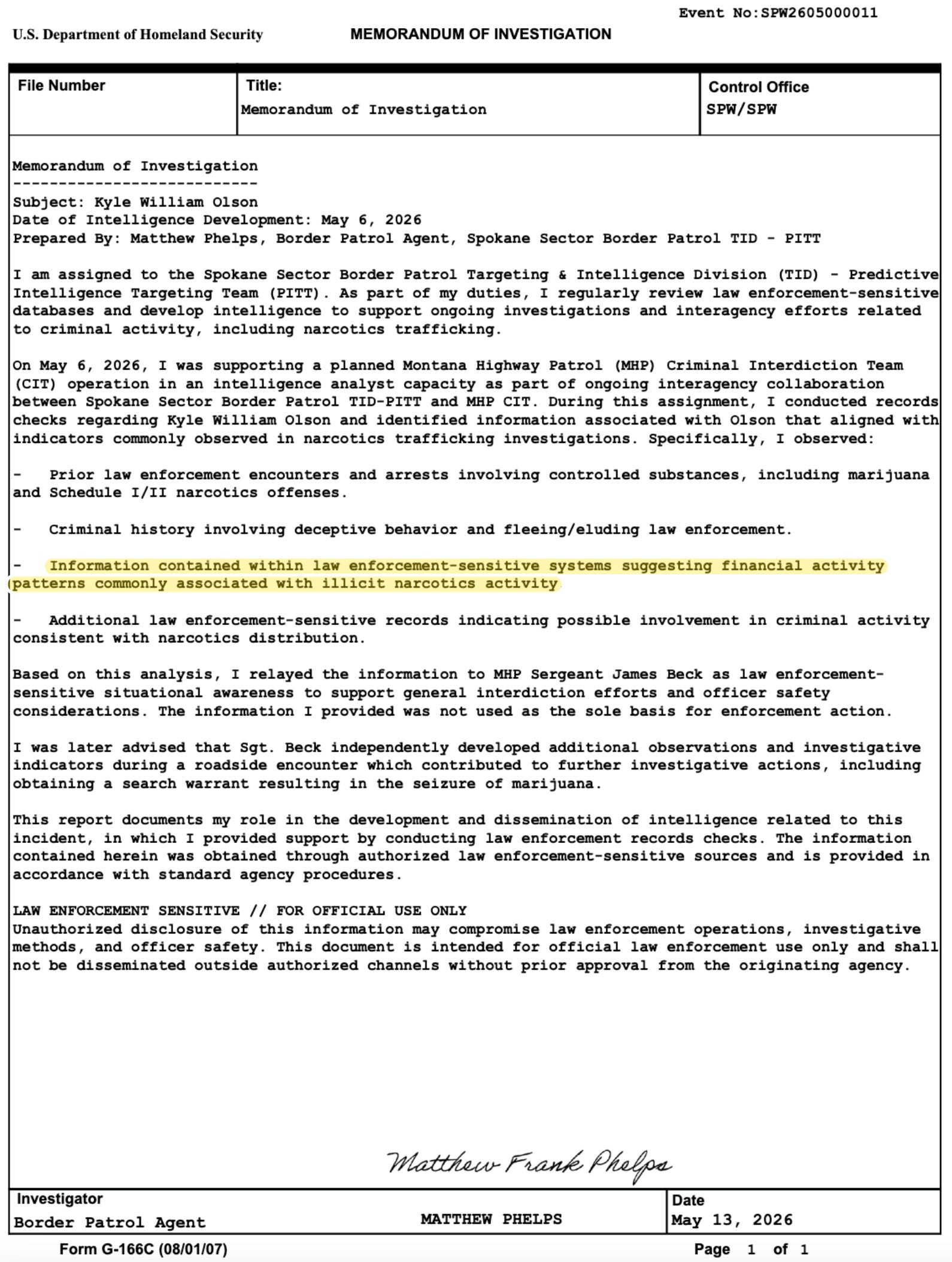
But an internal memo revealed that he had been pulled over because these predictive systems flagged “financial activity patterns commonly associated with illicit narcotics activity.”
Now, that driver was later charged with a DUI. But the government didn’t know that when they flagged him. They didn’t know anything about him. They just flagged his bank records. And Border Patrol won’t say what financial data they’re looking at, where they got it, or whether they had a warrant. But this obscure procedure fits a broader pattern.
Last year, the Associated Press reported that the same program was tracking Americans with license plate scanners on highways across the country. An algorithm flags drivers with suspicious travel patterns for federal agents, who then inform local police.
The agents themselves have a name for these: “Whisper stops.” The officer cites a minor infraction as a pretext. But the real reason is decided by prior surveillance, which preemptively decides who is a risk to public safety.
Unreasonable searches and seizures? The Fourth Amendment exists for this exact purpose. But the DHS and Border Patrol have decided it’s optional.
Some other stories that caught my eye:
An armed man who pushed through a crowd toward Amy Acton, the Democratic nominee for Ohio governor, pleaded not guilty to misdemeanor charges including assault and inducing panic. The Washington Post reports that Patrick M. Havas was carrying two pistols and a taser when he forced his way toward Acton during her speech at the Canfield Fair on Sunday, before troopers on her security detail intercepted him. Prosecutors say his motive remains unclear. Even though video from Havas’s own phone shows him calling Acton’s name as he moved through the crowd, a search of the device turned up no threats or fixation on the candidate. The incident lands in the middle of a heated race between Acton and Republican nominee Vivek Ramaswamy, both of whom received state trooper protection after winning their primaries. It also reflects a broader climate of political tension and violence. Federal campaigns have spent more than $100 million on security over the past decade, which is set to push further into the extremes. According to the Public Service Alliance, security spending in the 2023-24 cycle ran “over five times what it was in the 2015-16 cycle” amidst the growing threat of hyper-polarization to safety.
After conflicting rulings, Missouri’s congressional map descended into legal chaos Tuesday, the very day the state was required to finalize its November ballots. Supreme Court Justice Brett Kavanaugh declined to overturn a lower court ruling that blocked a new Republican-drawn map, which would have likely flipped one of the state’s two Democrat-held seats. Missouri’s Secretary of State Denny Hoskins had warned against that order:“hundreds of thousands of voters will be forcibly switched to new districts and forced to vote on General Election candidates they had no role in choosing.” State Republicans vowed to defy the order on those grounds, later securing the legal backing of a federal district judge who ordered the use of the GOP-friendly map Kavanaugh had just blocked. As of now, it is unclear which map will be used ahead of the Missouri midterm elections in November. The fight traces back to summer 2025, when President Trump urged Texas Republicans to squeeze up to five more seats out of their map, triggering a nationwide redistricting war that now spans nearly 20 states. The Supreme Court had previously blessed gerrymanders in Texas, California, and Louisiana this cycle.


