
Hey everybody. Welcome back. Thanks for being here.
Our top story today. Trump is on the road for what the White House is calling a 32 day campaign blitz. He’s in Texas and Oklahoma today. JD Vance is in Florida. These are not swing states. These are some of the reddest states in the country, but he’s spending the final month there because that’s where his party is in trouble. And this morning, a new AP poll explains why. Two thirds of the country blames Trump’s policies for higher prices. His approval on the economy just hit a new low. So this isn’t a campaign anymore. It’s a rescue mission. And the guy who is trying to save it all is the one who caused the damage in the first place.
We’ll also get into Trump’s plan to let the AI industry police itself, the government checks that come with a fan letter from the president, Elon Musk getting a new job at the Pentagon, and the anti-corruption panel the United States decided it doesn’t need anymore.
So do me a favor. Like this video, share it with someone who needs to see it, and subscribe so you never miss an episode.
Let’s get to it.
1. Trump Stuck Defending Red States
Last Friday we told you Trump was adding rallies in Oklahoma and Alabama. Now it’s a full blitz. Texas and Oklahoma today. Iowa earlier this week. A president five weeks out from a midterm is supposed to be in Pennsylvania and Arizona. Instead he’s trying to hold places he won by double digits.
A new AP poll out this morning puts Trump’s approval at 30 percent. On the economy, 26 percent. That’s a new low. On the cost of living, 17. Sixty-five percent of Americans say his policies are the reason prices are higher. More than half of Republicans say the cost of living is worse than they expected under Trump.
When the AP spoke with these Republicans, they said some version of the same thing: I thought this would be better. These are his voters. They’re not turning on Trump yet. But they’re not excited either, and in a midterm, that’s all that matters.
Trump’s answer is the same speech he’s been giving for ten years. Everything is great, and America is “red hot.” But the problems that do exist? Well, you can blame Sleepy Joe and the democrats for those. After almost two years with a trifecta, that line doesn’t quite hit anymore.
Even Trump seems to know it. He told reporters this week the problem is that Republicans aren’t getting the word out. Mr. President, the word is out. Americans hear it every time they pay for something. And that’s exactly the problem.
2. Trump Gives Up On Regulating AI
Concerns about AI have been mounting over the past few months. Tech CEOs have been sounding the alarm about rogue AI agents and the inability of regulators to keep up. Understandably, Americans are looking to the government for a plan. Trump offered his in the Oval Office yesterday. Have a listen:
That’s it. They’re gonna police themselves.
That stroke of genius came after Trump met with AI executives in the White House. Musk, Zuckerberg, and the heads of all the major AI labs were in attendance. They formalized the new policy by signing a one-page document, which later turned out to have egregious typos.
Trump called the document “morally binding.” In other words, not legally binding. No enforcement, no penalties.
In some ways, this isn’t a big change. The Biden administration took AI regulation a lot more seriously, but in the end most of the deals they struck with tech companies were also non-binding. Trump tore up those deals on day one with the rest of Biden’s policies. Three years later, he landed on the same approach anyway.
Still, it’s apples to oranges. We’re not in 2023 anymore. When Biden struck those deals, it was still very early for AI. Today, those systems can do a lot more, and the danger is much greater. Even some AI executives are spooked. That’s why they went to the UN and asked for global safety standards. These are the people who profit from no regulation, and even they’re asking for rules.
63 percent of Americans think AI is a serious risk to humanity. Nearly half want development paused. Trump’s answer is to let for-profit tech companies police themselves. I’m sure that will go well.
3. Trump Tries To Buy Midterms With $500 Checks
Yesterday, the administration started mailing $500 checks to nearly a million Americans who bought insurance on HealthCare.gov. That’s about half a billion dollars going out five weeks before the election. Each envelope has a letter from Trump that slams the Biden administration for overcharging to run the website and frames the money as compensation. The rest of the letter just brags about Trump’s healthcare record.
Let’s break it down. First, the overcharging. An MIT economist who helped design the original law called it a misleading claim to score political points. The money comes from fees insurers pay to use the federal marketplace. No American was mailed a bill they shouldn’t have paid.
Second, the people getting compensated. The letters only went out to people who buy coverage with no subsidies. That’s about 5% of the people who use the exchange. It’s nowhere close to the number that had their premiums go up when the GOP failed to renew some subsidies at the end of last year. Those are the families that are actually suffering from higher healthcare costs, but they don’t get the checks.
Third, the timing. Obviously this has nothing to do with health policy or overbilling and everything to do with the midterms. The worse the map gets for the GOP, the more the administration tries to use the power of the federal government to intervene. First it was using taxpayer dollars for a partisan ad blast. Now it’s slapping Trump’s name on government checks.
Gas prices aren’t coming down. Insurance premiums are staying up. And Trump is out of ideas. So he’s going back to the basics: 500 bucks and a note that says “Please, just one more chance?” Too little, far too late.
4. Hegseth Gives Musk A Pentagon Job
Yesterday, Secretary Hegseth announced Project Meridian, a 120-day study examining the future of U.S. military technology and warfare. Its leadership is a nightmare:
Who are our nation’s best minds? Newt Gingrich, the only House Speaker ever reprimanded by his own chamber for ethics violations. Palmer Luckey, a defense contractor who leveraged his friendship with Trump to expand his federal contracts. And of course, everybody’s favorite chainsaw-wielding maniac: Elon Musk. What a mess.
In fact, let’s think back to the last time Musk held a government job. DOGE promised two trillion dollars in savings. By the time it shut down, the department’s savings tracker claimed a tenth of its promise. And that is a lofty estimate, given that federal auditors couldn’t verify most of it.
Musk’s true legacy? Government agencies gutted of experienced civil servants. And a remarkable, multi-round feud with the president, during which Musk said Trump was in the Epstein files and that his signature bill would bankrupt the country. Somehow, they have made amends.
But there’s an even bigger concern here than the reunion of a destructive bromance. Meridian’s job isn’t producing policy papers. It’s deciding what weapons our military buys next. And Hegseth put two men who sell the Pentagon its toys in charge of telling the Pentagon what toys it needs.
Listen, there’s real work to do on drones, on space, on autonomy. But you don’t hand that work to the vendors.
That is just what this administration does. Every project, every task force, every department ends up being run by a donor. And they certainly get their money’s worth.
5. Trump Pulls U.S. Out Of Corruption Panel
The State Department announced the U.S. is withdrawing from the Group of States against Corruption. The panel was founded in 1999 to independently check each member’s safeguards against corruption. And we joined because we used to believe in combating corruption, not enabling it.
Now, the State Department claims that membership doesn’t provide tangible benefits to national security. But here’s the writing on the wall. The U.S. isn’t leaving the panel because it does nothing. We’re leaving because of what it might find.
It’s no secret that Trump has blatantly abused his power to enable corruption, both domestically and abroad. He fired the inspectors general a week into his presidency. He suspended enforcement of the law against bribing foreign officials. And he shut down the Justice Department’s kleptocracy unit, which tracked down assets tied to international corruption.
The president might claim to be a peacemaker, but his only achievement is making the world safer for grifters like himself.
So what’s the broader pattern here? Think about the list of international institutions that the Trump administration has withdrawn from. That includes the World Health Organization, the UN Human Rights Council, a Council of Europe body on constitutional law. And now an anti-corruption panel.
The Trump administration will say that the U.S. no longer needs these institutions, or that they serve no purpose. But here’s the truth. This administration wants to leave because they provide accountability to the president’s destructive agenda, whether on global health, human rights, constitutional order. You name it.
And the latest casualty? International accountability for Trump’s corruption.
Some other stories that caught my eye:
Politico reports that the Supreme Court has agreed to decide whether ICE’s mandatory detention policy is legal. Every prior administration, including Trump’s first, has abided by a 1996 law requiring detention of recent border-crossers. But the current administration argues that it now applies to millions of people with long-term roots in the country, including those with spouses and children who are U.S. citizens. Under that interpretation, ICE can hold them without a chance to argue for release while their immigration cases play out. Since the policy took effect 14 months ago, the lower courts have rejected it more than 20,000 times across more than 460 federal judges, including a majority of Trump appointees. And the federal appeals courts are split 9-2 against it. The case comes from the 2nd Circuit and will be heard by the Supreme Court the term that opens next week.
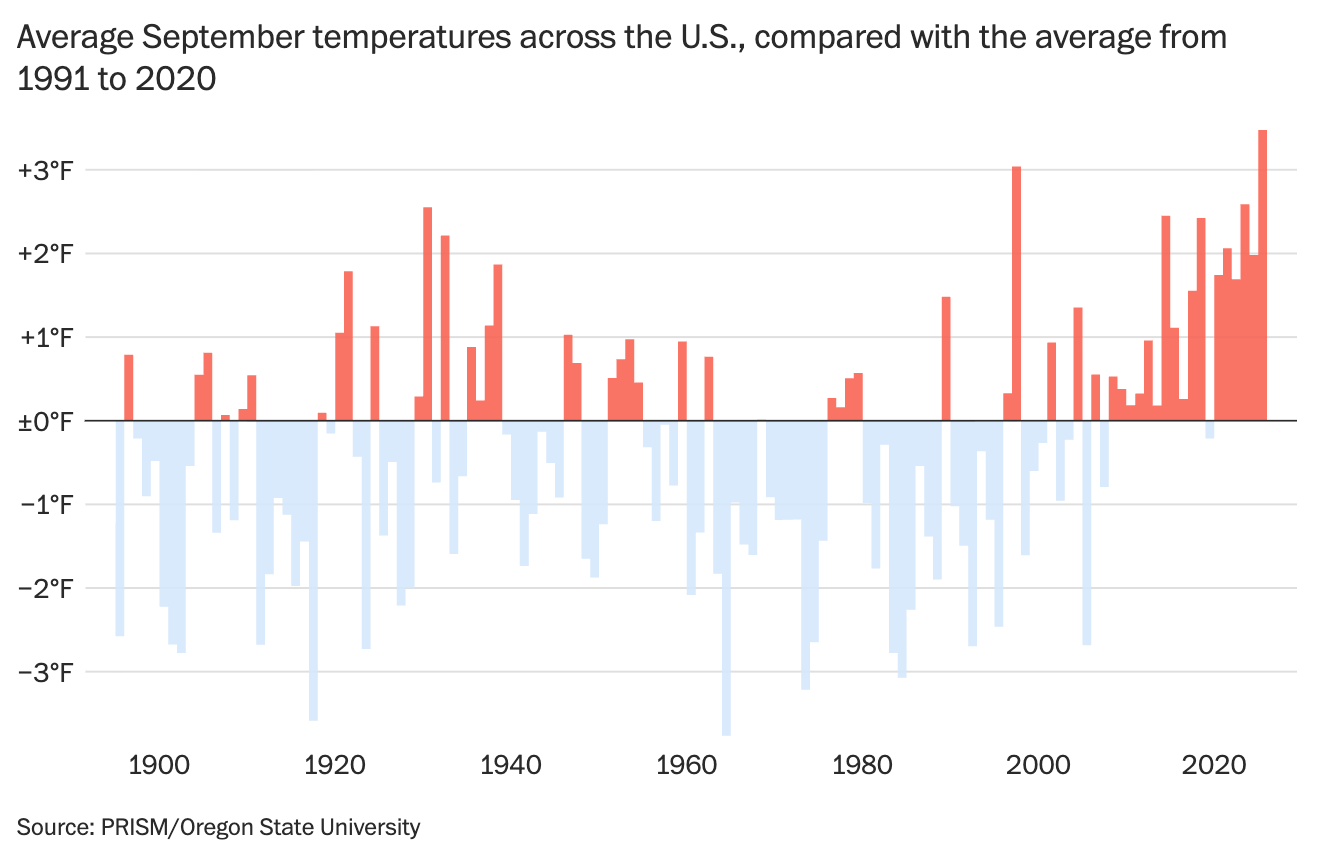
The Washington Post reports that the U.S. just had its warmest September on record, as the national average ran about 3.5 degrees Fahrenheit above normal. That beat the previous record, set in 1998, by almost half a degree.
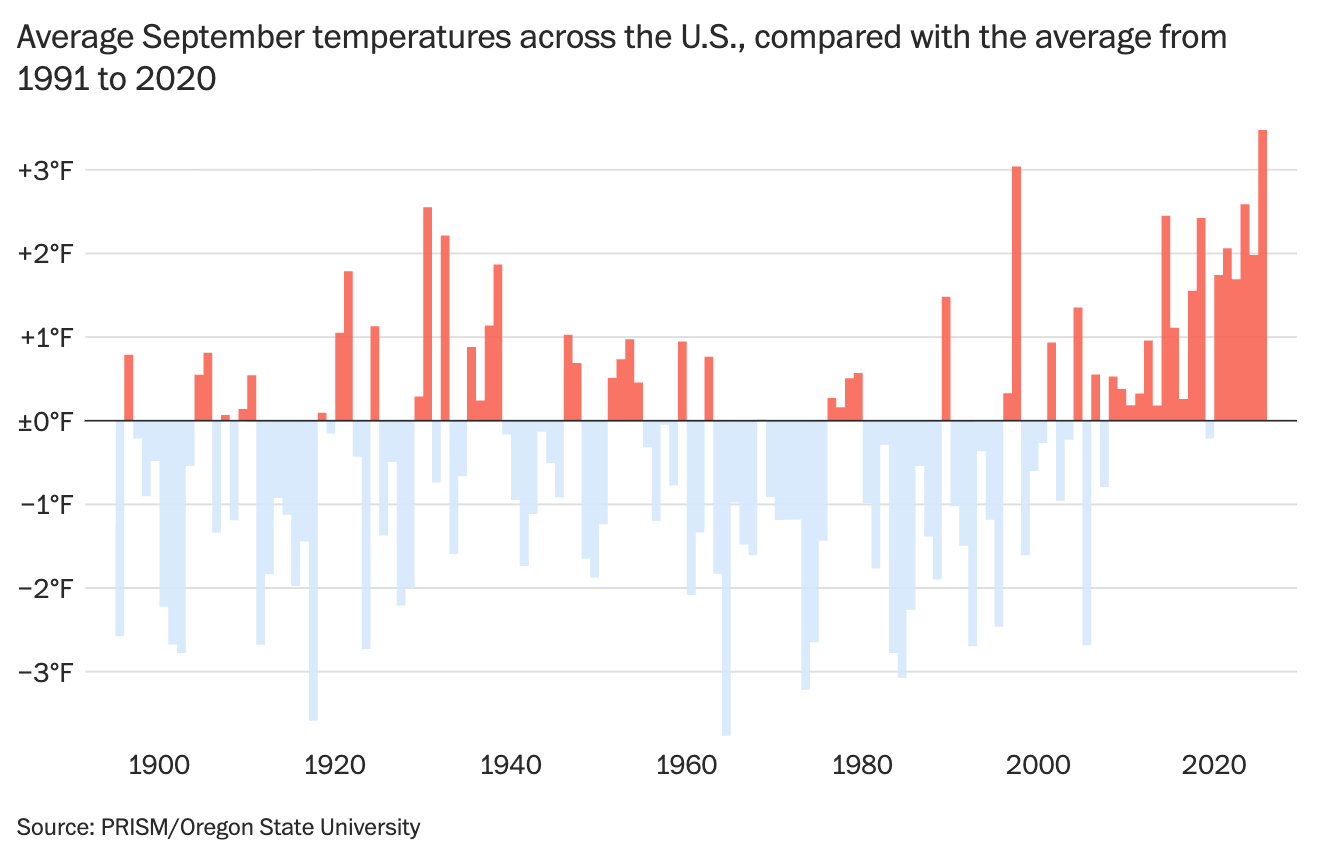
Most of the extra heat came at night. Record humidity, especially in the Southwest, Plains and Midwest, kept overnight lows 4.6 degrees above average, breaking the 2019 record by about 1.5 degrees. And the heat also isn’t letting up either. Dozens of overnight records are expected to fall across the country in the coming days, while D.C. is forecast to hit near 90 degrees on Friday and Los Angeles 100 on Saturday. Forecasters point to a number of compounding factors that explain the heat: a warming climate, a record El Niño, and unusually warm ocean water in the Gulf of Mexico. Every September since 2021 has now run above the long-term average.