


Hey everyone. Welcome back. Good to have you here.
Our top story today: the Trump administration is losing senior officials faster than under any modern president. Twenty-seven Senate-confirmed officials have walked away in just eighteen months. But the President is filling these positions with people the Senate isn’t getting to vote on.
We’ll also get into the thirteen billion dollars in Venezuelan oil money this administration has collected but nobody can find, the nuclear deal with Saudi Arabia, the President’s stunning comments about our fallen troops, and a rally speech in Georgia that showed exactly how afraid this White House is of Jon Ossoff.
Do me a favor. Like this video, share it with someone who needs to see it, and subscribe so you never miss an episode.
Let’s get to it.
1. The Administration Nobody Wants to Work For
The Partnership for Public Service published an analysis yesterday, first reported by The Hill.
Twenty-seven Senate-confirmed officials inside Cabinet departments have left in the first eighteen months of this term. At the same point in Trump’s first term, it was eleven. Under Bush, Obama, and Biden, the average was around 4.
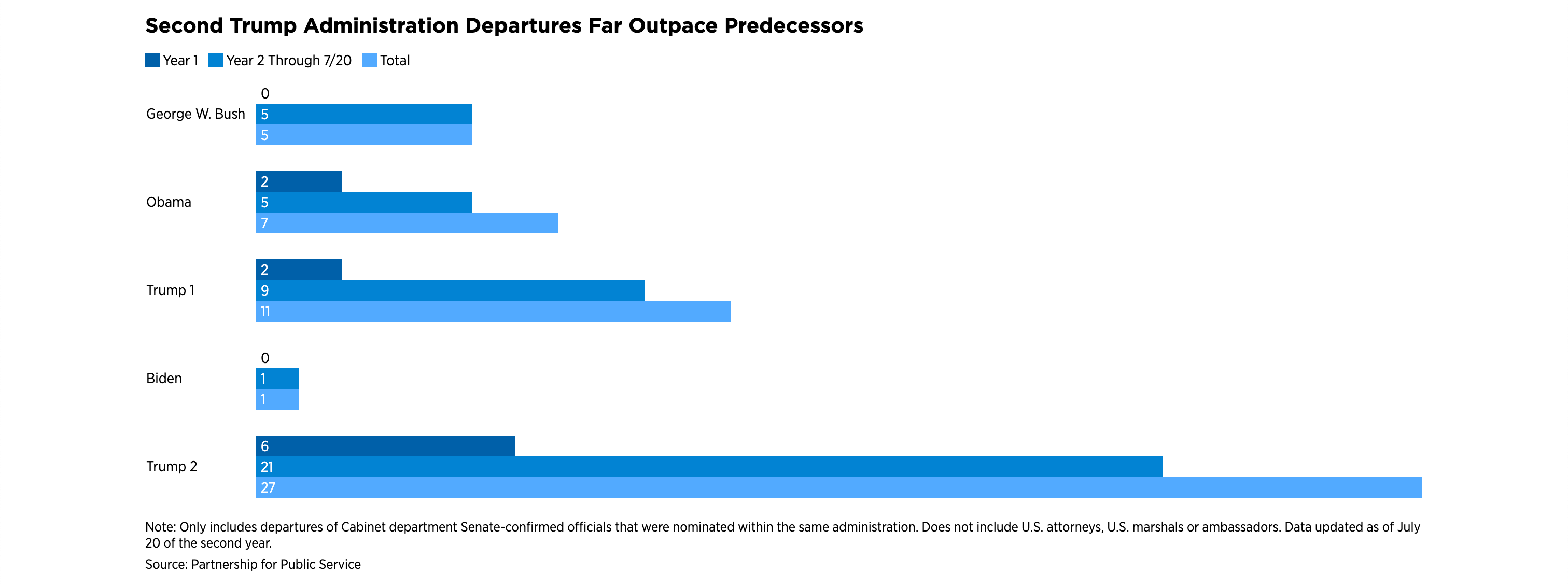
These are not junior officials. Three Cabinet secretaries. The heads of the CDC, the FDA, the IRS, and the Department of the Navy. Four general counsels. The Treasury alone lost six.
And the big deal here is that they’re mostly not being replaced. The President has made 578 nominations, fewer than any president since Reagan, and just 126 since January first.
It’s worth noting he said out loud in his first term: “I like acting” officials, because they gave him “more flexibility.” Which just means they don’t need to be confirmed by the Senate. He can put anyone he likes in these jobs. Not based on merit. Based on loyalty.
Senate confirmations are the one moment when somebody outside the administration gets to put a nominee under oath and ask what they actually believe. These acting officials got some of the most powerful jobs in government without answering to anybody.
And clearly the President is in no rush to change that. We’ve all seen what happens when his people go in front of Congress. It does not go well. So of course he doesn’t want to put anyone else in the hot seat.
But this needs to change. Advice and consent is in the Constitution, and it’s there for a reason. The founders did not build a check on presidential power thinking a president could get around the whole thing by sticking the word “Acting” in front of a job title. That’s not clever. That’s a loophole, and Congress should close it.
2. Nobody Can Find the Venezuela Oil Money
This week, The Financial Times reported that the United States has taken in roughly thirteen billion dollars from Venezuelan oil sales this year. That’s since we pulled Maduro out in January and Washington took control of the country’s oil exports.
Thirteen billion dollars. Publicly, about three hundred million of it can be traced arriving in the capital city Caracas.
The rest of it though? We have no idea where it is. Secretary Rubio told Senate Foreign Relations the arrangement was short-term, with the money in an account in Qatar. In April, the State Department said about three billion had gone back and that quarterly reports were coming. Since that, we’ve heard nothing else about it.
Meanwhile the President has said the money “will be controlled by me,” and that the United States is “making a lot of money” off Venezuelan oil. And last night, on a stage in Georgia, he offered this assessment of how it’s all going:
Uh no, Venezuela is not doing better than it has ever done. Their first-quarter GDP was the worst in 5 years. A month ago they were totally ravaged by two devastating earthquakes.
But you know who is doing better than ever? The oil companies. They’re pumping, they’re selling, and the money is flowing. Just not to Venezuelans, and apparently not anywhere the rest of us can see it. That’s the part the President’s paying attention to, because that’s the only part he cares about. It’s pretty ignorant for the actual suffering to be glossed over, but no surprise there.
There’s bipartisan demand for answers here. Democrat Joaquin Castro says the operation was about oil and power from the beginning, and that Congress has been kept in the dark. Republican María Salazar, who is very pro-Trump by the way, said this week that there needs to be more transparency.
Look, there’s no conspiracy theory needed on this one. The President told us himself the money would be controlled by him. Well, it’s been controlled by him. And now nobody can find it.
3. Trump Can't Keep His Saudi Nuclear Story Straight
On Wednesday, Energy Secretary Chris Wright and the Saudi Energy Minister signed a civilian nuclear cooperation agreement, along with a bilateral safeguards agreement. Thirty years, worth billions, with American companies at the center of the Saudi program.
This isn’t new territory. The U.S and Saudi Arabia have talked about nuclear cooperation across multiple administrations. But the terms are different this time.
According to the reporting on the deal, it doesn’t include the International Atomic Energy Agency’s Additional Protocol, which is basically just enhanced inspection. It doesn’t include the ban on enrichment and reprocessing that the UAE accepted, which is the one condition people call the gold standard. And it could allow an enrichment facility inside Saudi Arabia.
Then Thursday morning, the President wrote there will be “no enrichment of material,” that the deal “pertains only to non-military use such as the ones that Iran and UAE (and others) already have,” and that it is “totally subject to Saudi Arabia joining the very respected and successful Abraham Accords.”
But the Energy Department’s own announcement on Wednesday said nothing about the Abraham Accords, which could mean it’s not actually part of the agreement. So the President attached a condition to a deal a day after it was done, and it happens to be the one condition the Saudis have refused for years.
He says this is non-military, like the programs Iran and the UAE already have. They just aren’t the same thing. The UAE gave up enrichment in writing. We told Iran that enrichment was a red line worth starting a war over. Then we turned around and gave the country next door a path to the same thing. Now, maybe that doesn’t hurt our negotiating position with Iran. But it sure doesn’t help.
And by the way, the Saudi government’s wealth fund has two billion dollars sitting in Jared Kushner’s investment firm. The fund’s own screening committee advised against it, but the crown prince overruled them. And in January, that same fund financed a seven billion dollar real estate deal with the Trump Organization.
So the country that just got a nuclear deal with fewer safeguards than we’ve demanded of anyone in the region has also put billions into the President’s family’s businesses. In any other administration, that would be a scandal.
4. Trump Couldn't Honor the Fallen Without Talking About Himself
Over the past week, Iranian missiles and drones hit American bases across Jordan and Iraq. Four soldiers were killed, brave Americans as young as nineteen years old. Yesterday afternoon they came home, in flag-draped transfer cases at Dover Air Force Base. Before he attended that solemn homecoming, listen to what the President told reporters about these fallen troops:
He never spoke to them. But he still put his own words in their mouths, on the day their bodies returned home.
A few hours later he was at an event in Georgia, with the family of one of the four in the crowd. And for some reason, he decided to say this:
Think about how that sounds to every Gold Star family in this country. When your child comes home in a casket, the President opens a file and grades them. And if that’s not disgusting enough, he’s going to talk about it at a campaign rally?
There is exactly one job for a Commander in Chief at Dover, and it is to stand there in silence and let the moment belong to somebody else. But Trump can’t do it. No matter the situation, he will always make it about himself.
5. Trump Is Scared of Jon Ossoff
Georgia Senator Jon Ossoff has spent the last two weeks pressing every Trump official he can. It started when Jay Clayton, the President’s nominee to run our national intelligence, wouldn’t admit that his boss lost the 2020 election. And this week, as Iran proved that it can still hit back, Ossoff read Pete Hegseth his own words declaring their military “combat ineffective” and watched him squirm.
They were simple questions, but those simple questions terrified the administration. With Ossoff on the ballot again this November, Trump went down to Georgia yesterday to campaign against him. Just listen to how scared he really sounds:
He called the senator a nobody, in a speech where he said his name over and over, and in a state he flew down to in an attempt to unseat him. Sure.
Congressman Mike Collins is Trump’s preferred replacement, and it’s clear why Trump likes him. Collins called Georgia’s 2020 election “legitimately rigged,” he’s long supported pardons for January 6th rioters, and his son-in-law is a white nationalist influencer who spreads Nazi imagery online. So he really just checks all the boxes for Trump.
Look, this is how this White House handles questions it can’t answer. Who won in 2020. Did we actually defeat Iran. They know the answers, they just can’t say them. So their plan is to get rid of the people who ask, and replace them with yes men they know never will. And it’s our job to make sure that doesn’t happen.
Some other stories that caught my eye:
The Trump administration is considering military action in Mali. The Washington Post reported Wednesday that officials are weighing strikes on JNIM, the al-Qaeda affiliate that has spent the better part of a year strangling the country. If the President signs off, Mali becomes the eighth country he has bombed since taking office, from a man who promised to get us out of foreign wars. Sebastian Gorka, the National Security Council’s counterterrorism director, is pushing hard for strikes. Other senior officials are urging caution. Mali’s junta is propped up by Russian mercenaries, and the Post reports those forces have killed more civilians in the region than JNIM and ISIS.
The New York Times goes before a federal judge in Manhattan today. The paper is asking the court to throw out the Justice Department’s subpoenas for its reporters’ testimony and records, and it is accusing the administration of abusing the legal system to hunt for their sources. Its lawyers wrote that the government’s actions violate the most basic First Amendment protections for newsgathering activity. The Justice Department says it did everything by the book, that it is chasing a national security breach and not the reporting itself. U.S. Attorney Jay Clayton told senators last week he followed every applicable policy and kept the intrusion as narrow as possible. This comes after reporters wrote that the Secret Service urged the President to fly home from Turkey on the old Air Force One, because the luxury jet Qatar gave him doesn’t have the same defenses. Since then, prosecutors have gone after phone records belonging to reporters’ relatives, including two spouses and one reporter’s mother, and agents delivered subpoenas at reporters’ front doors instead of to the paper’s lawyers, which is how this is normally handled.


