

Hey everybody. Happy Monday. Thanks for being here.
Our top story today: President Trump has announced a deal to buy diesel fuel from Vladimir Putin. To do it, he’s lifting the sanctions Congress passed on Russian energy after the invasion of Ukraine. Sanctions I voted for, by the way. Senators from both parties say the deal is illegal and are demanding he reverse it. We’ll walk through what Trump did, why it breaks the law, and why some Republicans finally decided this was too far.
We’ll also get into Ukraine knocking out Russia’s bot farms, a federal judge yanking the taxpayer-funded Trump ads off the air, a new poll that says voters are done with Republicans, and the Justice Department going after five TV networks because they stood up to Trump.
So do me a favor. Like this video, share it with someone who needs to see it, and subscribe so you never miss an episode.
Let’s get to it.
1. Trump’s Putin Deal Splits GOP
On Friday, Trump announced that Putin has agreed to supply diesel to the United States and the world. Three hundred thousand tons right away, half a million in November, a million more after that. To make it happen, the administration is easing the sanctions on Russian energy. Scott Bessent says they’ll use every legal authority available.
But here’s the problem. In 2022, Congress banned Russian energy imports. I voted for it. And the law says the president has to consult Congress and explain himself before he changes it. As you can imagine, Trump did not follow the law. So on Sunday, seven senators on the Foreign Relations Committee, including Republicans Collins, Murkowski, and Curtis, wrote a letter demanding that the administration reverse the decision.
Tillis went on Meet the Press. Asked if the president is breaking the law, he said, “I believe that he may be.” Then he said this has deadly consequences.
And here’s Mike Pence: “President Trump’s decision to lift sanctions on Russian fuel amidst Putin’s ongoing and brutal attacks on civilian targets in Ukraine makes no sense and is a betrayal of the legacy and leadership of the late Senator Lindsey Graham.”
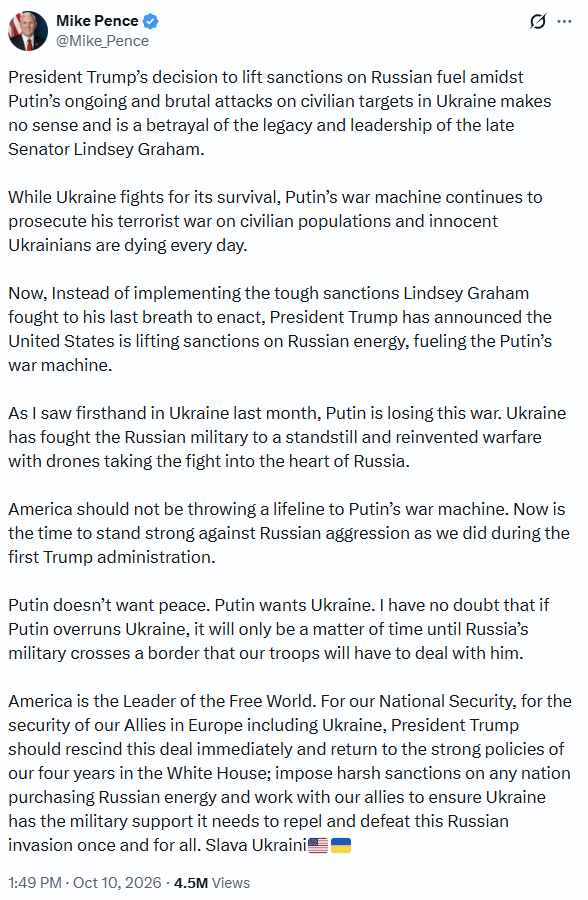
Lindsey Graham spent his final months pushing the toughest Russia sanctions bill the Senate had ever seen, and Trump asked the Senate to hold off on the vote. Now Trump is doing the opposite of what Graham wanted, and selling it as relief at the pump. Here’s the post.
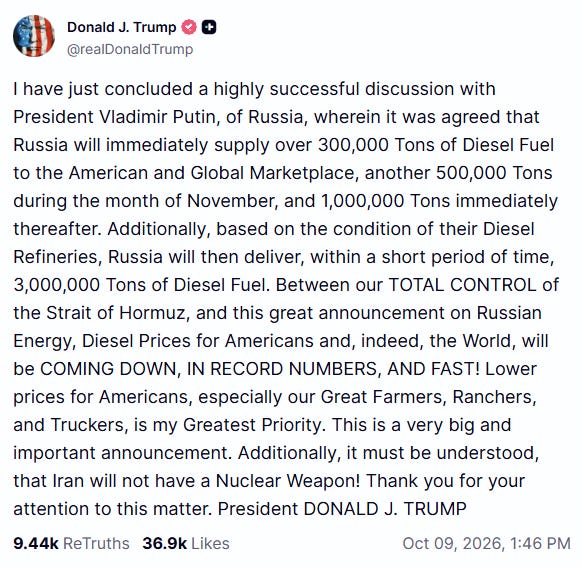
“Between our total control of the Strait of Hormuz,” he says, and “this great announcement on Russian energy, diesel prices will be coming down in record numbers.” Then on Sunday he announced an energy ceasefire in the war. Zelensky told Axios the announcement “was news for me.” Within hours, Russia struck a power plant in eastern Ukraine.
So let’s be clear about what happened. Diesel is at a record because Trump started a war with Iran. His solution is to buy fuel from the country that started the other war, hand Putin the revenue to keep it going, and announce a ceasefire that exists only in his Truth Social post.
So while it’s great that a few Republicans are pushing back, there are a lot more who aren’t saying anything. And they voted for this law too. Are they really going to shrug off the president ignoring it? This is a slap in the face to our allies, who weaned themselves off Russian fuel at a real cost.
And above all else, this is a slap in the face to Ukraine. Russia had its worst month of the year in September. Putin’s been managing a hole in his budget. He’s hurting. And right at that moment, the United States jumps in with a lifeline. What a disgrace.
2. Ukraine Silences Putin’s Troll Army
While Trump was cutting a deal with Putin on diesel, Ukraine was hitting Yandex, which is basically Russia’s Google. Their data centers run search engines, maps, food delivery services, and a big chunk of the Russian internet. Ukrainian drones struck three over the last week. One strike damaged two key supercomputers, taking down banks, phone carriers, and news sites across Moscow.
But the effects went beyond Russia. A service called Cloudflare tracks activity from Yandex’s network. Last week traffic was near its peak. After Ukrainian drones did their thing, it dropped to almost zero. So why does that matter? Because almost all that activity was coming from bots.
Here’s Zelensky on what people noticed.
Fewer trolls. Less division. People in Germany noticed the same thing. Accounts that spend all day cheering for the far-right AfD party suddenly went quiet. Nobody can prove exactly which accounts were tied to Yandex servers. But the timing is hard to ignore.
Russian bots aren’t limited to Europe. They infested American social media platforms a decade ago, and have been meddling in our elections and pushing the stories that divide us ever since. They’re woven into everything now.
These bots are part of the reason politics has gotten so ugly. So when you think about it, Ukraine just did more for the health of American social media in four days than Congress ever has. And they did it while our president was making a deal with Putin.
3. Trump’s Taxpayer Ads Ruled Illegal
You’ve probably seen one of these commercials by now: they’re the same kind of edits you see MAGA accounts pushing on X, starring Trump and his cabinet and talking up the administration. They were paid for with 20 million dollars of taxpayer money that Trump personally asked his budget director to find. Even the GOP was furious at the blatant misuse of public funds, especially from an administration that has focused so much on fraud and waste.
On Sunday, a federal judge ordered them off the air for good. She found the ads were an illegal misuse of appropriated funds and told the administration to cancel every remaining buy.
So the Trump administration lost in court. That’s nothing new. But here’s the kicker: it didn’t even try. The ads were so blatantly illegal that not even the DOJ could defend them. Take a look at this excerpt from the filing.
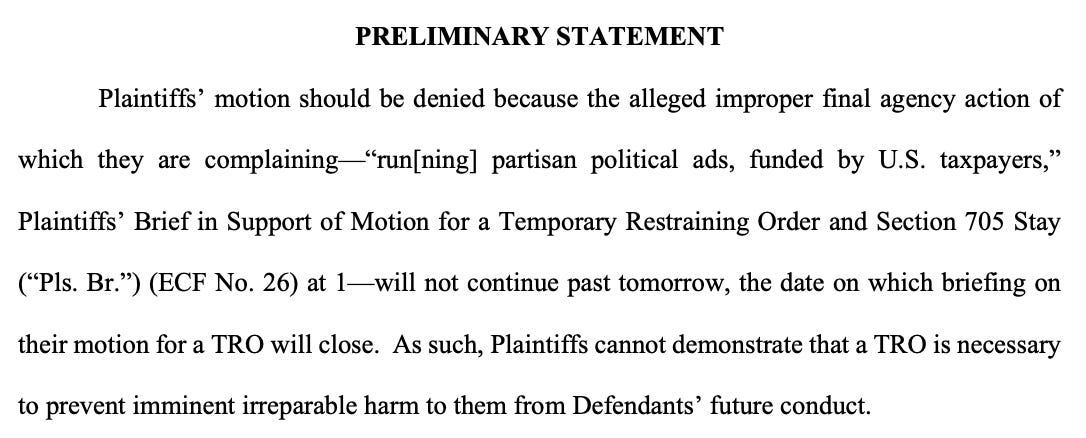
They’re not saying the ads are legal. They’re just saying the ads will be over soon, so there’s no need for legal action. That’s the whole defense: “we’re done anyway, so can’t you just let it slide?”
Remember that the White House spent two weeks insisting that the ads were just standard PSAs. No one was buying that, so Trump caved and announced his super PAC would foot the bill going forward. Now a judge has officially pulled the plug.
Even before the courts got involved, the American people knew this was wrong. A Reuters poll found over 85% of Americans opposed to the ads. In today’s political climate, you never see numbers like that.
I’m glad Americans can agree on this, and I’m glad the courts stepped in. But millions of dollars worth of damage has already been done, and the taxpayers want to know: where’s our refund?
4. Voters Reject Trump’s Midterm Bribe
On Friday, we talked about how almost half of Trump voters weren’t certain the president should even lead the party heading into the midterms. But Trump has put himself front and center anyway.
That means striking a deal with Vladimir Putin as a desperate attempt to lower gas prices. And it means dusting off the whole 5,000 dollar check idea again. He put out another video this morning with the same pitch. “If the Republicans win, you will each have $5,000 in your pocket.” For Trump, no bar is too low.
That raises the question: will any of it matter? The GOP has to win over undecided voters to hold its majorities. And the numbers aren’t on their side.
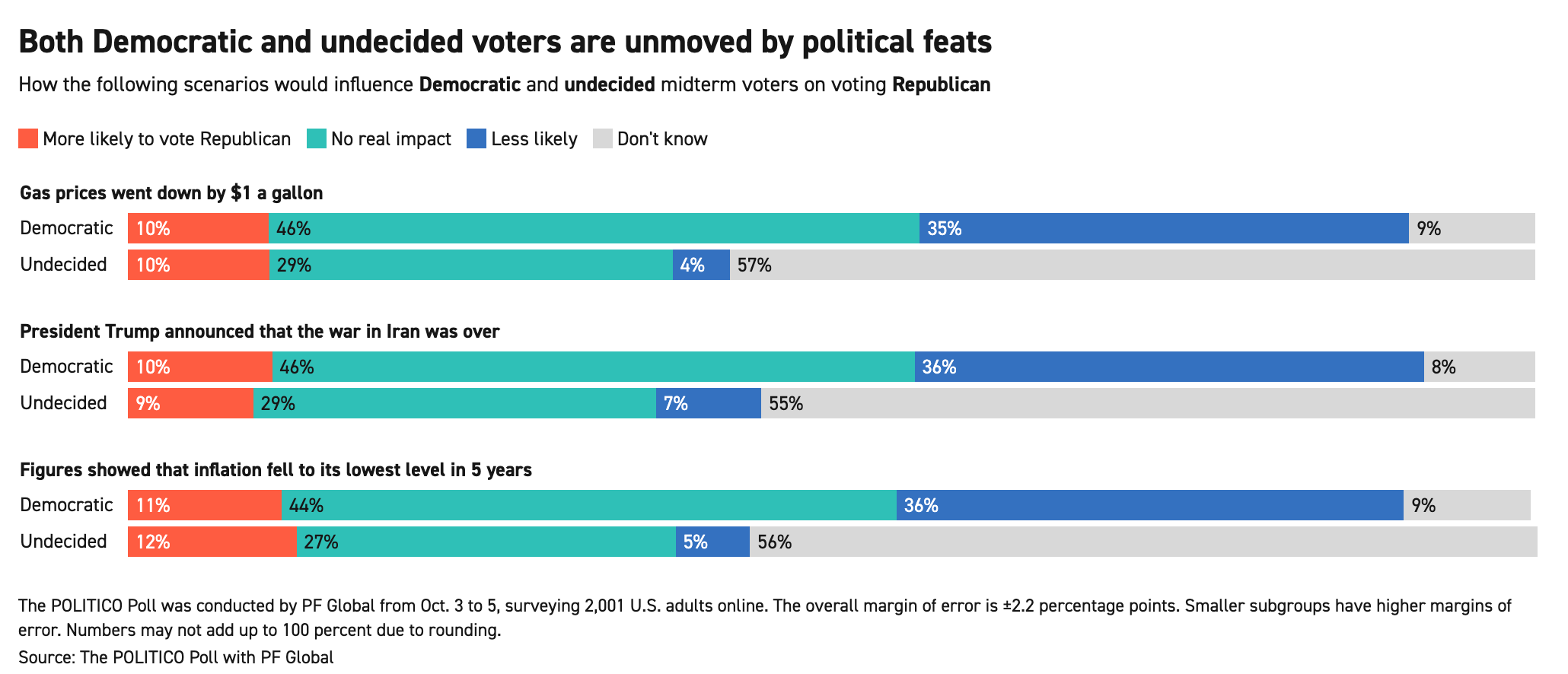
Politico asked undecided voters what the President could achieve to sway their support. If gas prices dropped by a dollar a gallon, only 10 percent said they would be more likely to vote Republican. If inflation fell to a five-year low, that would influence 12 percent. If the war with Iran ended? Just 9 percent.
What’s more, most Americans don’t believe Trump can fix any of this before Election Day. Just over a quarter thought he could bring gas prices down by a dollar, end the war with Iran, or significantly reduce grocery prices. Even among his own 2024 voters, fewer than 40 percent believe he can deliver on any one of them.
“There’s nothing that Trump can do,” one battleground GOP operative said. The “ship has sailed.”
You can’t fix almost two years of bad policies and decisions in three weeks. Voters have already made up their minds. And Trump’s last-ditch push isn’t changing that.
5. Trump Weaponizes DOJ Against Press
Last month, Trump banned CNN, MS NOW, and Politico from the White House, then pulled CNN out of the TV pool rotation. That prompted a united response from the five networks. They briefly stopped providing pool coverage. And they released a joint statement: “No administration should restrict a news organization because it objects to its reporting.”
Now Trump is opening yet another revenge campaign. The New York Times reports that the Justice Department’s antitrust division hit all five networks with formal orders to hand over documents. The DOJ’s theory is that the networks staged a coordinated boycott, the kind of collusion that’s illegal under the Sherman Act.
In a statement, a Justice Department spokeswoman described the five networks as “having proudly boycotted covering White House events.” She added that the department is simply investigating the violation of antitrust laws.
Let’s be clear about what this actually is. Five news organizations said the government doesn’t get to pick which reporters cover the president. Trump responded like he always does, by turning the federal government on his perceived enemies.
Legal experts told the Post that deciding what to cover is protected speech. As the Freedom of the Press Foundation put it: “Depriving Trump of the attention he craves is not a competitive harm.” Antitrust law, the group added, has long made room for First Amendment exceptions.
But winning was never the point. The point is the hassle. The legal bills. And the message sent to every newsroom: going against Trump comes at a price.
So far, the networks haven’t backed down. They’re defending the First Amendment from a president who treats the Constitution like it’s a suggestion.
Some other stories that caught my eye:
The Trump administration just hit the International Criminal Court with its broadest sanctions yet. On Friday, Secretary of State Marco Rubio announced a ban on all transactions with the court, effective after a six-month grace period. After that, any company doing business with the ICC could face U.S. penalties. Rubio said Trump will never let the court prosecute Americans, adding that the ban would cut off the court’s resources, “crippling its ability to operate.” The move builds on an executive order by the administration, announced February 2025, that sanctioned 17 of the court’s judges and prosecutors. And much of the fight traces back to the court’s November 2024 arrest warrant for Israeli Prime Minister Benjamin Netanyahu. Some 125 countries are members of the court, including many close U.S. allies. The U.S. and Israel are not. On Friday, the European Union and a group of allies including Canada, Germany, Japan, and Britain issued statements defending the court.
Violent threats against American elected officials have reached unprecedented levels. A New York Times investigation reviewed hundreds of records from 2024 through August of this year. It found threats against at least 44 governors, 70 senators, and 185 House members. That’s nearly half the House. The threats hit Republicans and Democrats alike, and they often targeted spouses and children. The Times interviewed several notable politicians who had faced threats, from Senator Alyssa Slotkin to Governor Tim Walz. One case stands out. When former Rep. Marjorie Taylor Greene forwarded threats against her son to President Trump, he texted back: “Your fault, you deserve it.” Weeks later, she announced her retirement. A White House spokesman did not deny the text but said the president condemns political violence. The costs of security are piling up. Federal candidates spent roughly $6 million on security in the 2017-2018 cycle; that passed $25 million by August 1 of this cycle. Over the past two years, federal prosecutors have charged just 53 people with threatening public officials.


