


Hey everybody. Happy Thursday. Thanks for being here.
Our top story today: the GOP exodus has begun. Trump built a first-of-its-kind midterm convention in Dallas to put himself at the center of the campaign, and his own candidates are suddenly discovering scheduling conflicts. A Politico survey found most of the more than 70 Republicans they asked are skipping it or won’t say. And it’s not just the convention. Across the battleground districts, Republican candidates are breaking with Trump.
We’ll also get into the hundreds of DHS agents hunting for voter fraud that doesn’t exist, the whistleblower who says ICE handed out badges before finishing background checks, the federal judge who just blocked Trump’s latest attack on birthright citizenship, and the White House lawyering up for the midterm embarrassment that they know is coming.
So do me a favor. Like this video, share it with someone who needs to see it, and subscribe so you never miss an episode.
Let’s get to it.
1. The GOP Exodus Begins
Next week, the Republican Party will hold the first midterm convention in its history, two nights at the American Airlines Center, headlined by Trump and JD Vance. The idea is a televised spectacle putting Trump front and center, sixty days before the election.
There’s just one problem: the candidates. Politico surveyed more than 70 Republican candidates and members. Most are either skipping Dallas or dodging the question. At least 45 offered reasons: fundraisers, weddings, district events, even a dove hunt. One House Republican called the whole thing “a waste of time” and “a mess.” It doesn’t help that the party is asking attendees for five-figure fees, with donor photos with Trump going for 88,600 dollars apiece. Michigan’s Tom Barrett was at least honest about it: “I can’t control what the president’s going to say.”
CNN’s Manu Raju asked some Republicans if they would be attending as they left a meeting:
Hilarious. The New York Times reports the members in the most competitive races are the ones staying away. The people whose careers depend on reading their voters correctly have decided that being seen with the President of their own party is a liability.
Trump, meanwhile, is promising the opposite of distance. Listen to this.
For a candidate down four points in a swing district, that is some very bad news. But this is the bed Republicans made. They built the whole party around one guy, and now the people trying to win elections can’t get far enough away from him.
2. DHS Hunts Fraud That Doesn’t Exist
The New York Times got hold of internal documents and training videos from DHS, and here’s what they show: hundreds of federal agents have been diverted to a desperate search for non-citizens on the voter rolls. We’ve been through this before. Red states conducted their own audits and found no evidence of widespread fraud. Utah found 13 fraudulent voters in a pool of two million. But this administration wants federal agents to chase ghosts anyway.
It’s not just the waste; their methods should bother you. Agents are taking personal info like dates of birth and partial SSNs and plugging them into state lookup websites. In some cases they’re effectively posing as individual voters on portals that clearly state they’re meant for the voter’s own use. These are federal agents, on government time, sixty days before an election, using your private information to scour the voter rolls.
This desperate search is just one piece of the puzzle. Just this week we’ve covered a USPS report that says Trump’s new mail voting system is built to fail, and a county in Texas cutting a third of its polling places. Once again, fraud is simply an excuse to meddle in this election.
But the American people know where the real fraudsters are. The same day the Times published those DHS documents, Gallup released a poll on corruption.
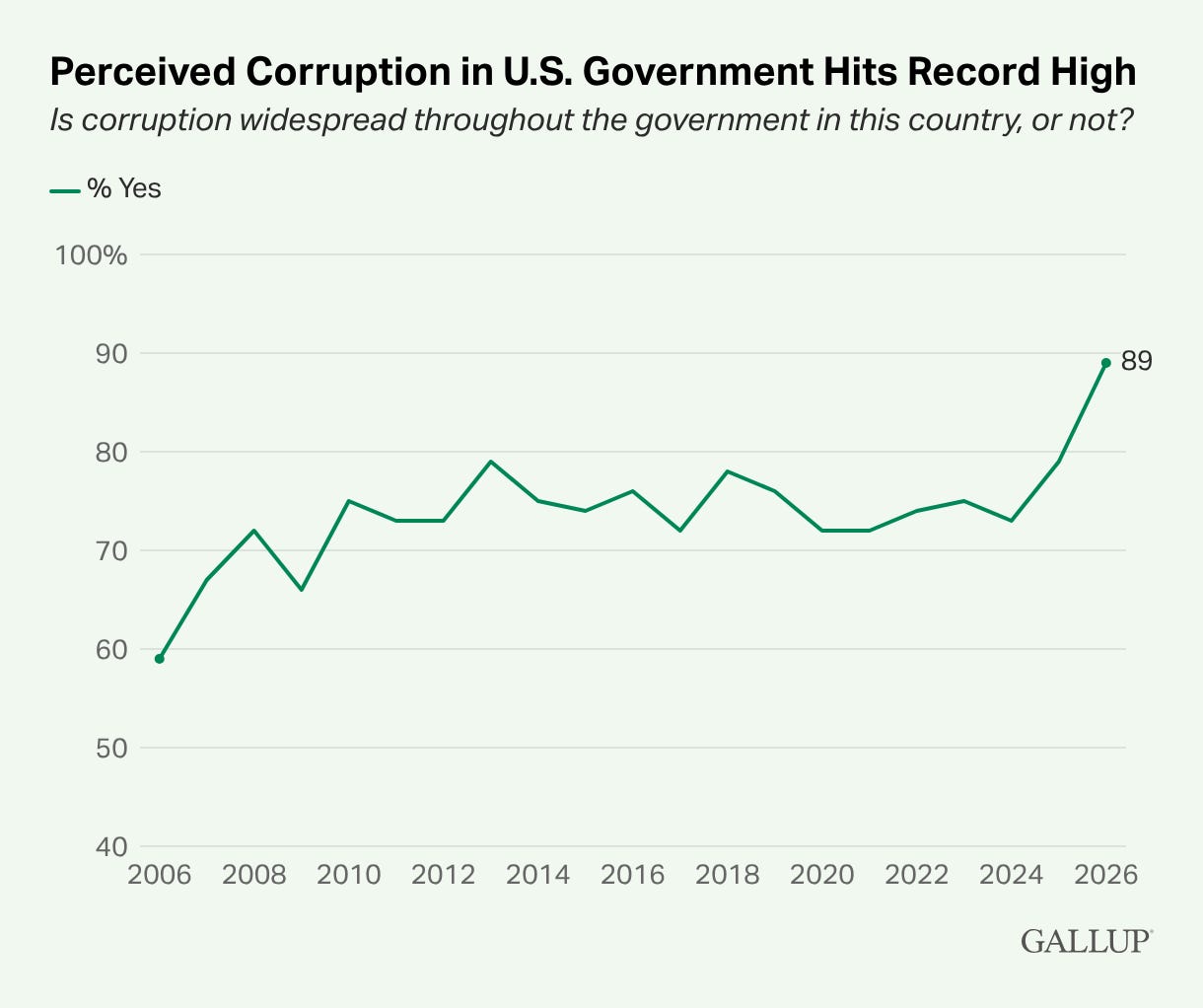
Eighty-nine percent of Americans say corruption is widespread in their government. That’s the highest number Gallup has recorded in two decades, up ten points in a single year. It’s 91 percent of Democrats, 90 percent of independents, and 83 percent of Republicans. On this one thing, America is united.
Those federal agents don’t need SSNs and voter databases to find fraud. All they need to do is take a trip to the White House. And the American people know it.
3. Whistleblower Exposes ICE Hiring
Here we have another whistleblower report, this time from a career ICE official. He was a 17-year veteran of the agency who oversaw a hundred employees vetting new applicants. His job was quality control on one of the biggest federal hiring surges in memory: ICE’s push to add 10,000 officers. According to him, meeting that goal meant an “unprecedented lowering of standards.”
His complaint describes systemic breakdowns that led to applicants getting jobs before they’d passed basic fingerprint, identity, or credit checks. Political appointees dodged background investigations entirely and got national security credentials anyway. He warned that these failures exposed the agency to grave national security risks. When he spoke to the Times, he summed it up this way: “We chose as an agency to be more convenient rather than thorough.” Remember that this is the same agency the administration funneled tens of billions of dollars to. But they don’t have time for background checks? It’s no wonder so many Americans think their government is corrupt.
Even when those fast-tracked agents make a mistake, the administration covers for them. ProPublica reported this week that leaders at the DOJ squashed civil rights charges against an ICE agent who shot a Venezuelan man in the leg in January. They did it over what sources called the “strongest possible” objections of the federal prosecutor on the case. This wasn’t a hard call, either. DHS originally claimed the agents were ambushed. But video evidence showed that story, in the government’s own words, “appeared to be false.” And the charges against the two men blamed were dropped.
Detention is a mess too. The San Francisco Chronicle reports ICE hasn’t paid outside medical providers for detainee care in nearly a year. Hospitals are owed millions, and some detainees have been billed directly for care that’s supposed to be free. Internal records show ICE itself called the situation an absolute emergency that could delay life-saving treatment. Advocates have another name for it: the death policy.
As usual, the administration doesn’t want to live in reality. Listen to their so-called border czar:
Most people support it. Sir, most people don’t. For Americans to respect the law, they have to respect law enforcement. And that’s not easy when the federal government gives out badges like candy. In this case, standards aren’t just red tape. They’re the difference between a police force and a Gestapo.
4. Birthright Citizenship Survives Another Attack
Yesterday, a federal judge in Maryland blocked Trump’s newest attempt to limit birthright citizenship, which he has continually failed to achieve since he took office.
Let me provide some context. The Fourteenth Amendment says that if you’re born on American soil, you’re an American citizen. Simple as that. Trump tried to end that with an executive order on day one. In June, the Supreme Court struck it down. But Trump wasn’t done.
He came back with a narrower order in August, ordering that federal agents could not recognize the citizenship of certain American-born children. That includes the children of so-called alien enemies, foreign government workers, and anyone accused of birth tourism.
The judge was not impressed. In a 35-page ruling, she wrote that the new order is “almost certainly unconstitutional.” She also argued that the President has attempted to strip a right enshrined in the Citizenship Clause from Americans since January 2025.
As the judge put it earlier in the case: he’s trying to rewrite the carve-outs to birthright citizenship “with the stroke of a pen.” Her injunction now protects every child in the certified class born since February of last year.
Notice the pattern? Every time the courts defy President Trump, he rewrites the same order slightly narrower. And the courts say no again. Trump is nothing more than the toddler who hears “no” and just keeps asking, hoping that the answer might change.
The strategy is exhaustion. The Constitution held yesterday, as it held in June. But a right that has to be re-litigated every six months is a right under siege. And a siege is exactly the point.
5. The White House Expects to Lose
Politico reports that the legal office for the White House is building a worst-case-scenario strategy for a Democratic House, even as the President remains publicly optimistic that his party will retain control.
At the center of its strategy, the Trump administration is pushing a sweeping claim of executive privilege. This grants the president the power to keep certain communications secret and to resist subpoenas from the legislative and judicial branches.
Executive privilege is already ripe for abuse by an administration with this much to hide. But Trump is going further. He wants to extend the privilege beyond government officials to cover his relationships with outsiders. Think of the private citizens who have dubiously influenced his decisions, no doubt for personal gain.
Adam Schiff and Senate Democrats responded by sending the White House counsel a letter last week, demanding to know exactly who this privilege supposedly covers. Their message is simple: Trump’s privilege claim is not a shield from justice. Not for him, and not for the people in his circle.
Corporate America is certainly concerned. Remember Monday’s story about how Trump donors are writing checks to Democrats? The subpoenas are coming. Every corporation knows it. Every GOP politician knows it, too.
That apparently includes Senate Majority Leader John Thune:
“A competitive environment.” How about that for an understatement? The Cook Political Report just moved Iowa and Texas, two Republican-held seats, to toss-ups. And that trend is only spreading across the country.
Thune is now publicly begging Trump and his allies to dump resources into Texas, which has voted for Republican senators for the past thirty years. When the Congressional map runs through Texas, the environment isn’t competitive. It’s a rescue mission.
And the Trump administration is sounding the alarm. Not to save the GOP. To save themselves, and their closest friends, from what’s coming.
Some other stories that caught my eye:
Russia and Ukraine are locked in an escalating air war deep behind the front lines, hitting warehouses, ports, gas stations, and power grids. And civilians on both sides are suffering more than at any point since the war’s opening months. Putin says Ukraine opened “Pandora’s box” by targeting the Russian economy. Ukraine’s campaign has hit more than 30 warehouses and crippled Russian fuel supplies, leaving about 70 percent of Russian gas stations without gasoline or diesel last month. In retaliation this week, Putin ordered massive strikes on Ukraine’s energy facilities heading into winter. And he has leveraged the use of ballistic missiles, which the country struggles to counteract with dwindling supplies of Patriot interceptors. Ukrainian civilian casualties are now at their highest since the war’s first weeks. Peace talks are in what the Kremlin calls a “deep pause,” and serious negotiations aren’t expected until next spring or summer at the earliest.
Patagonia sued the Trump administration yesterday over its decision to shrink Bears Ears and Grand Staircase National Monuments in Utah, arguing the Antiquities Act of 1906 lets presidents create monuments but not cut them down. The White House claims that the Obama and Biden administrations abused the act to lock up millions of acres of Utah’s public lands. Now he is selling off that land. Companies have already staked at least nine claims on land stripped from both national monuments, opening vast stretches of the desert landscape to oil drilling and uranium mining. When Trump first attempted to shrink the land in 2017, Patagonia sued and delayed the hearings until Biden reversed the cuts. This time, environmental lawyers worry the case could land in the Supreme Court. A ruling in favor of Trump would not only harm Utah’s monuments but also set a dangerous precedent, stripping protections from millions of acres nationwide.


