

Hey everyone. Welcome back. I hope you had a great weekend.
Before we get started, a quick thank you. Over the weekend the Washington Post picked up some of our reporting on the Pentagon’s paid internet trolls. It feels like nobody in Washington is holding this administration accountable right now. But that’s what this Substack is for. And your support is what lets us keep doing it. So thank you, and let’s keep this thing going!
Our top story today: Trump is losing his own voters. The farmers, ranchers, and working-class Americans who put him back in office are looking at four-dollar gas, a trade war with Canada, and a plan to flood the country with foreign beef. And they’ve had enough. But unlike Republicans in Congress, they aren’t afraid to say so. This is the coalition that built Trumpism. And it’s coming apart in the places Republicans cannot afford to lose.
We’ll also get into the former Republicans who are now running as Democrats; the Homeland Security Department caught spying on journalists, the secret deals cutting America’s global health programs in half; and the Pentagon’s new side business, Venezuelan oil.
Do me a favor. Like this video, share it with someone who needs to see it, and subscribe so you never miss an episode.
Let’s get to it.
1. Trump Is Losing Farm Country
First, a little bit of context. Cattle prices are the highest they’ve been in a generation. That’s not Washington’s doing. The American herd is the smallest it’s been since the 1950s, so for the first time in years, ranchers were finally getting paid.
Then the President announced he’ll bring in 300,000 metric tons of tariff-free foreign beef to lower prices at the grocery store. Cattle markets dropped right away. The Farm Bureau warned the plan could do long-term damage to the industry. And that’s on top of the Iran war that has sent diesel and fertilizer prices soaring.
In 2024, farming-dependent counties gave Trump an average of 78 percent of the vote. But the Lincoln Project put together a video of what those same voters sound like today:
Those aren’t Democrats. Those are the people who wear the hats. So how is the White House responding? Here’s Trump’s Agriculture Secretary:
Once again, just a meaningless compliment for the boss. But that doesn’t change anything for the farmers who are hurting.
And that attitude is exactly why Republicans in Washington are starting to panic. Jonathan Martin at Politico has spent weeks talking to Republicans about November, and the year that keeps coming up is 2006, when Democrats took the House and the Senate in a single night.
Kevin Cramer, the Republican senator from North Dakota, told him “He’s in serious trouble in farm country.” And then he admitted what that means for his party: “Trump is us. I’m not very optimistic.”
But it goes beyond the farm. A new poll this morning finds that among Americans who call themselves working class, only one in four believe politicians actually want to help them. The people who put Trump back in office feel forgotten.
These voters shrugged off the tweets and the indictments because they believed one thing: that Trump was on their side. Instead, they’ve got a president who keeps making choices at their expense.
Next week, Republicans head to Dallas for a midterm convention where one of Trump’s own advisers admits the message will be “whatever crazy stuff the president says.” That’s the plan for winning these people back. Good luck!
2. Republicans Are Losing Their Own Candidates
This weekend, the Washington Post profiled a wave of former Republicans running this year as Democrats. Not independents. Not third-party protest votes. Democrats.
There’s David Jolly, the former GOP congressman running for governor in Florida. It’s a job Democrats haven’t held in nearly three decades, but Jolly is polling surprisingly well. And he’s not alone. There are others in Pennsylvania and New Jersey. But the one I want to talk about is Nancy Lacore, in South Carolina.
Lacore spent 35 years in the Navy. She started as a helicopter pilot and finished as a three-star admiral running the Navy Reserve. That’s a force of almost 60,000 people. Last August, Pete Hegseth fired her along with dozens of other senior officers. They didn’t even give her a reason.
But they may just pay the price for that disrespect. Now Lacore is the Democratic nominee for South Carolina’s First District, the seat Nancy Mace gave up to run for governor. Take a look at one of her recent campaign ads:
It’s a powerful message. Lacore left the GOP a decade ago, and she’s focusing on independents and former Republicans, telling the Post she wants to show them they have a place in the Democratic Party.
Lacore is a lot like me. She didn’t leave the GOP, the GOP left her. And she’s counting on the fact that over the past two years, it’s left a lot of voters too.
But there’s another reason her candidacy matters right now. Her district is full of military families, and Lacore spent 35 years in that world. She knows what it costs, and she knows first-hand how this Pentagon has been treating the people who serve. In Pete Hegseth’s Pentagon, all that matters is ideology. No respect, no decency.
Unfortunately for Hegseth and this administration, the voters they have disrespected will get the last word in November.
3. Trump's War on the Press Escalates
Trump has been attacking the free press since his first day in office, but he’s only getting more desperate as his presidency unravels. The Guardian recently reported that DHS has been using a provision of the Tariff Act of 1930 to obtain the private records of journalists, unions, and nonprofits, all without a judge’s signature.
That nearly century-old law was written so customs officials could inspect import records and make sure duties get paid. But a summons under the act only needs the signature of a DHS official, and the process can be kept secret.
Here’s how it played out in Minnesota. Two journalists covered a protest that disrupted a church service in St. Paul back in January. Both were arrested and charged for participating, even though they were just trying to document the event. Both have pleaded not guilty. Prosecutors went to a judge twice for warrants on their YouTube accounts. The judge shut them down both times, saying there was no probable cause.
Less than a month later, DHS served Google with a customs summons for the same data. Google refused, pointing out there was no customs investigation. But T-Mobile bent the knee, turning over six months of phone records. More than 10,000 calls and texts were divulged without the journalists even knowing.
There were more targets. Democracy Now. The Milwaukee Journal Sentinel. Even Megyn Kelly wasn’t safe. A former inspector general at DHS called it “outrageous conduct on so many levels.” Of course it is. None of these cases involved anything close to a customs violation. But as usual, this administration doesn’t care about the truth. If it means muzzling a journalist, they’ll use any underhanded method they can think of.
The habit comes straight from the top. Yesterday, the President threatened a NBC journalist, saying a comment he didn’t like was a “threat to the country.”
So what was this comment? A possible call for violence? A national security leak? Not even close.
Kristen Welker, appearing on NBC before Meet the Press on Sunday, said Trump’s primary endorsements had “mixed results.”
That’s not a dig at Trump. It’s not even an opinion: Six Trump-backed candidates for House and governor lost their primaries this month alone. But Trump flew off the handle anyway.
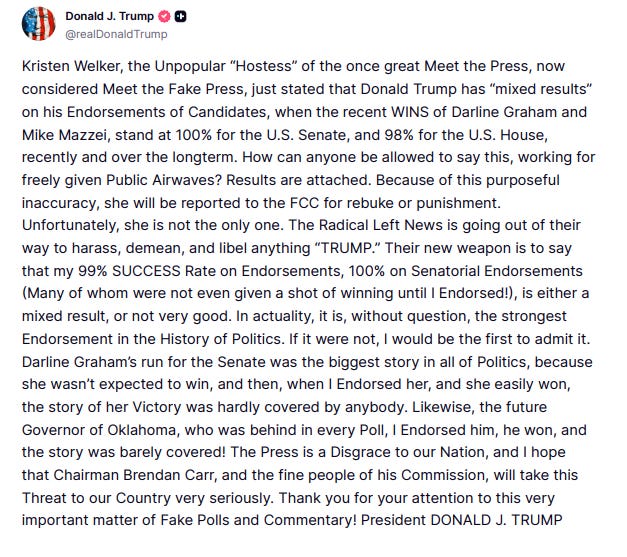
Ranting on Truth Social, he said Welker would be “reported to the FCC for rebuke or punishment,” and called on his handpicked FCC chairman to treat the inaccuracy of her comment as a threat to the country. In a separate post about polls he didn’t like, he wrote “FCC to the rescue!”
The FCC doesn’t regulate news content, and it can’t punish an anchor for saying something accurate. But Trump knows this won’t go anywhere. That’s not the point. The point is to make the next reporter think twice.
Ask yourself: if his endorsement was really such a boon, would Trump be lashing out like this? If the administration was really winning, would they be scrambling to muzzle the media and paying X influencers to launder their message instead? I think we all know the answer to those questions.
4. The Secret Deals Gutting Global Health
The Washington Post reports that the administration plans to cut global health funding to developing countries by tens of billions.
What does this plan look like, exactly? After pausing foreign assistance and dismantling USAID, the Trump administration had the State Department draw up bilateral health agreements with 34 developing countries. The administration has refused to disclose the terms of such agreements, citing the need to protect “sensitive” negotiations. Which means almost nobody has seen what’s actually in them. Until now.
Documents that Public Citizen and Partners in Health had to sue to get show what they were hiding. Across the 18 countries they reviewed, U.S. health funding drops 59 percent from 2024 levels by 2030, forcing recipients to make up the difference. That leaves Sierra Leone, for example, pressed to absorb a 71 percent cut in under five years. And if a country falls behind, the deals include penalties: even more cuts.
The State Department says the cuts are about transparency and self-reliance. Transparency, from the government that hid these health agreements. Self-reliance, from the government that can’t protect its own citizens from major outbreaks.
Meanwhile, the consequences of its delusions will ripple globally. These are the programs that fight deadly diseases. The programs that prevent HIV, Ebola, and tuberculosis from harming innocent people, from spilling across borders.
And here’s the thing. Congress already said no to this. Lawmakers, Republicans included, rejected the administration’s request to cut global health by $6.2 billion. They kept the funding almost exactly where it was. The administration’s response? Just don’t spend it. Technically, the money is good for five years. But clinics don’t run on technicalities. These programs will collapse long before that deadline.
So where does that leave us? A bipartisan Congress votes the full amount. The administration sits on it. And people suffer as a result.
The President likes to call cuts like this “America First.” But putting America first is what these programs actually do. They catch the outbreak before it reaches our shores. If an outbreak gets loose, we’ll spend more in a month than these programs cost in a decade. But for some reason, that’s the trade the administration keeps making. And they’ve been making it since day one.
5. The Pentagon Gets Into the Oil Business
Late Friday night, Trump announced what he called “The biggest oil deal in world history” over Truth Social.
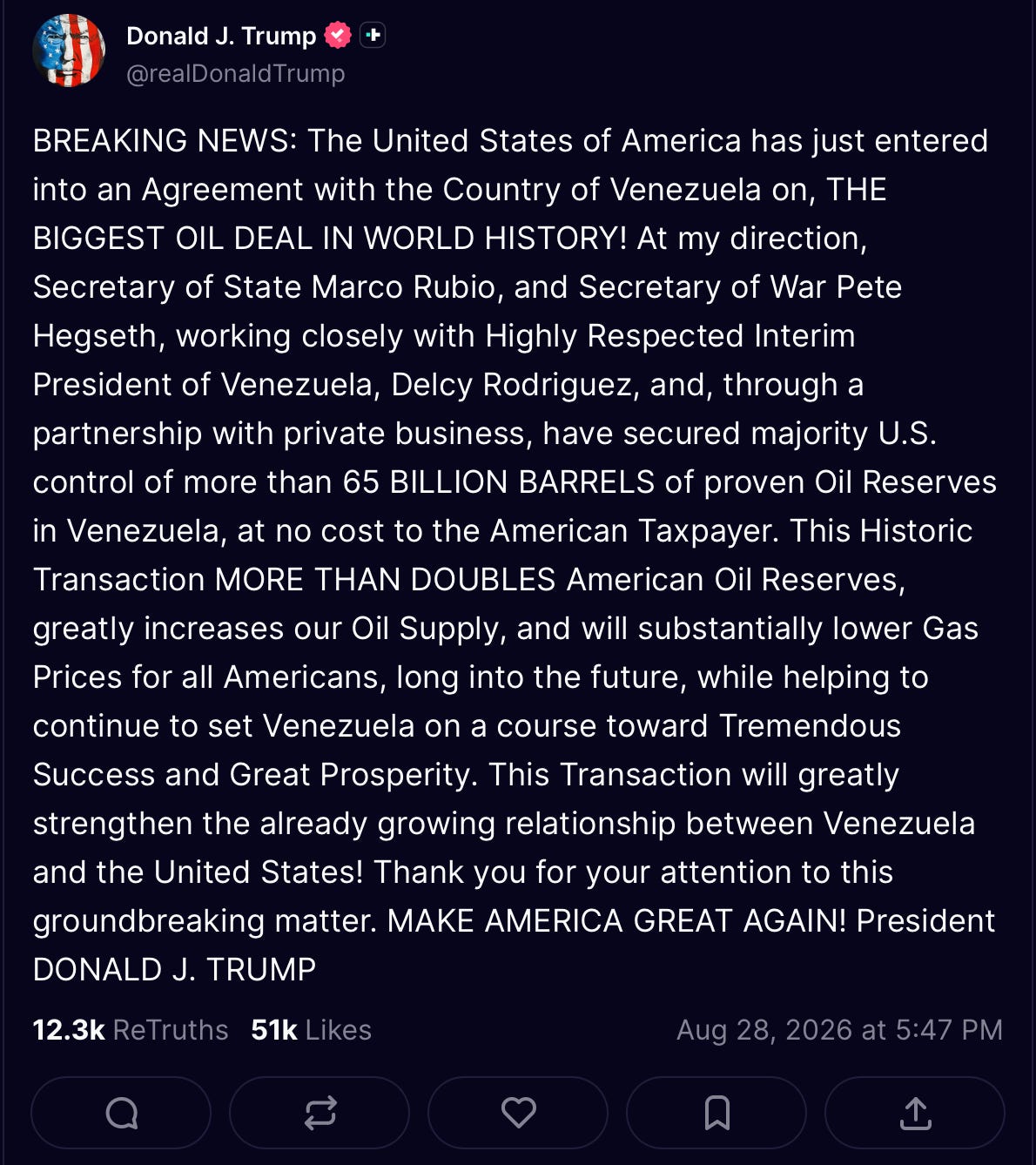
He claims that the U.S. government took a stake in a private company that holds the rights to 65 billion barrels of proven oil reserves. Of course, there are strings attached.
The Wall Street Journal and the New York Times have filled in the details. The company is run by a Venezuelan businessman who lined his pockets through government contracts under previous presidents. Unsurprisingly, his name once surfaced in a U.S. money laundering case tied to Venezuela’s state oil company.
A corrupt businessman? You might say that Trump is well-versed in that line of work. And his administration plans to cash in.
Under the agreement, the U.S. government would take a 35 percent stake in his company, which holds 100-year rights to 17 Venezuelan oil fields. The deal also includes the right to buy 20 percent of its oil at cost.
The rights were granted by Maduro’s former vice president, who takes orders directly from Trump, after he placed her in power. And that arrangement is how the administration gets around Venezuela’s constitution, which says the oil belongs to the state.
For American oil companies, that constitutional provision is a non-starter. And without private capital, the administration has been forced to pursue its own investments, pushed through the Pentagon.
This raises serious legal questions about the authority of defense agencies, especially without Congressional approval. Even the Pentagon’s spokesperson said that its strategic capital office “does not take equity stakes in private companies.”
Whatever the case, the Trump administration needs a headline about cheaper gas ahead of the midterms. Americans are struggling. And they know Trump is to blame.
But what they may not know is that meaningful production out of Venezuela is years and potentially billions of dollars away.
So here’s what the “biggest oil deal in world history” really is. A corrupt Venezuelan middleman, a puppet government, and a Pentagon office baffled by its new mandate.
Remember, this President ran on energy independence. But now we’re betting the Pentagon’s money on Venezuela. Which is your money, by the way. That’s not independence. That’s desperation.
Some other stories that caught my eye:
Milo Yiannopoulos, the British far-right provocateur who rose to prominence during Trump’s 2016 campaign, has been deported to the United Kingdom, the Department of Homeland Security announced Saturday. ICE agents picked him up on Thursday at the New Orleans airport. DHS says he entered the country legally in 2019 before overstaying his visa and skipping his immigration hearing. He was handed a final removal order on July 22. Having once worked for Marjorie Taylor Greene, Yiannopoulos has been a fringe figure for years. He was pushed out of the mainstream right after defending adult relationships with minors, before drifting into the Tucker Carlson and Candace Owens orbit as a Trump critic. MAGA blogger Laura Loomer told the Post she has been reporting Yiannopoulos to ICE, DHS, and the FBI since 2024, and she takes “100 percent” credit for his arrest. DHS has not said whether that impacted their decision.
The New York Times published interviews yesterday with ten deportees from the first ICE flight to Liberia, who described a 14-hour trip in which agents beat detainees who protested, slamming some to the ground and leaving others screaming in pain. DHS has failed to appropriately address these allegations, maintaining that they are simply preserving peace, law, and order. The stories tell otherwise. Leonardo Sánchez, a Cuban welder who carries scars on his torso from a 2018 stabbing, said he was chained around the waist and denied the toilet. Then, he was pinned to the tarmac with an agent’s knee on his abdomen when he refused to get off the plane. Others showed cuts on their wrists and bruises on their necks. And several said they were told they would be flown back to the United States, only to be dropped at a guarded hotel in Equatorial Guinea, where guards warned they would shoot their feet if they tried to leave. That flight carried the first of 1,200 people the administration plans to send to Liberia this year under deals with at least 35 countries.


