


Hey folks, Zach here. This will be my first post (of many) on the 2026 midterms. I am excited to help bring you the latest look at the political environment and, later, specific races that will determine the balance of power in 2027 and beyond. Today’s post is a big-picture look, including the battlefields for Senate and House as well as public opinion polling data to provide a more textured read of the currents of the electorate. So, take a look and let me know what you think!
The Big Picture – Warning Signs for the GOP
For those of you who follow politics closely, you’re well aware that the president’s party rarely does well in a midterm environment. From George W. Bush’s “thumping” to Barack Obama’s “shellacking” the shift away from the current occupant of the White House is a time-honored American tradition. And these midterms are shaping up no differently, with nearly all available data pointing to a rough November for President Trump and Republicans.
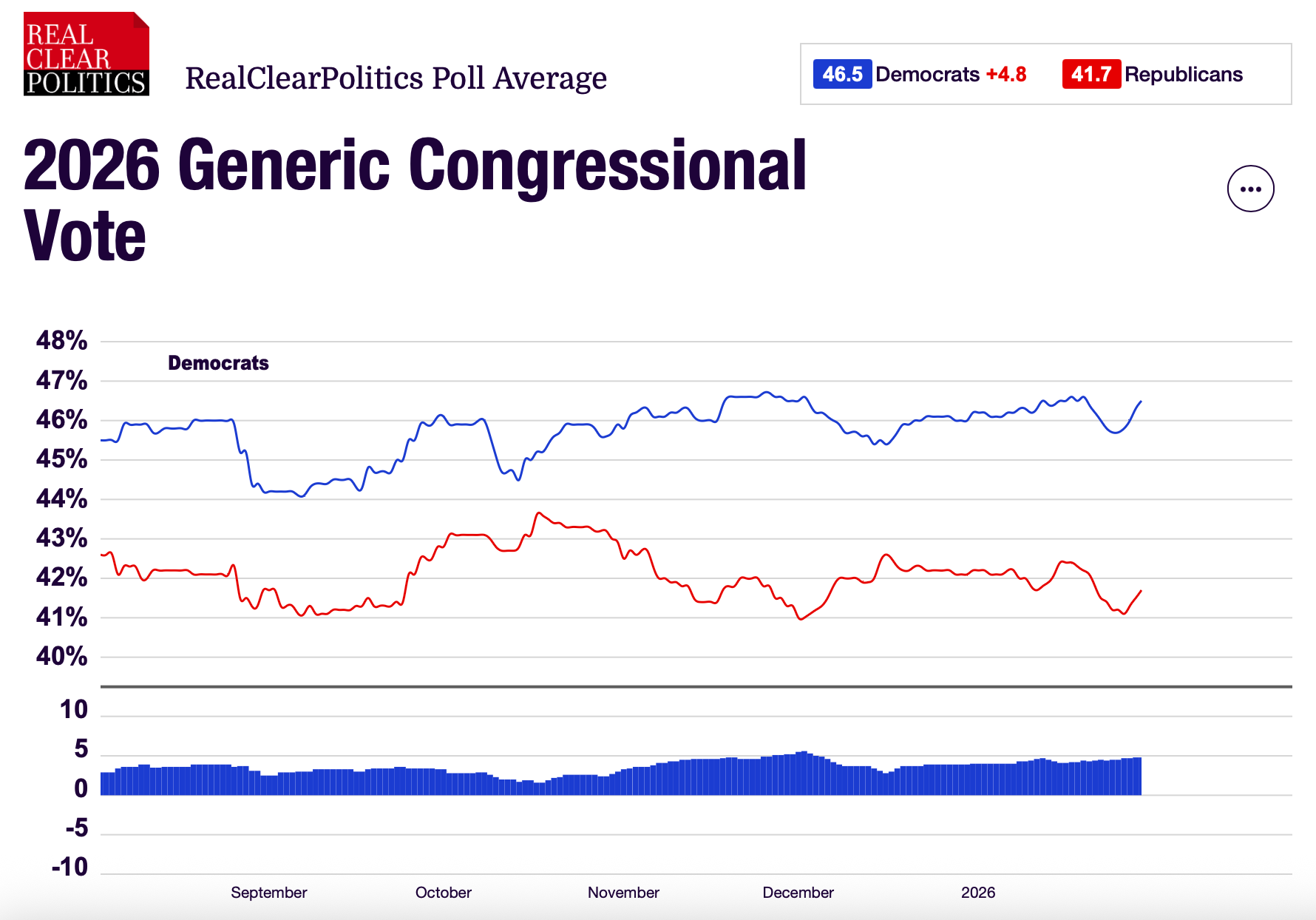
On the broadest indicator—the generic congressional ballot—Democrats currently hold a meaningful edge in most public averages. RealClearPolitics’ average (as of early February) shows Democrats +4.8. To put this level of support in context, the most recent Fox News poll found Democrats +6 on the generic ballot, the highest recorded support for either party ever. The previous high was 50% for the Democrats in October 2017, right about a year before their historic midterm wave of 2018.
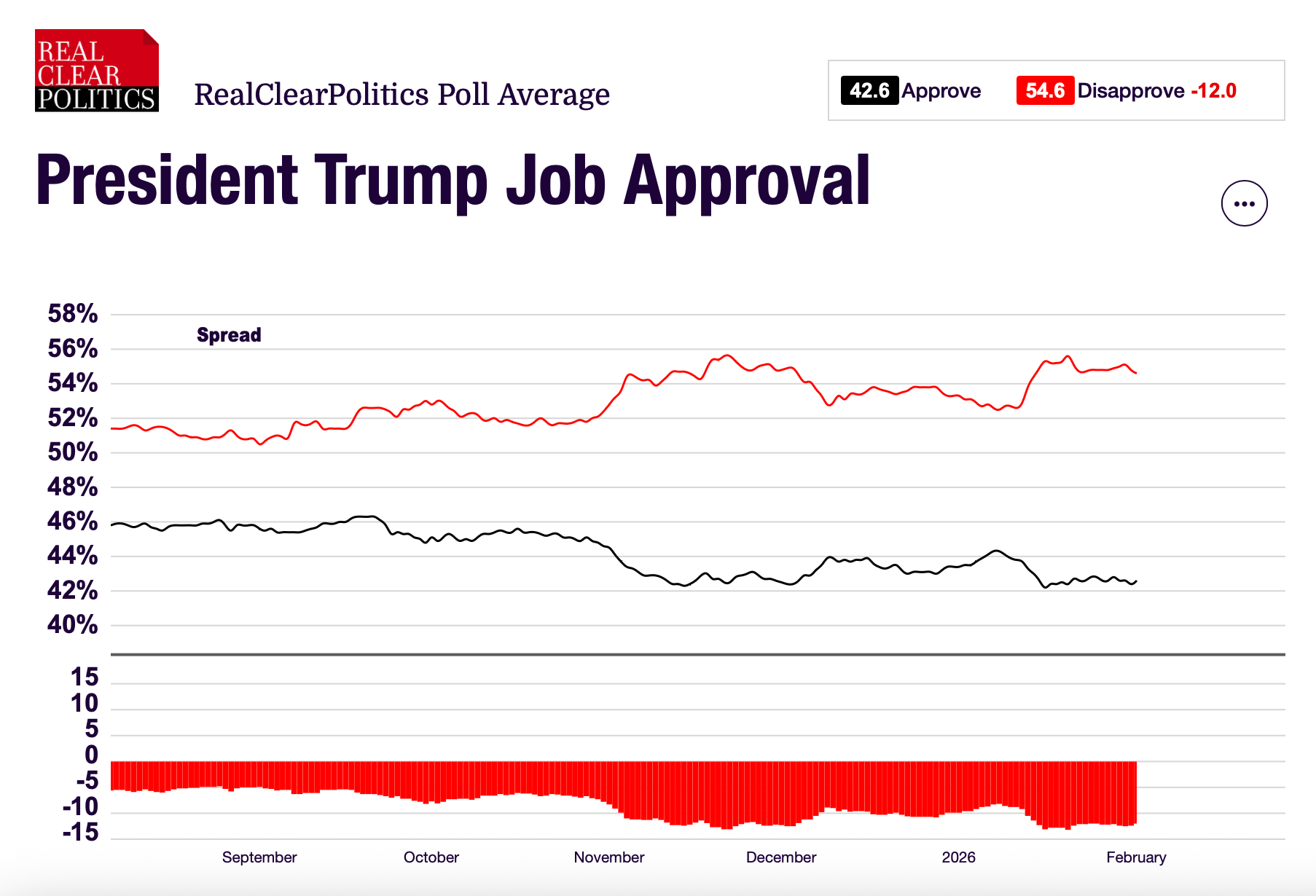
That advantage is reinforced by President Donald Trump’s job approval sitting clearly underwater in major trackers. RealClearPolling shows an average around 42.6% approve / 55.1% disapprove (net -12.5) in the most recent window it reports. Decision Desk HQ’s average is similar (42.9 approve / 54.5 disapprove). As you can see by the chart below courtesy of RealClearPolitics, President Trump’s approvals have trended steadily downward for the last six months, reaching new lows in recent weeks in part due to the furor over ICE’s actions in Minnesota.
Put simply: if these numbers hold, Republicans would be trying to defend narrow congressional margins with a president who is not currently popular—often a rough recipe in a midterm.
The Senate and House Battlefield – Narrow Majorities
While the political environment is shaping up in favor of Democrats, public opinion is only one part of the electoral equation. The playing fields of the Senate and House matter just as much, giving us an idea of the realistic – and reach – opportunities to flip seats both sides will be aiming for. First, let’s look at the GOP majorities in each chamber.
Currently, the GOP holds a 53-seat majority in the Senate.
And after a newly elected Democrat is sworn in this week, Speaker Mike Johnson will be working with an unbelievably thin one-seat House majority.
The simple majority math means it is far more likely that Democrats will flip the House. But with current polls showing a potential blue wave, the Senate looks far more promising today for Democrats than even a few months ago.
Political handicappers generally look at three key “buckets” of races to make up the playing field.
Toss-ups: these are the races that are simply too close to say who has the advantage at this point.
Lean Democrat: races where current dynamics slightly favor Democrats
Lean Republican: races where current dynamics slightly favor Republicans
Races can move in and out of these categories based on new information.
In the House, political handicappers see roughly 35 truly competitive seats at this juncture.
Toss-ups: 16-18 total (12-14 of these are currently held by Republicans)
Lean Democrat: 12-14 total (1 held by a Republican)
Lean Republican: 3-4 total (1 held by a Democrat)
In the Senate, the map is far more favorable to the GOP.
Toss-ups: 4 (2 held by Republicans)
Lean Democratic: 1 (Open, Previously held by Dems)
Lean Republican: 2 (Open, Previously held by Republicans)
This underscores the basic structural reality: the House is far more flippable for Democrats than the Senate.
However, if the political environment continues to move in Democrats’ favor, the two open Lean Republican Senate seats could move to Toss-ups.
What Voters Say is Driving the Environment
When Democrats racked up win after win in November of 2025, they credited their success to a focus on “affordability.” Roughly two months later, voters are signaling that they are still concerned with the cost of living and high prices of everyday goods.
The same Fox News poll that found Democrats with a historic lead on the generic ballot also found voters giving Democrats an advantage on “affordability” (+14).
While affordability means something different to every voter, a trend around health care costs is emerging in the wake of Congress failing to extend the Affordable Care Act subsidies for a large chunk of middle class Americans.
A late-January KFF Health Tracking Poll finds health-care costs have become the public’s top economic concern in the run-up to the midterms, with 44% of voters saying the issue will have a “major impact” on their decision to vote and similar levels saying it will matter for party choice.
On immigration, the issue is more complicated than good vs. bad. Republicans still tend to poll better on the border in many surveys, but the methods of enforcement are now creating measurable backlash:
A late January Reuters/Ipsos poll reports Trump’s immigration approval at 39% with 53% disapproval and finds 58% saying ICE agents have “gone too far.”
Separately, Fox News reports 59% say that ICE is “too aggressive.”
So the 2026 issue terrain looks like economic pain + a president underwater, with immigration still potent for Republicans but also carrying real downside risk if swing voters continue to perceive chaos or overreach.
The Texas Special Election Shock
Over the weekend, Democrats scored a headline upset in a Texas state Senate special election: Taylor Rehmet flipped a seat in SD-9 that had been reliably Republican—and that Trump carried comfortably in 2024. Reuters characterizes it as a “wake-up call” for Republicans because it came in a deep-red baseline district and fits a broader pattern of Democratic overperformance in low-turnout specials.
Why it’s significant:
Flips like this suggest Democrats can win on Trump-friendly turf when the message is tight and the GOP brand is under strain.
Special elections are special, but a string of them can indicate national drift, especially when paired with a generic ballot showing Democrats ahead by ~5.
These wins quickly become proof points that shape recruiting, outside money, and risk tolerance on both sides, often months before the “real” electorate tunes in.
One stat that blew my mind: if Democrats overperformed statewide in November the way Taylor Rehmet did in SD-9, the GOP’s gerrymander would actually backfire -- and Democrats would net 3 House seats in Texas.
Now, we absolutely cannot assume a broad nationwide overperformance mirroring this special election. But the magnitude of this flip cannot be ignored.
Conclusion
Taken together, the data point to a national environment that is clearly favorable to Democrats, driven by an unpopular president, a Democratic edge on the generic ballot, and voter anxiety around affordability and health-care costs. If those conditions persist, they create a real path for Democrats to reclaim the House and to overperform in suburban and exurban terrain. At the same time, the Senate map remains structurally biased toward Republicans, with relatively few true battlegrounds and several Democratic seats located in states that have trended right at the presidential level. Even a modest national Democratic wave may not be sufficient to translate into large Senate gains, particularly absent retirements or late-breaking candidate problems on the Republican side. The most likely outcome, if current trends hold, is asymmetric: a House electorate that responds sharply to national conditions, alongside a Senate battlefield that remains narrower, more state-specific, and harder for Democrats to fully capitalize on.
Let me know if you have any questions or suggestions in the comments!
I think it looks great!! I just hope that Trump fails at rigging the elections and the blue tsunami happens for the good of our country.
My concerns are more generic. (1) I’m afraid that our president will declare martial law and cancel elections if it becomes obvious that the GOP will not do well. (2) If ICE is at my polling place I will turn my car around and go home. I’m not happy to say that, but that’s what I’ll do. (3). Why are so few people mentioning the SAVE Act? The possible disenfranchisement of 60+ MILLION female voters should be a big deal. I realize that it hasn’t passed yet, but I suspect that it will pass in spite of the fact that it is blatantly unconstitutional.