

Video discussion for paid members follows article
I want to talk to you today not as a politician. Not as a former member of Congress. Not as a commentator. I want to talk to you as a Protestant Christian who has spent his entire adult life trying to reconcile faith with public service, and who watched yesterday in genuine horror as the President of the United States attacked the Pope of the Catholic Church and then — within hours — shared an AI-generated image presenting himself as Jesus Christ.
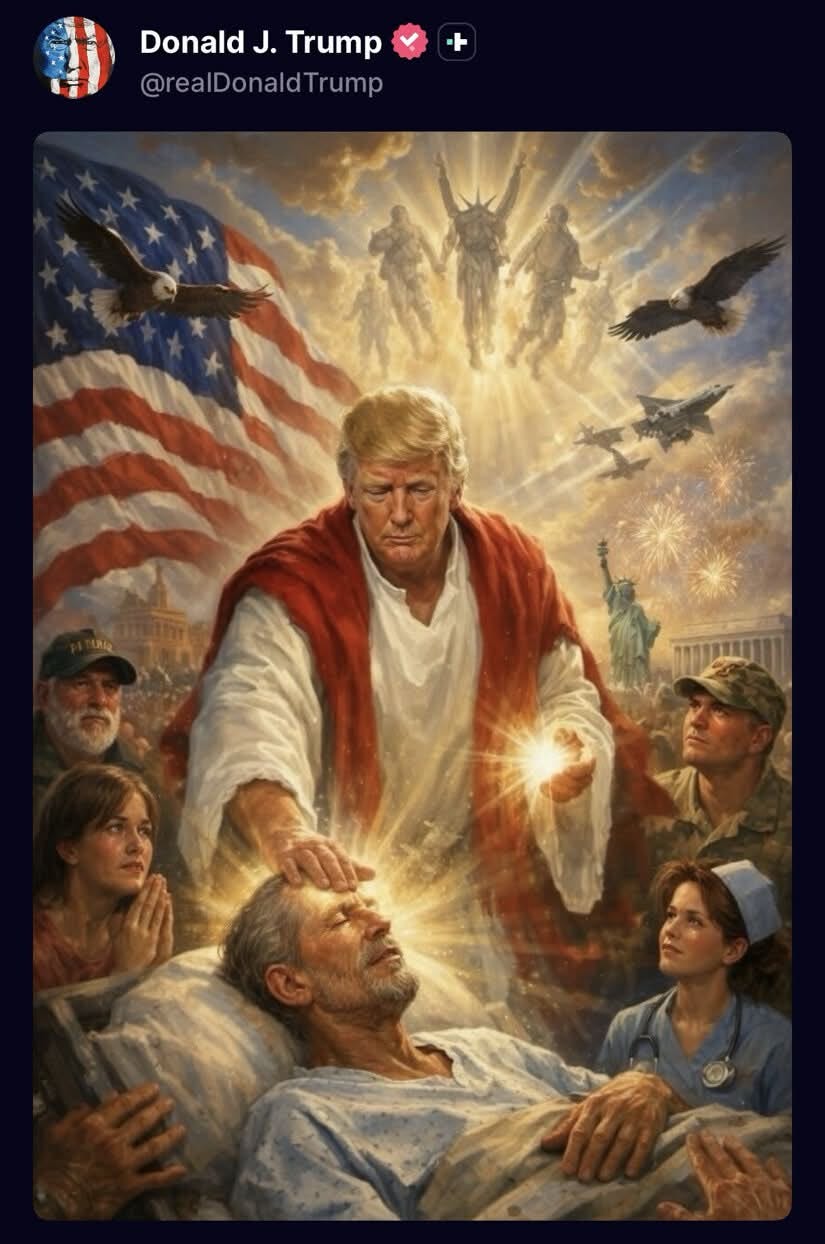
I’ll say plainly what that is: blasphemy. And if you call yourself a Christian and you are not willing to say that out loud, today is a good day to ask yourself why.
On Sunday night, Trump attacked Pope Leo XIV in a lengthy Truth Social tirade. Then, apparently unsatisfied, he promoted an AI-generated image of himself as some kind of American Jesus healing people. Let that sink in for a moment. The same man who just finished publicly humiliating the leader of 1.4 billion Catholics — the same man who has claimed God personally approves of his military decisions — turned around and posted a meme casting himself in the image of Jesus Christ.
This is not politics. This is not foreign policy. This is a man telling you, with a picture, who he thinks he is.
Trump and his Defense Secretary Pete Hegseth have repeatedly invoked God in public messaging during the Iran war, with Hegseth framing the war effort as divinely supported and using scriptural justification. And when Pope Leo pushed back — when the first American-born pope in history said that Jesus “rejects war, whom no one can use to justify war” — Trump responded by calling him “WEAK on Crime” and “terrible for Foreign Policy,” and demanding the Pope “stop catering to the Radical Left.”
Let me read you something from the Sermon on the Mount. Matthew 5:9: “Blessed are the peacemakers, for they will be called children of God.” The Pope quoted that verse when defending himself on the plane to Africa. He wasn’t being political. He was citing Jesus.
Trump’s response to the Beatitudes is, apparently, that they’re too soft on crime.
This didn’t start yesterday. Back in 2015, just months after launching his presidential campaign, Trump took aim at Pope Francis, claiming the pontiff failed to recognize the danger of ISIS. In early 2016, after Francis said building walls wasn’t Christian, Trump called the Pope’s comments “disgraceful” and suggested he was “a pawn” of the Mexican government. A decade of this. A decade of attacking the moral authority of the Church whenever it dared to speak inconvenient truth to his power. And every time, too many Christians shrugged.
I am a Protestant. I don’t agree with the Catholic Church on everything — that’s what makes me a Protestant. But I know what the body of Christ looks like when it speaks with one voice, and I know what an assault on it looks like too. When you attack the Pope for quoting the Sermon on the Mount, you are not attacking a political opponent. You are attacking the Word of God as spoken from the lips of the church.
There is a word in Scripture for what Trump did yesterday with that image. In Exodus 20:4, the second commandment: “You shall not make for yourself an idol.” In Isaiah 14, the prophet describes the spirit of pride that says “I will make myself like the Most High” — and uses it as the defining sin of a fallen power. In the New Testament, 2 Thessalonians 2 warns of “the man of lawlessness” who “exalts himself above every so-called god or object of worship, so that he takes his seat in the temple of God, proclaiming himself to be God.”
I am not calling Trump the Antichrist. I am calling him a man who shared a picture of himself as Jesus Christ. Those are not the same claim. But I am asking every Christian who saw that image and felt a twinge of unease — trust that twinge. The Spirit sometimes speaks in discomfort.
That phrase the Pope used — delusion of omnipotence — should have landed like a stone in every Christian heart in America. Because we have watched this president claim that God approved his military strike. We have watched his administration invoke Scripture to justify bombing a civilization. We have watched him float between threats of total annihilation and declarations of victory, all while claiming divine favor. And now we have watched him post himself as Jesus.
The Pope’s response to all of it was simply this: “Enough of the idolatry of self and money! Enough of the display of power! Enough of war!”
Enough. That word.
Now I want to speak directly to my fellow evangelicals. I know what you’re going to say, because I’ve heard it for years. But he’s pro-life. I get it. I really do. The protection of unborn life is a core conviction for millions of sincere Christians, and I respect that conviction deeply. But I need you to sit with a few hard questions.
How many abortions has Donald Trump personally paid for? This isn’t a rhetorical jab — it’s a documented question that his own former associates have raised publicly and never been credibly denied. The man you’ve handed your moral authority to has lived a life about as far from the pro-life ethic as it is possible to live. Multiple marriages, decades of bragging about infidelity, and a personal history that makes a mockery of the family values framework evangelicals spent thirty years building.
And here’s the thing that should shake you even more: in the first full year after the Supreme Court overturned Roe v. Wade, an estimated 1,037,000 abortions took place in the United States — the highest number measured in over a decade. The most recent data show abortion volume continuing to climb. The thing you were promised would reduce abortions — the thing you gave up your credibility, your witness, and your integrity to achieve — has not reduced abortions. They went up.
I say this not to relitigate Roe. I say this because the pro-life voting bloc was handed a specific promise: support this man, get judges, end abortion. The judges came. The ruling came. And abortions went up anyway. The deal didn’t deliver. And in exchange for that deal, the American evangelical church traded its prophetic voice, its moral clarity, and now apparently its willingness to say that a president cannot post himself as the Messiah without consequence.
That is not a trade. That is a surrender.
David French, writing for the New York Times, put it plainly: there is behavior so self-evidently wrong that merely seeing it should lead to fury and disgust. He expressed concern that some evangelicals are so captured by Trump that they won’t unite with their Catholic brothers and sisters in response to what he called outright blasphemy and intolerable attacks on the pope. He’s right to be concerned. Because we’ve been here before. Every time Trump has crossed a line that should have broken the spell — mocking a Gold Star family, bragging about assaulting women, pardoning people who attacked police officers, threatening to destroy a whole civilization — the evangelical community has either gone silent or found a reason to justify it. The silence is no longer neutral. At some point, silence is endorsement.
I am asking Christians — Protestant, Catholic, doesn’t matter — to say out loud what you know to be true in your hearts. Not for the Democrats. Not for the media. Not for Adam Kinzinger. For the integrity of your own faith. For the witness of the Church in the world. For the simple, irreducible truth that Jesus Christ is not a meme. His image is not a political tool. His name is not a brand.
Pope Leo said it as well as anyone could: “Blessed are the peacemakers. I will not shy away from announcing the message of the Gospel and inviting all people to look for ways of building bridges of peace and reconciliation.”
That’s the Gospel. That’s the church doing its job. And it should not require courage to say so. But apparently, right now, it does.
So I’m asking for that courage. From Republicans with a platform. From pastors with a congregation. From Christians with a social media account and a conscience. You don’t have to agree with the Pope on immigration or Iran policy to look at a president sharing an image of himself as Jesus Christ and say: this is wrong. This violates something sacred. This has gone far enough.
Because if we can’t say that — if we can’t hold that line — then I’m not sure what line we were ever actually holding.
Matthew 6:24: “No one can serve two masters.”
Choose.
And one more thing — let’s talk about Hungary, because what happened there yesterday deserves a moment.
Viktor Orbán, after sixteen years of dismantling Hungarian democracy from the inside, got voted out in a landslide. His replacement, Péter Magyar, won a two-thirds supermajority — the same kind of parliamentary dominance Orbán once used to rewrite the constitution and entrench his own power. The crowd in Budapest chanted “Russians go home” — a phrase that echoes back to the 1956 uprising against Soviet occupation. Think about that imagery for a second.
This matters enormously for Ukraine. Orbán was Putin’s man inside the European Union. He blocked, stalled, and vetoed EU military and financial aid to Ukraine at every turn, all while maintaining cozy energy ties with Moscow. There are credible reports that members of his own government were quietly sharing the contents of EU meetings with the Kremlin. He was not just an obstacle — he was arguably an active asset for Russia operating from inside the Western alliance.
That’s over now. Magyar has pledged to rebuild Hungary’s relationships with the EU and NATO, and his victory is expected to immediately unlock billions in EU aid to Ukraine that Orbán had frozen. The Kremlin just lost its most reliable veto inside Europe.
Oh, and one more detail worth savoring: JD Vance flew to Budapest days before the election specifically to campaign for Orbán. Trump personally called into a rally for him. The full MAGA machine was deployed to keep their favorite authoritarian in power.
The Hungarian people said no anyway. Seventy-seven percent turnout — the highest since the fall of communism. Democracy, it turns out, isn’t dead. Sometimes it just needs the right moment to wake up.
Video for paid members:
