


One of the questions I get most often from people watching the chaos in Washington is actually a very simple one. If members of Congress know something is wrong, and if they’re retiring anyway, why don’t they just do something about it?
People aren’t usually asking about the loud voices. They’re not asking about the members who built their entire careers around outrage. They’re asking about the quieter ones. The members who privately admit that much of what is happening isn’t right. The ones who shake their heads in the hallway, or pull you aside to say, “This isn’t what the party used to be.” Or the ole “concerned” tweets.
The public assumption is that a retiring member of Congress should be the freest person in the building. They don’t have to worry about reelection. They don’t have to worry about campaign donors or primary challengers. Their political future, at least in that role, is already decided. So why wouldn’t they be the people willing to stand up and use the power they still have?
The reality is that even the “good ones” rarely do.
The first reason is pressure. Turning against your own party in a meaningful way is one of the hardest things a member of Congress can do. That pressure is not abstract. It is immediate and personal. Colleagues stop talking to you. Leadership threatens to strip committee assignments. Activists mobilize against you. Donors start making phone calls. Your staff gets dragged into the fight. The anger comes from all directions.
Congress is an intensely tribal place. Breaking with the tribe in a symbolic way—casting a single vote or making a speech—already carries consequences. Breaking with the tribe in a way that actually disrupts the system is something far bigger. It means actively standing in the way of your own team. It means becoming the person who forces uncomfortable decisions.
But the second reason is the one people rarely talk about openly.
Money.
Members of Congress understand that when they leave office there is a very lucrative ecosystem waiting for them. Lobbying firms, consulting contracts, corporate boards, speaking engagements, think tank fellowships. Washington has built an entire post-congressional economy around former members.
The value of a former member of Congress in that world isn’t just their knowledge. It’s their relationships. It’s their access. It’s the ability to pick up the phone and call a former colleague and get a meeting. It’s the ability to walk a client into an office on Capitol Hill and say, “I used to serve with these people.”
That access is worth a lot of money.
But access depends on one thing above all else: not burning down the relationships that give you that access in the first place. If you spend your final months in Congress openly rebelling against leadership, embarrassing your colleagues, or shutting down the legislative process, those relationships disappear very quickly. The phone calls stop getting returned. The doors quietly close.
And so many members, even the ones who know better, simply ride out the clock. They keep their heads down. They make a few speeches. Maybe they cast a protest vote here or there. But they never actually use the leverage that they still have.
The frustrating part is that the leverage can be very real.
The House of Representatives currently runs on extremely thin margins. Sometimes the difference between control and paralysis is just a handful of votes. In certain moments, the entire functioning of the chamber can hinge on just one or two members.
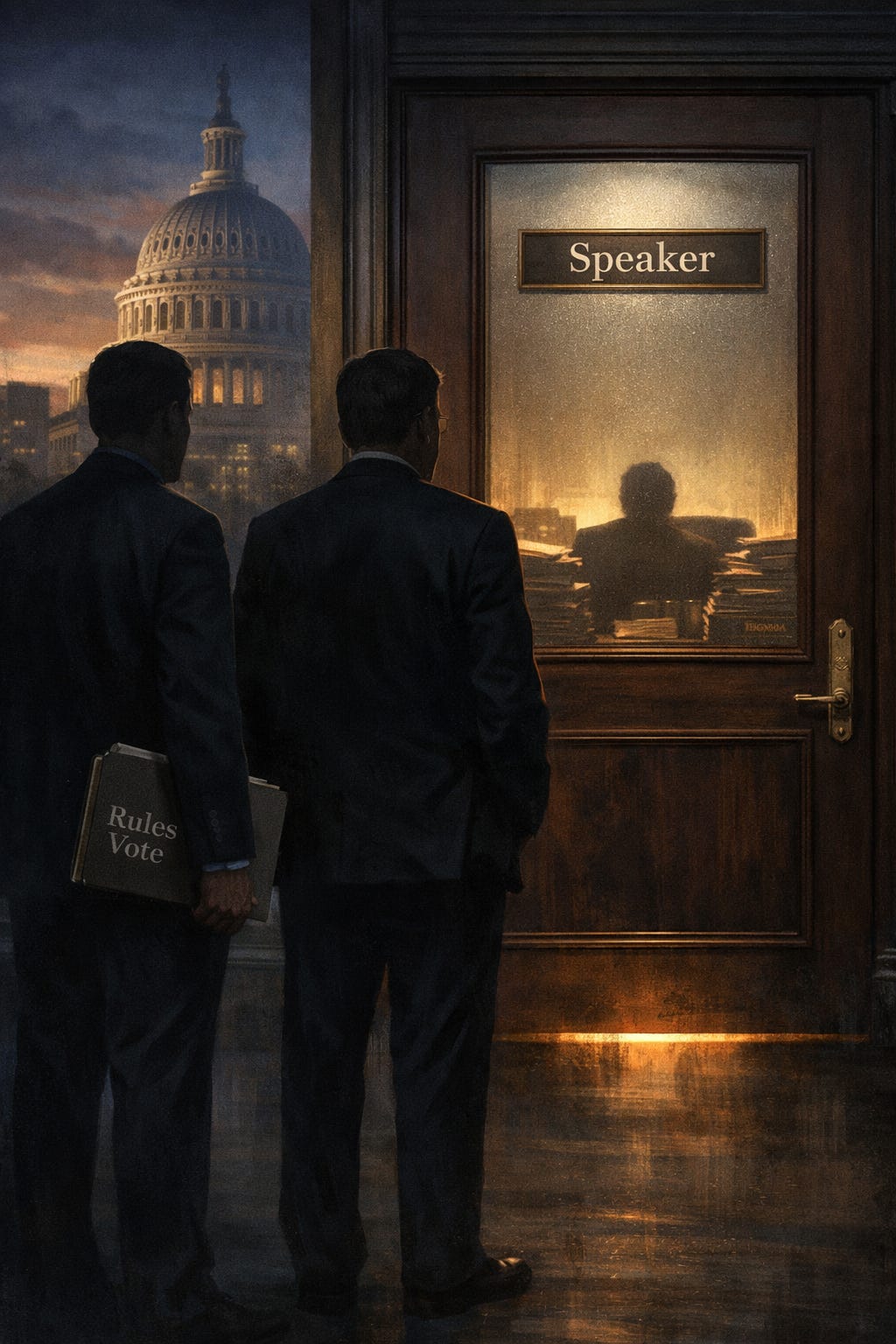
Imagine, for example, that two Republican members who are retiring walk into Speaker Mike Johnson’s office and tell him something very simple. They say they will vote with Democrats against every single procedural motion on the floor. They will vote against every rule that brings legislation up for debate. They will vote with the minority on every motion to recommit.
In the House, those procedural votes are everything. Without the rule vote, legislation doesn’t even come up for debate. Without procedural control, the entire legislative machine stops moving. Two members could effectively paralyze the chamber.
Not forever, but long enough to force something that leadership desperately wants to avoid: negotiation. Those two members could say the House will remain frozen until Ukraine aid is brought to the floor. They could demand a vote on a war powers resolution. They could force consideration of issues that leadership would rather avoid.
It would not require a revolution. It would simply require two members deciding that their conscience matters more than their future consulting contract.
But moments like that almost never happen. Even members who know something is wrong often continue calculating the personal cost. They wonder whether this will destroy their relationships with colleagues. They worry about what doors might close after Congress. They worry about whether the people they served with will view them as traitors.
And so the system rolls forward.
When I left Congress, I thought a lot about something that most members try not to think about while they are there. Your time in Congress will define you publicly for the rest of your life. Unless you go on to become president, governor, or something similarly high-profile, your years in Congress are the chapter people remember when your name comes up.
I spent twelve years in Congress. Whether I like it or not, those years will shape how people see me for the rest of my life. My son will eventually read about that time. One day my grandchildren will read about it too. I will have to live with the choices I made and the things I chose not to do.
Every member of Congress understands this at some level, but the pressure of the moment makes it easy to forget. The meetings, the votes, the constant political noise, and the fear of angering colleagues all combine to create a powerful incentive to simply survive the moment. Many members convince themselves that the safest path is to keep their heads down until retirement.
Eventually the moment passes.
Every political movement fades. Every era becomes history. When that happens, the calculations that seemed so important in the moment suddenly feel much smaller. The consulting contracts and board seats fade into the background, but the historical record remains.
One day MAGA will sit where may stupid political movements eventually sits: in the museum of bad ideas. Future generations will look back on this era the same way we look back on McCarthyism or the politics of segregation. They will study how it happened and who stood up to it.
Many of the people who quietly went along with it will eventually realize something uncomfortable. They had more power than they admitted to themselves at the time. They had opportunities to push back, to slow things down, to force debate or accountability.
They did not have the power to fix everything, but they had the power to do something.
Years from now, when the pressure of the present moment is gone, many of them will look back on that time with a quiet kind of shame. They will remember the private conversations in hallways where everyone admitted that something was wrong. They will remember the meetings where colleagues whispered their concerns. They will remember the moments when just a few members could have changed the trajectory of the House.
And when they think back on those moments, they will have to confront a very simple question.
Why was I such a coward?
Apologies, accidently turned off comments for this one. Back on!
So politicians start their careers by promising to fight for the people, and end their careers protecting themselves. This system stinks.