


Video for paid subscribers follows article
For years we have heard the same talking point from the Trump administration and its allies: government waste is the problem. The answer, they said, was to slash programs, dismantle agencies, and create flashy new outfits like the so-called fake agency Department of Government Efficiency — DOGE — to root out fraud and save taxpayer money. The pitch was simple. Government was bloated, and adults were finally back in charge.
But the reality looks very different.
According to a watchdog analysis, the Department of Defense spent $93.4 billion on grants and contracts in September 2025 alone, with nearly half of that money spent in the final five business days of the fiscal year.
Anyone who has worked inside government understands that the end of the fiscal year can become a mad scramble to spend money before it disappears, but the scale of what happened here raises serious questions about priorities.
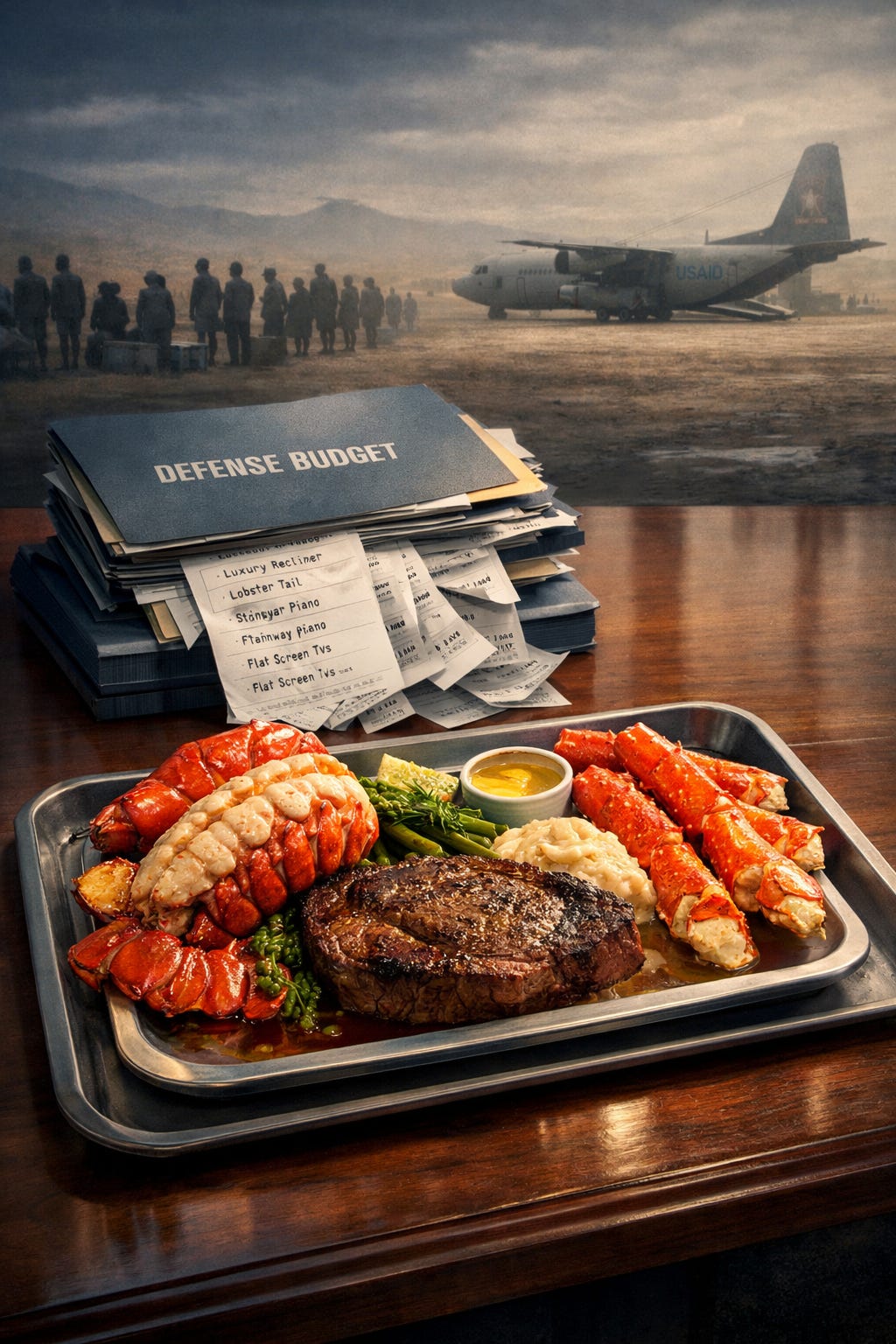
Some of the spending is almost comical if it weren’t real taxpayer dollars. The Pentagon spent $6.9 million on lobster tail, $2 million on Alaskan king crab, $15.1 million on ribeye steak, and $1 million on salmon in September alone. There were 272 orders of doughnuts totaling $139,224, along with $124,000 for ice cream machines and $12,000 for fruit basket stands.
That same spending spree included $60,000 for Herman Miller recliners, a $98,000 Steinway piano for the Air Force chief of staff’s home, and millions spent on electronics like Apple and Samsung devices. Even more staggering, the Defense Department spent $3.5 billion on cable television services.
At the same time Americans were struggling with rising grocery costs, borrowing money just to buy food, and falling behind on car payments, the Pentagon was filling shopping carts with lobster and ribeye.
What makes this particularly jarring is that this administration simultaneously dismantled programs that actually matter to people around the world. Under the banner of eliminating waste, they gutted much of the United States Agency for International Development. For decades, USAID helped prevent famine, stabilized fragile regions, and projected American compassion and leadership around the globe.
That money fed starving people.
But apparently feeding the world was wasteful. Lobster for the Pentagon was not.
I spent years in uniform flying the RC-26B surveillance aircraft with the Air Force. It wasn’t glamorous. It wasn’t flashy. But it was effective. The aircraft supported counter-terrorism missions and provided intelligence that helped protect American troops on the ground.
In 2023, the program was cancelled.
Why? Because the Air Force didn’t want to spend about $20 million a year to keep it going.
Think about that for a moment. The entire annual cost of a program that directly supported operational missions was less than what the Pentagon spent on lobster tail in a single month. Programs that actually protect American lives were eliminated in the name of efficiency, while luxury purchases and end-of-year spending binges rolled on.
This is the fundamental problem with the politics of “waste.” The loudest critics of government spending are often the least interested in actually fixing it. They are interested in headlines and ideological targets. Programs that help poor people or foreign populations are easy political punching bags. Quiet spending inside the defense bureaucracy is not.
Now, a quick aside. Yearly budgeting and spending can be difficult. Let’s just take my personal Congressional budget per year of around $1.3 million. That covered everything from salaries, new printers, paper, and correspondence, to travel. If I went over my budget for the year, I was personally on the hook for the overspending. So naturally, we saved a lot of expenses for the end of the fiscal year so that we could make sure we stayed within the allowance. Some end of year splurging is understood, but this amount from DOD? Simply insane.
Real fiscal responsibility is not about cutting programs that feed the hungry or abandoning alliances that stabilize the world. It’s about making serious choices about priorities.
If the government wants to talk about waste, we should start with the billions spent on furniture, electronics, luxury food, and end-of-year spending sprees that do little to strengthen national security.
Because the truth is simple.
We didn’t stop feeding the world to save money.
We stopped feeding the world so someone else could buy lobster.
Video for paid subscribers
