


Video discussion for paid subscribers follows article
Let me be direct with you, because I think you deserve that, and because frankly I’m not sure enough people in positions of influence are willing to say it out loud right now: if this ceasefire holds, the United States lost. Not “didn’t fully win.” Not “achieved mixed results.” Lost. And the victory laps being run out of the White House today — the Truth Social posts, Pete Hegseth at the Pentagon podium declaring “Operation Epic Fury” a “historic victory” — are the kind of performance that would embarrass any serious military strategist, and that should embarrass every American who’s been paying attention.
I spent years in Congress on the Foreign Affairs Committee. I flew combat missions. I watched administrations of both parties navigate the impossible geometry of the Middle East, where every action creates three new problems and every adversary has been playing the long game for centuries longer than we have. I say all of that not to wave credentials around, but because I want you to understand that what I’m about to tell you isn’t partisan sniping. It’s an honest assessment from someone who has spent a long time thinking about what it means to use American military power, and what it means when you use it badly.
Here’s what actually happened. In January of this year, the Iranian people rose up in the largest protest movement since the 1979 Islamic Revolution. They were in the streets. They were risking their lives. And Donald Trump, true to his instincts for a crowd-pleasing moment, promised to help them. He threatened military action if Iran’s regime didn’t stand down. He talked about regime change. He positioned the entire military buildup that followed as being, in part, about liberating the Iranian people from their oppressors. Those people heard that. They believed it, or at least they hoped. And now, today, with the ink barely dry on this two-week ceasefire, the regime is still in power. A younger Ayatollah Khamenei has already used his first public address to declare that Iran’s leverage over the Strait of Hormuz “must continue to be used.” The Iranian people who put their bodies on the line are now in a worse position than they were before — the regime that massacred thousands of them in January has survived a U.S.-Israeli bombing campaign, declared victory over America, and emerged with more economic leverage than it had when the war began. If you promised those people we were coming to help, you owe them an honest accounting of what just happened.
What just happened is this: Iran, which had closed the Strait of Hormuz — the waterway through which roughly one-fifth of the world’s oil and LNG passes every single day — has now turned that chokepoint into something that may prove more dangerous than a closed strait ever was. They’ve built a toll booth. Since mid-March, the IRGC has been charging ships up to two million dollars per transit, collecting payments in Chinese yuan and cryptocurrency, and Iran’s parliament has already advanced formal legislation — the “Strait of Hormuz Management Plan” — to codify this arrangement permanently. The numbers are staggering. At a fee of two million dollars per tanker on the roughly twenty million barrels of oil that transit the strait daily, analysts at Foreign Policy and CNN have calculated potential revenues exceeding eight hundred million dollars a month. Annualized, that is a sanctions-busting revenue stream that dwarfs anything the Trump administration was ever going to offer Iran at a negotiating table. Some estimates, accounting for the full scope of energy traffic at scale, reach into figures approaching ninety billion dollars a year. Secretary of State Rubio himself called this illegal and unacceptable at a G7 meeting. But illegal and unacceptable doesn’t mean it isn’t happening, or that we have a credible plan to stop it.
And let’s talk about what we didn’t accomplish, because the celebration requires us to. Iran’s missile capacity was degraded — yes. Iranian naval assets were struck. Khamenei was killed. But Iran’s missile program was not destroyed. Within hours of the ceasefire announcement, Iran was still launching missiles at Gulf states. Kuwait reported significant damage to oil facilities and water desalination plants. The UAE activated air defenses against Iranian drones. The enriched uranium stockpile — the nuclear program that was supposed to be the central justification for this entire campaign — is still in place. Trump himself, in a Truth Social post this morning, talked about “working with Iran to dig up and remove buried uranium,” which is a remarkable thing to post as a victory statement. If the uranium is still buried in Iran, and we’re hoping Iran will let us dig it up, we have not resolved the nuclear question. We have deferred it, at enormous cost, to a negotiation that Iran now enters with significantly more leverage than it had in February.
I want to be clear about what happened diplomatically, because I think history needs to record it accurately. Trump went from threatening to wipe out Iran’s “whole civilization” — bridges, power plants, water treatment facilities, the kind of targeting that legal experts said would constitute war crimes — to agreeing to a two-week ceasefire brokered by Pakistan in the span of about twelve hours. He went from “annihilation” to “let’s talk in Islamabad on Friday” in the time it takes to fly across the country. Iran’s Supreme National Security Council has already described the deal as “an enduring defeat for Washington” and noted that the U.S. accepted Iran’s own ten-point proposal as the basis for talks. Iran is now calling it — loudly, publicly, to their own population and to the world — a victory. When your adversary is calling it a victory and your own Vice President is calling it a “fragile truce,” those two assessments are not both correct. One side has a cleaner read on what just happened.
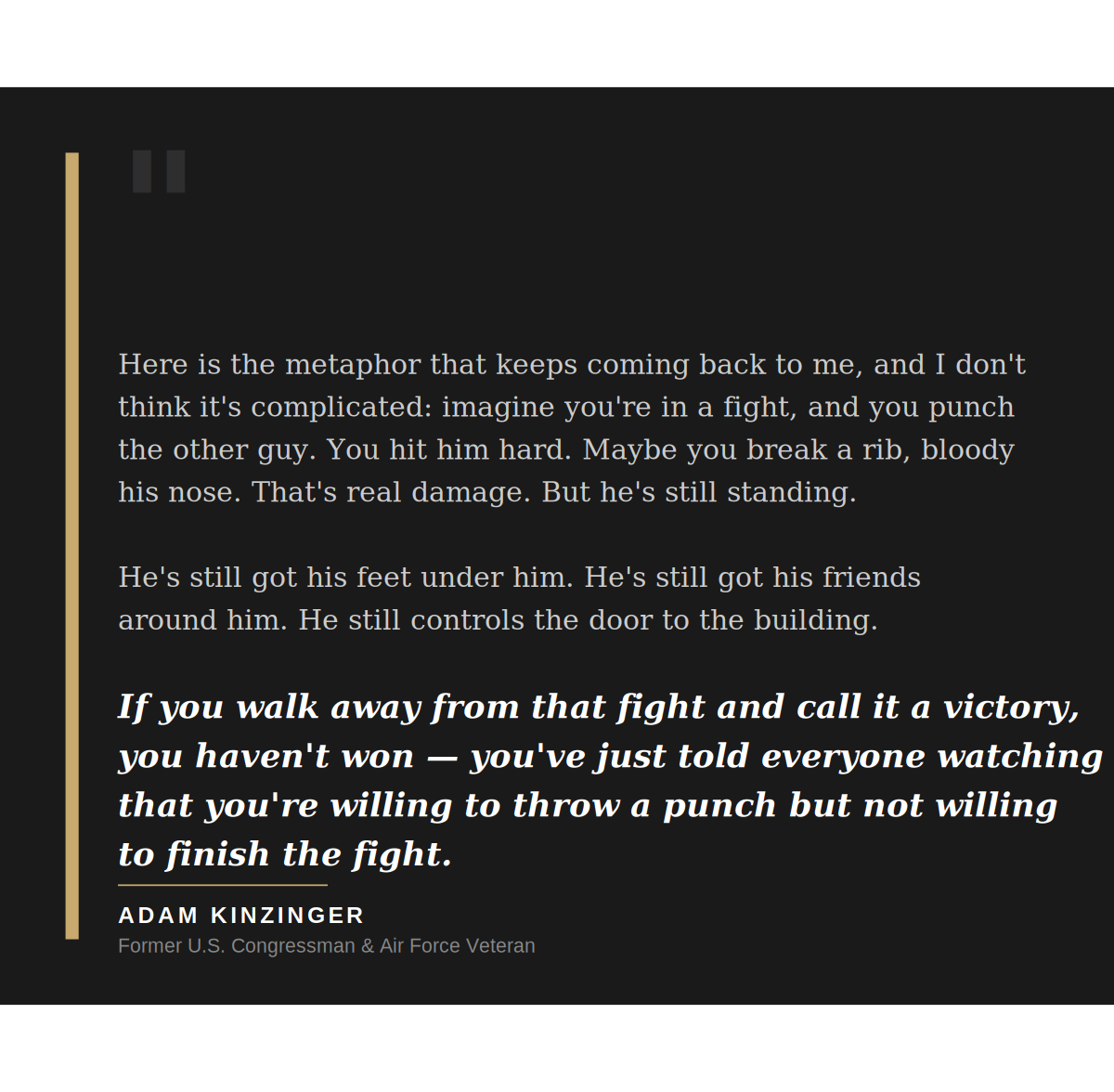
Here is the metaphor that keeps coming back to me, and I don’t think it’s complicated: imagine you’re in a fight, and you punch the other guy. You hit him hard. Maybe you break a rib, bloody his nose. That’s real damage. But he’s still standing. He’s still got his feet under him. He’s still got his friends around him. He still controls the door to the building. If you walk away from that fight and call it a victory, you haven’t won — you’ve just told everyone watching that you’re willing to throw a punch but not willing to finish the fight. The regime is in power. The regime’s fundamental purpose — and let me be very clear about this, because it matters — is to stay in power. Weapons, missiles, nuclear programs: these are not ends in themselves for a regime. They are tools for survival. They are what a government reaches for when it needs to deter the people who might remove it. We degraded some of those weapons. But the regime has survived. Which means the weapons that remain, and the new ones they will build, are now in the hands of a government that just demonstrated it can withstand an American bombing campaign and come out with a better negotiating position than it started with. That’s not a deterrence success. That’s a deterrence failure.
I’ve had the experience, sitting in Congress, of watching colleagues from both parties convince themselves that a good press conference was the same thing as a good outcome. I’ve watched smart people talk themselves into celebrating tactical moments as strategic victories. And I’ve watched the long-term costs of that confusion pile up — in lives, in credibility, in the slow erosion of American power. What I’m seeing today feels familiar. The stock market went up when the ceasefire was announced. Oil futures dropped. Everyone exhaled. And in that collective exhale, we risk losing the thread of what we actually went in there to do, and whether we did it.
We didn’t do it. And the Iranian people, the ones who were waving signs and calling for freedom while Trump was promising them the cavalry was coming, are now watching from a worse position than they were in before any of this started — with a regime that has survived, that has established a new revenue stream in their chokepoint, and that has a younger, more energized supreme leader who has already signaled he intends to press every advantage he now has. I think about those people a lot. I think about what it means to offer hope to people risking their lives for freedom, and then negotiate a deal their oppressors are calling a victory.
The broader lesson here is one that transcends this administration and this conflict, and it is one that I believe with every part of my experience in uniform and in government: if you are going to engage in war, you had better have the patience and the clarity of purpose to win it. Not to land punches. Not to generate good headlines for a news cycle. Not to give your Defense Secretary a podium moment. To win it. Military force, when it is used without a coherent theory of the outcome you’re trying to achieve — without the patience to see that outcome through, without the willingness to absorb political cost in service of a strategic goal — doesn’t create peace. It creates intermissions. It creates two-week ceasefires that both sides call victories. It creates toll booths in international straits and emboldened regimes and disillusioned populations who once believed in us. We are better than this. America’s military power and credibility deserve better stewardship than this. And the people of Iran, who looked toward us and dared to hope, deserved better than what they got.
Video for paid subscribers:
