


Unable to do a video for this today, because I am at a meeting with a group of Ukraine and world experts. This was a main topic of conversation:
Venezuela. Iran. Greenland. Minneapolis.
There’s so much to occupy our attention these days that it’s easy to lose track of the most consequential crisis in the world: The continuing war in Ukraine.
Nearly four years have passed since Russia invaded its western neighbor on the absurd pretext that Russian speakers in Ukraine were subject to “genocide” and Kyiv needed to be “denazified.” In truth, Russia’s dictator Vladimir Putin attacked to fulfill his dream of a new Russian empire. And when he ordered a massive invasion in February 2022, he and his generals expected to take the capital within days. It didn’t go that way.
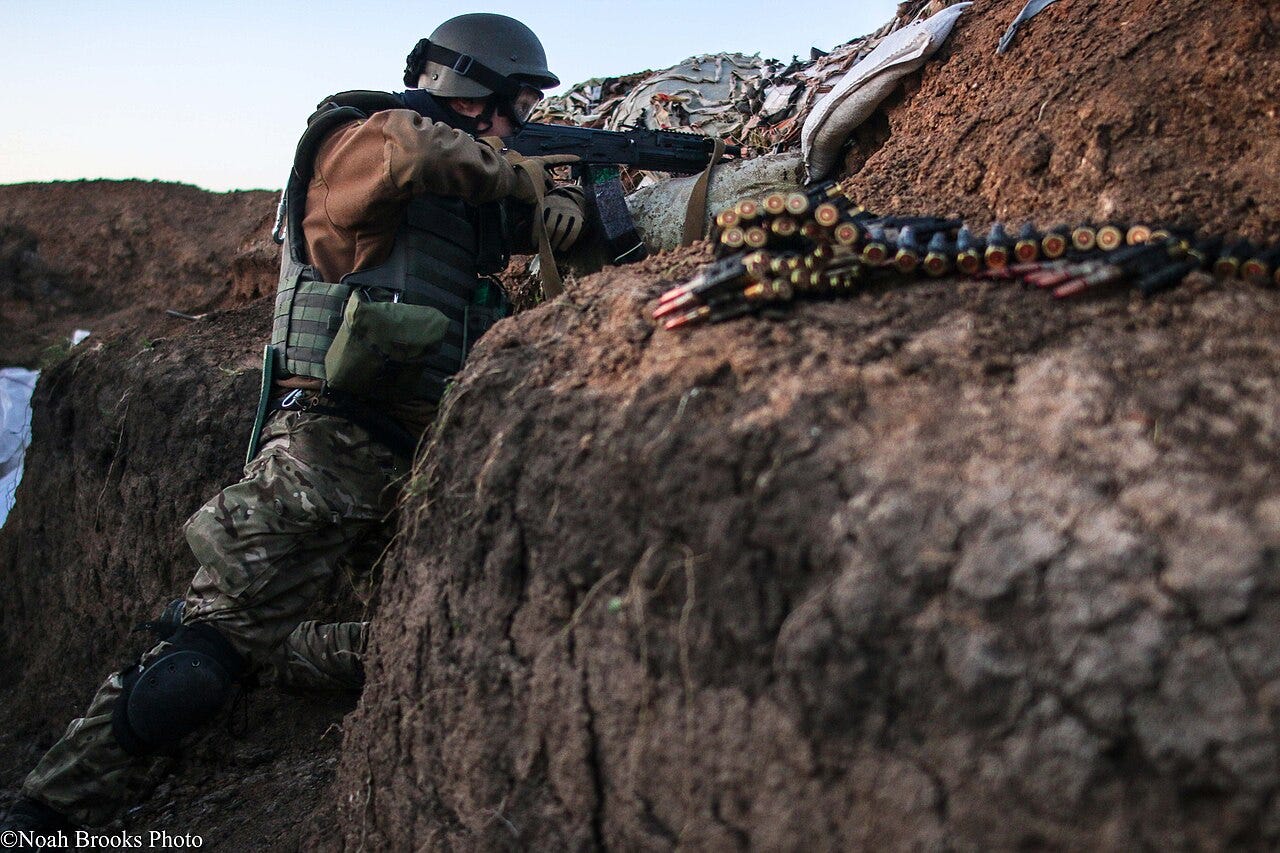
As you surely remember, the Russians were met by an astonishing bend-but-don’t break response from brilliantly commanded defensive forces. The Ukrainians proved expert at asymmetrical warfare, using small units that utilized anti-tank weapons and drones to stop armored columns in their tracks. Thus trapped, the tanks, personnel carriers, and trucks became easy pickings. As the Russians were forced to retreat, they suffered enormous losses, with as many as 6,000 killed in the first two weeks of the conflict.
Having driven the Russians back to the Eastern Region of Donbas, the Ukrainians have resisted the invaders for four years. It’s hard to overstate the magnitude of this achievement. Just consider;
Russia’s population is more than three times Ukraine’s.
Its economy is ten times Ukraine’s ($2.2 trillion Gross Domestic Product to Ukraine’s $190 billion)
Moscow’s standing army includes more than 1.3 million soldiers compared to Kyiv’s 900,000.
It has a 10 to one advantage in aircraft.
The exception, which has made all the difference, has been Kyiv’s brainpower. Month by month, the Ukrainian’s have upgraded their drones, making them less vulnerable and more capable. Its sophisticated drones are able to destroy Russian armor, decimate its infantry, and carry out attacks on the Russian homeland. Estimates of Russian casualties (dead, wounded, missing) range from 800,000 to 1.1 million. Ukraine’s losses are believed to be far less. (Estimates of losses on both sides come from outside observers, not the governments themselves.)
In addition to its superior drones, Ukraine has benefited from $130 billion in aid (weapons, training, humanitarian assistance) from the United States and $200 billion from the countries of the European Union. This assistance made it possible for Kyiv to keep fighting after it quickly drained its own arsenal. The arms have been essential, but it must be acknowledged that all of the fighting is being done by the Ukrainians themselves.
The reality of Russia’s failure was driven home when, on January 11, the length of the war in Ukraine surpassed its involvement in the Second World War. More than 1,400 days have passed since Moscow’s forces crossed into Ukraine. Russia has spent over $540 billion, and it has received direct assistance from Iran, North Korea, and China. (Iran sends Russia drones. China has provided essential manufacturing equipment and computer chips. North Korea has sent troops.)
Before the war, Russia boasted the third-biggest military spender in the world. Under Putin, it had sought to be regarded as a superpower on a par with the United States and China. This ambition was always ridiculous, as Moscow couldn’t come close to matching China’s sheer manpower and America’s astoundingly effective technology.
Similarly, Russia’s sphere of influence was tiny compared with America’s. It has become smaller in recent years as its Syrian ally Bashar al Assad was driven into exile in Moscow, and then President Nikolas Maduro of Venezuela was captured by U.S. forces and brought to New York to stand trial on drug charges. What military allies remain? Well, there’s tiny Cuba, isolated in the Caribbean, the hermit dictatorships of North Korea, Belarus, and Iran, which is beset by citizen uprisings
To understand Russia’s isolation, all you have to do is look at the countries that have sent weapons of trainers to help Ukraine. This includes 29 of the 32 countries of NATO, unlikely contributors like Cambodia, Argentina, and Colombia, and traditional U.S. allies such as Canada and Australia. Ireland and Iceland have sent non-lethal aid. Just a few months ago, Japan announced a $3 billion loan to Kyiv. Ukraine’s collateral? Interest on Russian assets frozen by the West.
In total, Western countries and their allies have frozen over $300 billion in Russian assets. More than $200 billion of this is in cash, but real estate, yachts, and other assets are included in the freeze. The Russian government and private individuals have been affected. Meanwhile, Russia has missed out on hundreds of billions in trade. This loss is estimated to have reduced annual GDP growth by more than one percent.
According to polls, three-quarters of the Russian people continue to support their troops, a natural tendency, but they are increasingly interested in peace talks. Given his persecution of opponents, which means there’s no alternative, Putin’s popularity remains extremely high.
Four years in, Putin is operating as if Russia has one national purpose -- to take all of Ukraine. He is counting on aid-fatigue diminishing Western support for Ukraine’s defenders. This effort must continue for as long as Putin persists. It may be a very long time.
“There’s so much to occupy our attention these days” that hardly anyone is talking about the Epstein files anymore. This can’t be a coincidence.
Thank you, Adam... I mentioned just yesterday - Russians have been trying to take Pokrovsk and re-take Kupiansk for over TWO YEARS. and they are still stuck. Poll after poll after poll is conducted to ask Ukrainians, and the answer comes back the same - Ukrainian people are not interested in surrendering to Russia and they do not trust any assurances of peace coming from Russia.