


Note: Video for paid subscribers follows article.
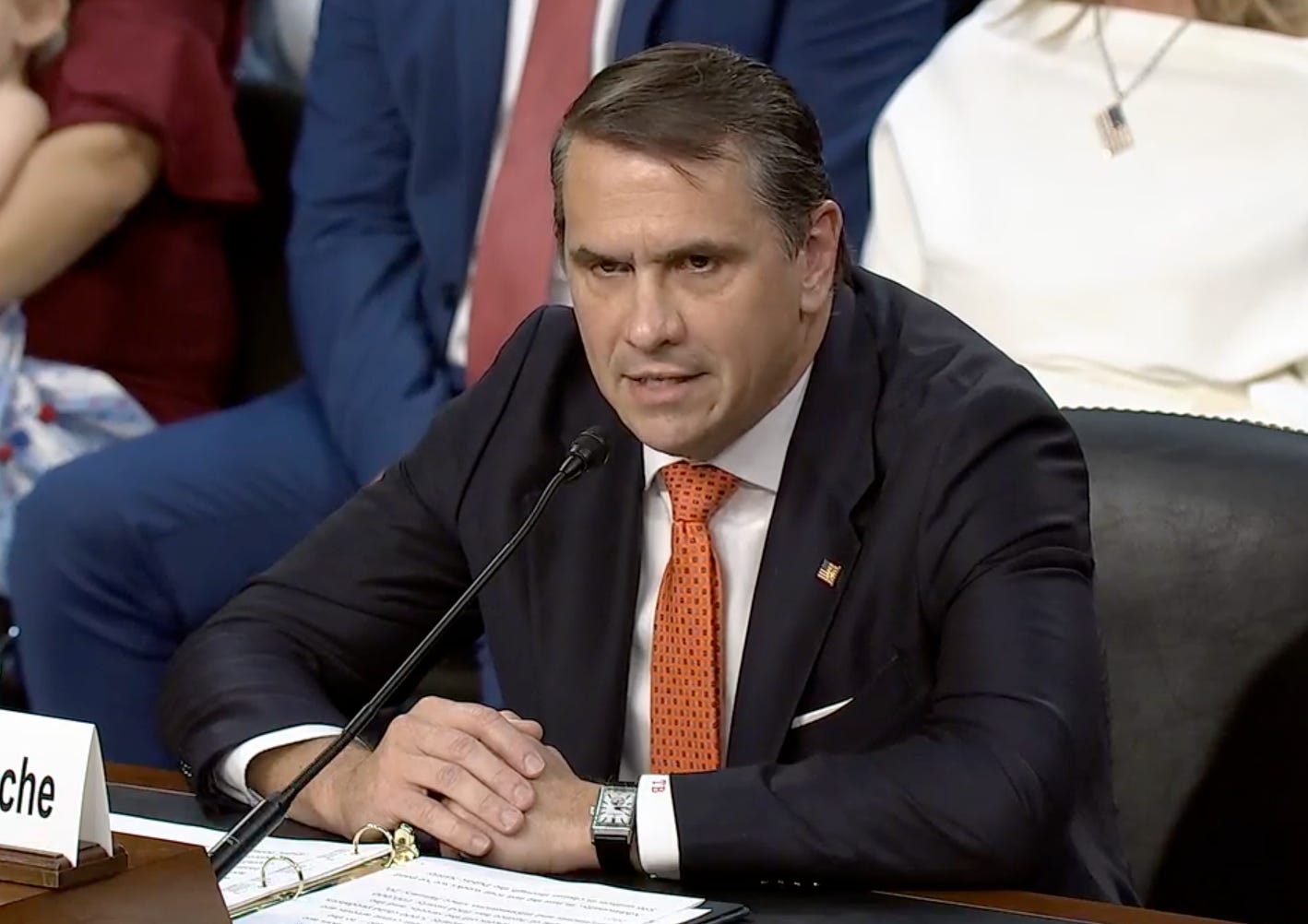
In Hart Senate Office Building Room 216 on Wednesday morning, black cloth covered Lindsey Graham’s empty chair where the South Carolina senator had spent years questioning nominees. Across the room, Todd Blanche took his place at the witness table and asked the Senate to make him Attorney General. But the most revealing piece of paper was not his prepared statement. It was a one-page order he signed in May beneath the Justice Department seal, declaring that the United States “RELEASES, WAIVES, ACQUITS, and FOREVER DISCHARGES” Donald Trump and his family from certain tax claims and is “FOREVER BARRED AND PRECLUDED” from pursuing them.
That document tells us more about Blanche than anything he said at his hearing. Senate Judiciary Chairman Chuck Grassley opened by telling him, “We’re not starting out from a blank slate. You have a track record.” Grassley meant it as reassurance. However, that record is exactly why Blanche should be rejected.
Blanche told the committee that the Trump administration was restoring the public’s “faith in justice.” Americans, he said, had watched the Justice Department turn against “many of you and a former president,” but “we are fixing that.” After reciting the department’s work against violent crime, fraud and drug cartels, he insisted, “None of this is Republican or Democrat.”
Prosecuting traffickers and violent criminals is not partisan. But those duties cannot launder the rest of his record. Blanche defined the loss of faith in justice through Trump and his allies, then offered the department’s ordinary work as a defense of its extraordinary abuses. Trust is restored when the attorney general can tell the president no—and when the public believes the answer will remain no after the president starts yelling.
Blanche’s résumé makes his conduct worse, not better. He spent nearly 15 years at the Justice Department, beginning as a contractor and paralegal before becoming a federal prosecutor and supervisor in the Southern District of New York. He later represented Paul Manafort, Igor Fruman and Boris Epshteyn before taking on Trump’s criminal cases. Trump, like every American, is entitled to vigorous counsel. The problem is that Blanche carried the loyalties of Trump’s defense team into an office whose client is the United States.
At his 2025 confirmation hearing for deputy attorney general, Blanche promised that “politics would play no role” in his decisions. Once in power, however, he defended Trump’s public demands for prosecutions, saying such communication from the president “should make every American happy.” Under Blanche, the department accelerated investigations of Trump’s perceived enemies.
Dick Durbin summarized the problem more bluntly on Wednesday. “In less than 18 months at the Department of Justice, you’ve shown you’re still President Trump’s personal attorney,” he told Blanche, recalling Blanche’s public declaration to Trump: “I love you, sir.” More than 1,200 former Justice Department employees oppose his confirmation. Their objection is not that he once represented Trump, but instead that he never stopped.
His answers about the Epstein files revealed the same instinct. Blanche acknowledged that “mistakes were made” when faulty redactions exposed victims’ identities and said he took responsibility. In nearly the same breath, he claimed that the White House had been “more transparent than any past administration” about Jeffrey Epstein. Blanche turned his admission into another boast. The administration’s handling of the files, in his telling, became evidence of its openness even when the question concerned mistakes that had endangered the privacy of victims.
The clearest evidence of his unfitness remains the Anti-Weaponization Fund, also known colloquially as Trump’s Slush Fund. The amount is sometimes misstated as $1.88 billion; it was $1.776 billion, a nod to 1776. The money would have come from the Treasury’s Judgment Fund and been distributed by a body selected largely by the attorney general. The plan purported to insulate individual payment decisions from judicial review, and it was broad enough to compensate Trump allies claiming they had been victims of “lawfare,” potentially including people prosecuted for January 6 offenses. Even Mitch McConnell called it “utterly stupid” and “morally wrong.”
Blanche announced the fund as a “lawful process.” Only after Republican senators revolted did he say it would not proceed. At Wednesday’s hearing, Senator John Cornyn noted that Trump had never agreed in writing to eliminate it and might sue the government for breaching the settlement. “I suppose they could bring a lawsuit and we would litigate,” Blanche replied, “but there’s no fund.”
That is the fund’s architect asking the Senate to trust his word that the machinery he built will never be switched on. Blanche does not deserve credit for dropping the match after other Republicans pointed out that he was standing in gasoline.
The fund grew out of Trump’s $10 billion lawsuit against the IRS over the leak of his tax information. The settlement purported to protect Trump, his family and his businesses from broad categories of tax audits and claims. The president was effectively suing agencies he controlled, while his former defense lawyer ran the department responsible for representing the government.
U.S. District Judge Kathleen Williams concluded that the case had been used to obtain taxpayer money and exemptions from audits and investigations. She wrote that Blanche’s ability to speak for both sides showed “there was only one party whose interests were being represented throughout this case.”
She also called his earlier testimony that there was “no mechanism” for judicial review “at best, misleading and, at worst, disingenuous.”
That should end the nomination. Senators do not need to decide whether Blanche is a cartoon villain or whether every decision he has made was corrupt. They must judge his fitness for an office carrying almost unmatched discretionary power. He has used public authority to reward a patron, protect his interests and pursue his enemies.
Robert Jackson, before becoming a Supreme Court justice and the chief American prosecutor at Nuremberg, warned that the greatest prosecutorial danger arises when “law enforcement becomes personal.” The prosecutor has enormous freedom to select whom to investigate, what charges to pursue and which conduct to overlook. When prosecutors base those choices on the president’s allies and enemies, the law becomes a tool of favoritism.
Consider John Mitchell, Richard Nixon’s law partner and campaign manager who became attorney general, helped corrupt the Justice Department and went to prison for his role in Watergate. Blanche is not Mitchell, but the institutional pattern is familiar: A president’s private loyalist enters the Justice Department, insists that devotion to the president is compatible with impartial justice and treats old boundaries as bureaucratic superstitions.
I served in a Republican Party that talked constantly about law and order, limited government and politicized prosecution. Those principles were imperfectly honored, but they were recognizable as principles. Blanche represents the next stage of the party’s decline: redesigning government so that loyalty to Trump becomes the measure of legal legitimacy. Investigating him is weaponization. Protecting him is justice. Paying his allies is redress. Shielding his taxes is settlement.
A man can be intelligent, disciplined and accomplished and still be morally unfit for public power. Those qualities can make the danger greater, because he knows which doors to close, which phrases to use and which signatures make private loyalty look like official action.
Blanche is not unsuited to be the attorney general because he defended Trump. He is unsuited because, after taking an oath to serve the country, he continued to behave as though Trump were his only client.
Video discussion for paid subscribers:
