


Note: video for paid subscribers follows article.
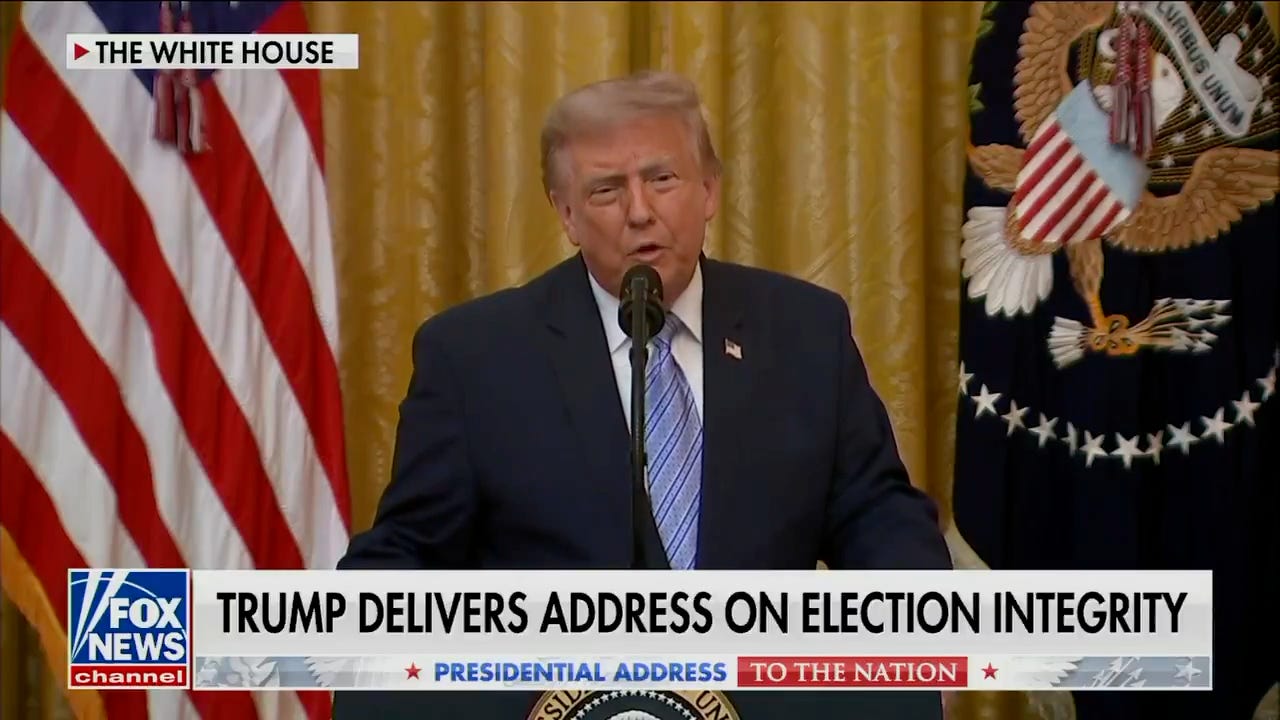
Donald Trump stepped to the microphone Thursday night and placed the 2020 election back on the table, not as a settled vote but as a body he insisted had been tampered with. For 25 minutes, he offered no evidence that a foreign government changed a vote, that fraudulent ballots altered the result, or that Joe Biden had not won. Instead, he used the presidency to make suspicion itself sound official.
Trump declared that “no country can be great without fair and honest elections.” That is true. But everything that followed revealed that he treats election integrity not as a principle but as a privilege—his privilege to decide which elections count.
The best way to understand the speech is to notice what Trump did not discuss. He did not question the 2016 election, which he won despite losing the popular vote, or the 2024 election, which returned him to the White House. He dwelled on 2018, when Republicans lost the House, and 2020, when he lost the presidency. In Trump’s theory of democracy, victory authenticates the system and defeat indicts it.
We know this because Trump once expressed confidence in the very protections he now ridicules. In February 2020, intelligence officials briefed him on the government’s efforts to defend the election and secure voting machines. Former officials say Trump wanted to assure Americans publicly that the election would be safe. Then he lost. Only afterward did the system he had praised become a conspiracy vast enough to explain his defeat. The vulnerabilities did not suddenly appear on Election Day. What changed was the identity of the winner.
Changing How You Read the News: Here’s Why It Matters
Americans aren’t just disagreeing; we’re being shown completely different stories.
Every day, news outlets decide what to publish. In polarized media environments, audience demographics can split coverage. If you rely on only one side of the media spectrum, you could miss stories entirely, not because it isn’t credible, but because it doesn’t align with certain editorial priorities.
That’s why I’m often asked where I go to do research for my reporting. One of the main research tools I use is called Ground News. Ground News shows me how stories are being covered from different political perspectives, and it highlights “blindspots” where only left-wing or right-wing media is covering a story.
That kind of visibility is rare right now, and it changes how you understand the news. I’ve worked out a deal with them; if you want that level of insight every day, head to GroundNews.com/AdamK and subscribe to get 40% off the Vantage plan, the one I use.
Ground News is subscriber-funded, so they don’t rely on ads that could introduce bias. By subscribing, you support both our channel and their independent team working to keep the media transparent.
The omission of 2024 was revealing. Trump ignored foreign interference aimed at helping him win. U.S. intelligence officials said Russia produced more AI-generated content to influence the 2024 race than any other foreign power and sought to boost Trump over Kamala Harris. The intelligence community also concluded that Vladimir Putin authorized a 2020 influence operation aimed at hurting Biden, supporting Trump and weakening confidence in American elections, while finding no evidence that any foreign actor manipulated votes. Trump dwelled on unsubstantiated allegations and stepped around the foreign operations that benefited him. Apparently, interference becomes a national emergency only when he can portray himself as its victim.
I know what it costs to tell that truth as a Republican. After January 6, I voted to impeach Trump. I joined the House committee investigating the attack, one of only two Republicans who served on it. My party censured me. Former colleagues treated me as a traitor. I left Congress, giving up my political career and, in the eyes of much of the Republican Party, my reputation. A threat mailed to my home promised to execute me, my wife and our five-month-old son.
I did not make those choices because I had stopped being a Republican, or because I suddenly agreed with Democrats about every policy matter. I made them because a constitutional republic cannot survive if political leaders teach citizens that losing is proof of betrayal. I believed that principle was important enough to lose a career over. I still do.
The most damning fact about Trump’s evidence is that it failed to prove his accusation. He cited suspicious voter-registration applications in Muskegon, noncitizens on voter rolls, foreign influence campaigns and vulnerabilities in electronic voting machines, but none established that illegal votes changed the outcome of an American election.
The Muskegon applications were intercepted before any ballots were cast, and studies have repeatedly found noncitizen voting to be exceedingly rare. After investigators examined millions of documents, a White House official acknowledged that the review had found no evidence that a foreign government changed votes.
Trump also blurred the distinction between influence and interference because that distinction ruins his story. Foreign governments spread propaganda, steal information and try to manipulate public opinion. Those are serious threats. They are not evidence that voting machines changed ballots or that Joe Biden did not win.
This is the method: collect legitimate concerns, isolated misconduct and technical vulnerabilities; strip away their context and proportion; place them beneath the presidential seal; then tell Americans the system is contaminated.
No election system is flawless. That is why we use paper records, audits, recounts, bipartisan canvassing boards and courts. Imperfection is an argument for safeguards. Trump turns it into an argument for permanent suspicion.
American history offers its own warning about the political uses of defeat. After the Civil War, former Confederates and their defenders constructed the Lost Cause, recasting military failure as moral nobility and blaming defeat on betrayal rather than on the cause itself. Trump has similarly transformed a documented loss into a mythology of victimhood. The comparison is not between the causes but between the methods: when a leader cannot accept losing, he invents a history in which he never truly lost. The grievance then becomes more useful than the truth, giving supporters an injury to avenge and permission to distrust any institution that refuses to validate it.
Trump has spent six years doing that to the 2020 election. Audits, recounts, Republican officials, his own attorney general and court after court failed to find fraud sufficient to change the result. His refusal culminated in a mob attacking the Capitol while Congress counted the electoral votes. Now he is placing the federal government behind the lie.
That is the danger in Thursday’s address. Trump urged Justice Department prosecutions, promised further federal action involving state election systems and promoted the SAVE America Act. At the same time, his budget proposes cutting $707 million from the federal cybersecurity agency charged with protecting election infrastructure. As Garry Kasparov warned, Trump is diminishing trust in elections, then using the distrust he created to justify giving himself more control over them.
The target is not actually 2020. It is November 2026.
Trump said, “We have very important elections coming up. We want those elections to be honest.” Coming from a president who accepts only favorable outcomes, that was less a reassurance than a warning. He is preparing supporters to see a Republican loss as evidence of fraud and federal intervention as the remedy. He is creating the pretext before the votes are cast.
Real election integrity requires a president to defend the process even when it disappoints him: to protect election workers, strengthen cybersecurity and tell supporters that citizenship includes the obligation to lose without inventing a conspiracy.
Democracy depends on evidence governing our doubts and on defeated candidates surrendering power when the evidence says they lost. I gave up my place in Congress because I believed that bargain was the foundation beneath every other political disagreement. Without it, the Constitution is just paper protected by people who no longer agree that votes are binding.
Trump wants Americans to believe I sacrificed my career over a fight that belongs to the past. Thursday night proved that the fight is still being waged. The question was never only whether the 2020 election would stand. It was whether any election Donald Trump loses will be allowed to stand. I sacrificed my career to defend a simple rule: In a democracy, the loser has to accept the result, or nothing else matters.
Video discussion for paid subscribers:
