


Happy Sunday, everyone. Are you ready for some good news?
This administration has spent years going after American science. It proposed the largest cut in NASA’s history, roughly a quarter of the whole agency and about half of its science programs. Researchers have been pushed out, labs consolidated, missions zeroed out on paper before anyone could even argue about them.
But last month, one groundbreaking telescope left the launch pad anyway. And the story of how it got there is our good news this Sunday.
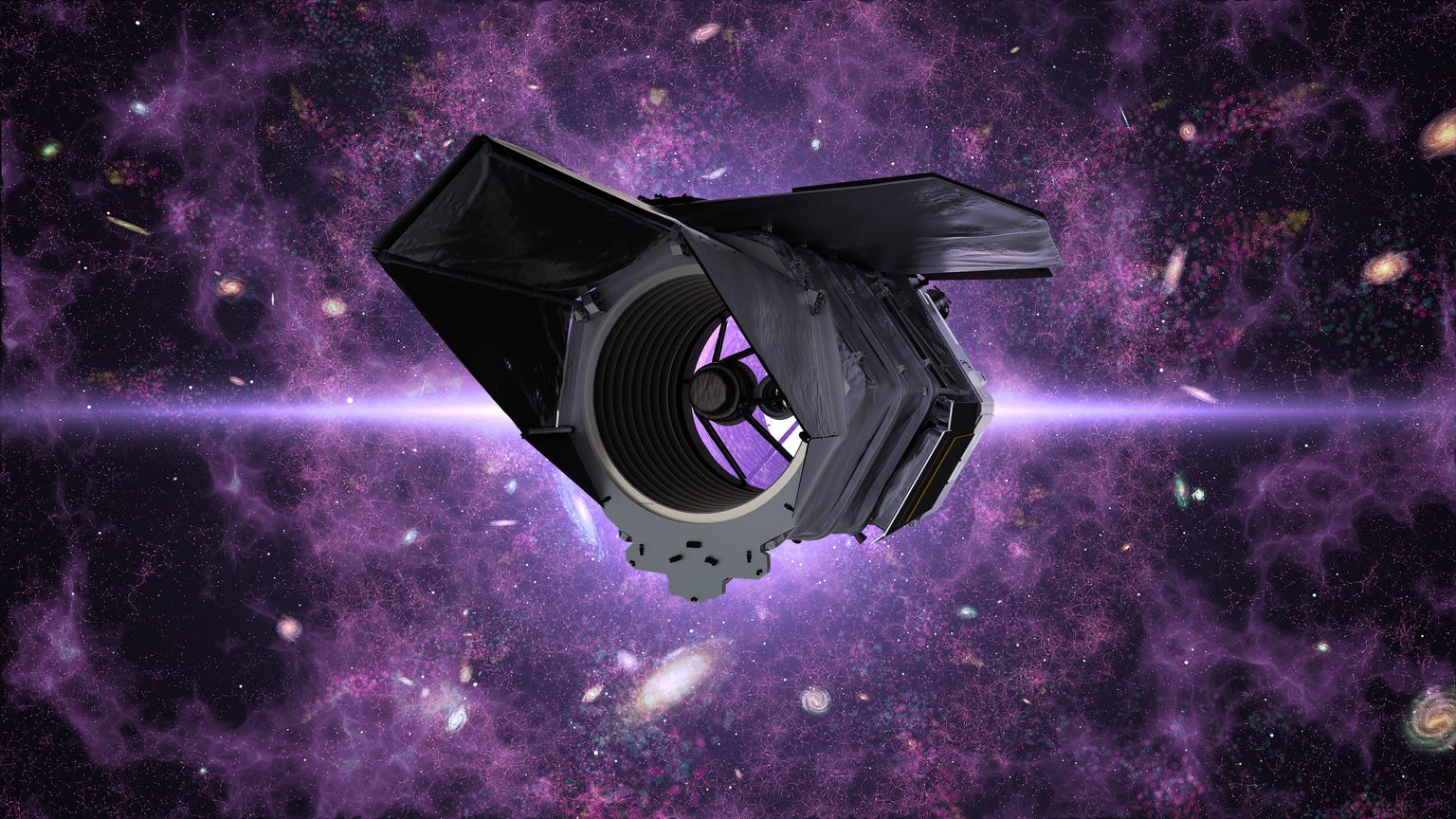
It’s called the Nancy Grace Roman Space Telescope, named for the woman who became NASA’s first chief of astronomy and the first woman to hold an executive job at the agency. Roman spent her career fighting for a space telescope nobody in Washington thought the country needed. She won that fight too. We ended up calling that one Hubble. You may have heard of it.
Now the telescope named after her is about to make Hubble look quaint.
Roman carries a mirror the same size as Hubble’s, but paired with a camera so wide it captures a piece of sky roughly a hundred times larger in a single shot. What would take Hubble two thousand years to process, Roman can do in one. Astronomers expect it to survey a billion galaxies, map the structure of the universe across cosmic time, and hunt for the answer to one of the biggest open questions in physics: whether our entire model of dark matter and dark energy is simply wrong.
It should also expand the list of known planets around other stars from around six thousand today to as many as a hundred thousand. Every scrap of that data, 1.4 terabytes a day, the fastest stream any NASA astrophysics mission has ever produced, goes public immediately. Free, to any astronomer or curious kid with a laptop.
And my favorite detail? The telescope’s primary mirror wasn’t built from scratch. It started life as a spy satellite mirror, one of two donated to NASA years ago by the National Reconnaissance Office after the intelligence community decided it didn’t need them anymore. A piece of hardware built to look down at the Earth got repurposed to look out at the universe instead. Somewhere in that swap is a pretty good metaphor for what this whole mission has been.
Because Roman has been fighting for its life since long before it ever reached orbit.
Three years running in his first term, this President’s budget asked Congress for zero dollars for the telescope. He wanted to kill it outright. Three years running, Congress said no. And Congress said no again this year, when he made one last-ditch effort to gut the funding.
Even with all of that hanging over them, the people actually building Roman didn’t wait around to find out how the fight would end. They ran two shifts a day. They worked Saturdays, and plenty of Sundays too. Management kept pulling the launch date earlier and earlier, racing to get the thing off the ground before anybody in Washington got another chance to cancel it.
It worked. The team finished eight months ahead of schedule and under budget. Roman lifted off from Kennedy Space Center on the morning of August 30th, beginning a three-month, million-mile journey out to its permanent post.
Then, two weeks after launch, NASA announced the mission’s first win. Roman’s first course correction, the delicate engine burn that sets a spacecraft on its final path, was so precise it used less than a tenth of the fuel engineers had set aside for it. Combined with other savings along the way, that leftover fuel means a telescope designed to operate for ten years now has enough left in the tank to work for more than twenty.
The metaphor is hard to ignore. For years, this administration called the project wasteful. It came in early, under budget, and is now going to outlive its own mission plan by a decade.
Julie McEnery, Roman’s senior project scientist, said she expects the most exciting science from Roman won’t be the discoveries anyone predicted at all. It’ll be the ones nobody saw coming and raise entirely new questions for the missions that come after this one. “There’s no telling,” she said, “what more we’ll know and have seen by this time next year.”
That’s the thing about real science. It rarely pays off on a schedule anyone in elected office ever gets to enjoy. Roman is expected to keep sending data back into the 2040s. Nobody who fought over its budget this year, on either side, will still be serving in Washington when its biggest discoveries finally arrive. That’s exactly why a project like this is easy to kill on a spreadsheet. And it’s exactly why it’s worth protecting.
For once, enough people in Washington understood that. In a Congress that can’t reliably pass a budget on time or agree on what happened on a given Tuesday, a bipartisan majority has now stood up for this one telescope four separate times.
That is not nothing. In this town, these days, that might be close to a miracle.
Somewhere out past the moon right now, a mirror that used to spy on this planet is turning around to look at the wonder of the universe instead. And one day, we’ll learn yet undiscovered secrets about this journey we’re all on, all thanks to the determination of the engineers at NASA and some unexpected bipartisanship down here on Earth.
And that, my friends, is good news for your Sunday.
— Adam
Great story! Made me proud and angry in equal measure.
I agree, the fact that they had to race to make it happen before their funding got cut is just more evidence of the anti-science efforts, among other things, of this administration.