


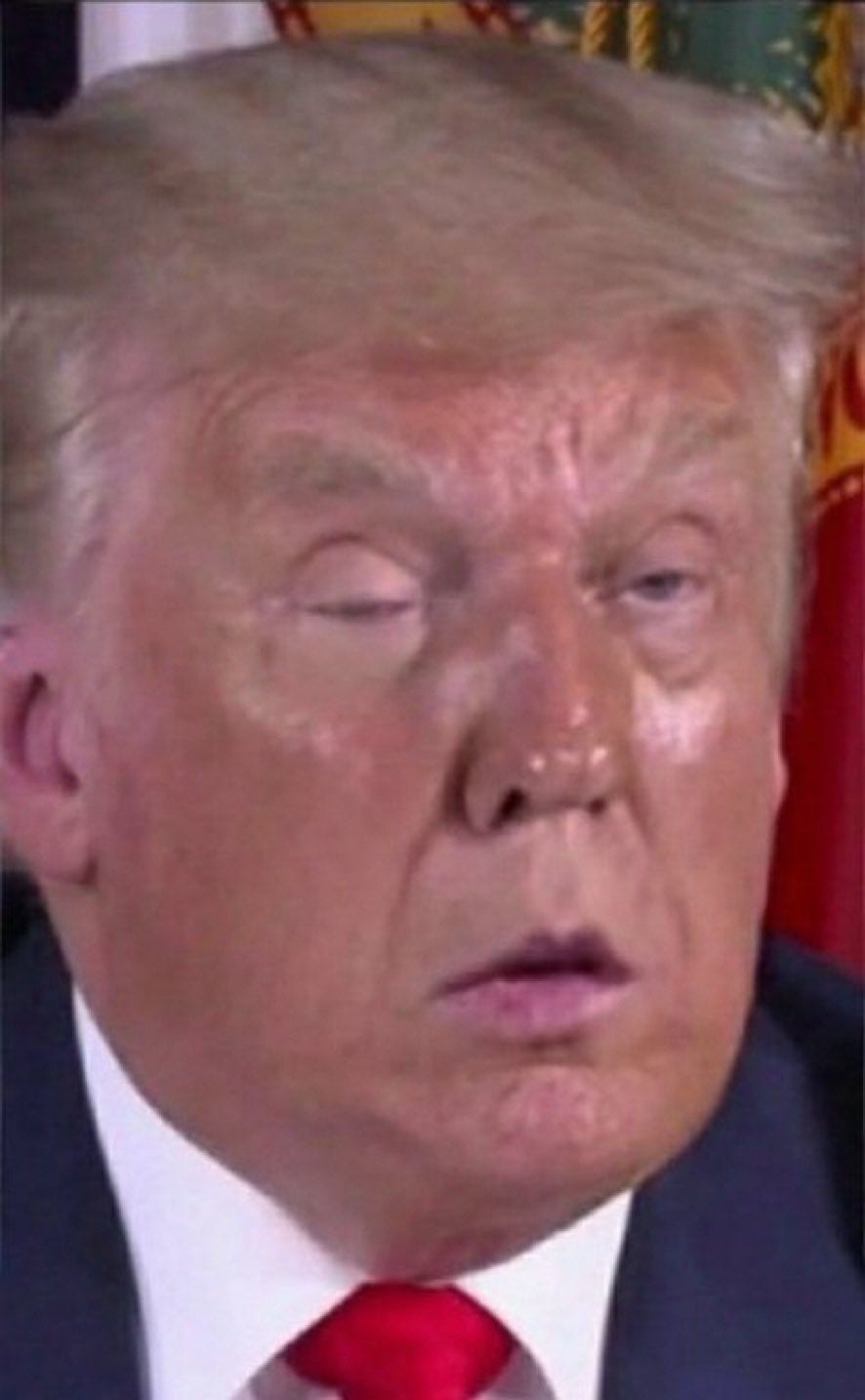
Video discussion for paid subscribers follow article. Sorry for the picture, didn’t meant to scare ya, but I just had to
On Sunday morning, the President of the United States sat down with NBC’s Kristen Welker for a Meet the Press interview and walked out of it. Not metaphorically. He got up, said “You’re a one-sided crooked network… I’ve had enough,” and left.
He is 79 years old. He is the most powerful person on Earth. And he couldn’t finish an interview.
That moment, uncomfortable as it was to watch, wasn’t really about Kristen Welker. She asked him about his $1.8 billion “anti-weaponization” fund—money earmarked to reward people who claim government persecution, including January 6th participants. She pushed back on his claim that FBI agents had “ushered” rioters into the Capitol. She said there was no evidence. He insisted there was “tremendous evidence.” She held her ground. He couldn’t handle it.
So he left.
Let me say what a lot of people are thinking but few in his orbit will ever say out loud: this is not normal behavior for a president, and the pattern right now is alarming.
The Week That Tells the Story
Take a step back and look at just the last few days, because the picture they paint together is striking.
Saturday, June 6th was the 82nd anniversary of D-Day. Thousands of young Americans stormed the beaches of Normandy in 1944—wading through surf, cut down in the sand, dying so that Europe might be free. It is one of the most sacred dates on the American calendar. Previous presidents, regardless of party, have treated it with reverence.
Donald Trump spent D-Day posting AI-generated videos of himself to Truth Social. Himself riding a camel. Himself skydiving with a red parachute. Himself walking through cheering crowds. He also posted an AI-generated image of the future Obama Presidential Library rendered as a giant garbage can surrounded by homeless encampments, and took shots at a federal judge blocking his White House ballroom project.
Not a word about the boys on the beaches. Not one.
The White House quietly issued a written statement—drafted by staff, not the president—that briefly acknowledged the anniversary. But from the man himself? Nothing but a digital hall of mirrors reflecting his own image back at him.
Meanwhile, the reflecting pool is blue. If you haven’t been following this particular episode of American surrealism, here’s the summary: Trump had the Lincoln Memorial Reflecting Pool—one of the most iconic, historically resonant public spaces in the world—repainted “American flag blue.” Not the quiet gray of stone and water that has framed the Capitol skyline for over a century. A vivid, swimming-pool blue. Historians were appalled. Preservationists sued. The project ballooned to nearly $20 million. Critics noted the final product looks remarkably similar to the pool at Mar-a-Lago.
Trump has been obsessed with defending it. Multiple posts. Intense personal investment in a paint job.
And then there is Iran. One hundred days into a war that was launched without a declaration of Congress, against an enemy we were in active negotiations with when the bombs dropped. Iran’s Supreme Leader is dead. The region is on fire. The war is deeply unpopular—historically so. Four Republicans broke with the party to pass a War Powers Resolution rebuking the president. Iran has rejected his peace plan. Iran called him “deceitful” and denied that negotiations he claimed were happening were happening at all.
Trump’s response has been to insist this doesn’t contradict his campaign promise of “no new wars.”
So to recap the week: ignored D-Day, obsessed over a paint job, got embarrassed on the world stage by Iran, and then stormed off a television set when a journalist asked him a hard question.
This is the President of the United States.
The Rumble Strips
I want to offer a theory I’ve been sitting with for a while, because I think it explains a lot of what we’re watching—not just with Trump, but with a particular class of people who reach the absolute summit of wealth or power.
Think about driving on a highway at night. You get a little tired, your mind wanders, and you start drifting toward the shoulder. And then you feel it: that jarring brrrrr under your tires. The rumble strips. They exist for one purpose—to tell you that you are leaving the road and that you need to correct course. They don’t argue with you. They don’t negotiate. They just make it impossible to ignore the fact that you are about to drive off the highway.
Here’s the thing about billionaires—and about presidents who surround themselves only with loyalists: they have no rumble strips.
I know this from personal experience, from the other direction. I served in Congress for over a decade. In that world, I had rumble strips everywhere. If I said something stupid, a colleague would pull me aside. If I was about to vote the wrong way, my staff would flag it. If I showed up somewhere in a ridiculous outfit, my family would make fun of me until I went and changed. And don’t even think about doing something stupid around my military buddies! I had people around me whose job—formal or informal—was to tell me the truth. Not because they were paid to flatter me. Because they knew me, they respected me, and they understood that letting me drive off the road wasn’t kindness. It was negligence.
That’s not how it works when you have unlimited money or unchecked power.
If a billionaire walks into a board meeting wearing an orange shirt with pink pants, every single person in that room tells him it’s a genius fashion choice. Not because it is. Because their job, their bonus, their access—all of it—depends on the billionaire feeling good. Nobody laughs. Nobody says hey, maybe reconsider. The rumble strips have been paved over. The road just gets wider and smoother and more forgiving, right up until the moment it doesn’t.
I’ve seen this with tech billionaires who start believing their own mythology and make catastrophic business decisions while their inner circle applauds. I’ve seen it with Wall Street titans who surround themselves with yes-men until the whole thing collapses. And I am watching it, in real time, with the President of the United States.
Donald Trump has not had a genuine rumble strip in years—arguably in decades. The people around him now are not advisors in any meaningful sense. They are validators. Some are true believers; some are opportunists; some are simply afraid. But none of them are doing what a real advisor does, which is look the boss in the eye and say: Sir, you cannot skip D-Day to post AI videos of yourself. Sir, the reflecting pool fight is making you look unhinged. Sir, you need to get in front of the Iran situation before it becomes your Iraq.
Nobody is saying it. So nobody is hearing it. And the car keeps drifting.
What We’re Watching
I want to be careful here, because I am not a psychiatrist and I’m not going to play one on Substack. But I think we are allowed—we are obligated, even—to look at the behavioral pattern and ask hard questions.
A man who cannot sit through a challenging interview. Who spends the anniversary of the greatest military sacrifice in American history posting AI videos of himself. Who is emotionally consumed by whether a reflecting pool is the right shade of blue while a war he started spirals into a quagmire. Who responds to congressional rebuke not with reflection but with defiance. Who, when Iran calls him a liar on the world stage, simply repeats the lie louder.
This is not strength. This is not confidence. This is a person who is not receiving honest information, not tolerating honest feedback, and not processing reality in a way that connects to what the rest of us can see.
History has examples of leaders who reached this point—insulated, flattered, unchallenged, and gradually untethered from the feedback loops that keep human judgment grounded. It rarely ends well. For them, or for the people they’re supposed to be leading.
The rumble strips are gone. The road feels smooth. And the car is drifting.
Someone needs to say it. So I’m saying it.
Video for paid subscribers:
