

Video for paid subscribers follows article. It’s a bit longer than usual
Let me say upfront: I know this isn’t the fun conversation. Defense spending, war preparedness, thinking carefully about adversaries — none of that competes well with a recipe post or a weekend travel essay. There are so many things we need to fund in this country. Healthcare. Education. Infrastructure. The yawning wealth gap that’s hollowing out the middle class. We desperately need defense procurement reform, comprehensive immigration reform to broaden and strengthen our workforce, and serious tax and spending reform to close the gap and fund the programs Americans actually depend on.
But here’s the thing: we don’t get to choose the world we live in. And the world we live in right now is more dangerous — in more ways simultaneously — than at any point in modern history.
This is not a scare piece. It’s a necessary conversation. And it’s one that too many politicians, on both sides, are either avoiding or actively making worse.
The Landscape Has Changed. Our Defenses Haven’t.
Borders don’t stop ideology. Oceans don’t stop fiber optic cables. A terrorist cell can be recruited over an encrypted app from a server farm in three different countries. A financial institution can be kneecapped — not with a missile, but with a keystroke. Critical infrastructure, power grids, hospital systems, water treatment — all of it sits on networked systems that are, in many cases, disturbingly vulnerable.
We are not uniquely exposed. Every nation faces some version of this reality. Our adversaries feel these threats too. But the difference is this: America has coasted, in some critical areas, on legacy thinking — the assumption that our size, our alliances, our technological edge, and our geographic luck will always be enough.
That assumption is becoming dangerous, because the world is becoming smaller and smaller and distance doesn’t matter much anymore.
Ukraine Changed Everything. We’re Still Catching Up.
Russia’s full-scale invasion of Ukraine began in February 2022. In the four years since, battlefield technology has leapt forward by fifteen years. And the most consequential shift has almost nothing to do with aircraft carriers or hypersonic missiles.
It has to do with drones.
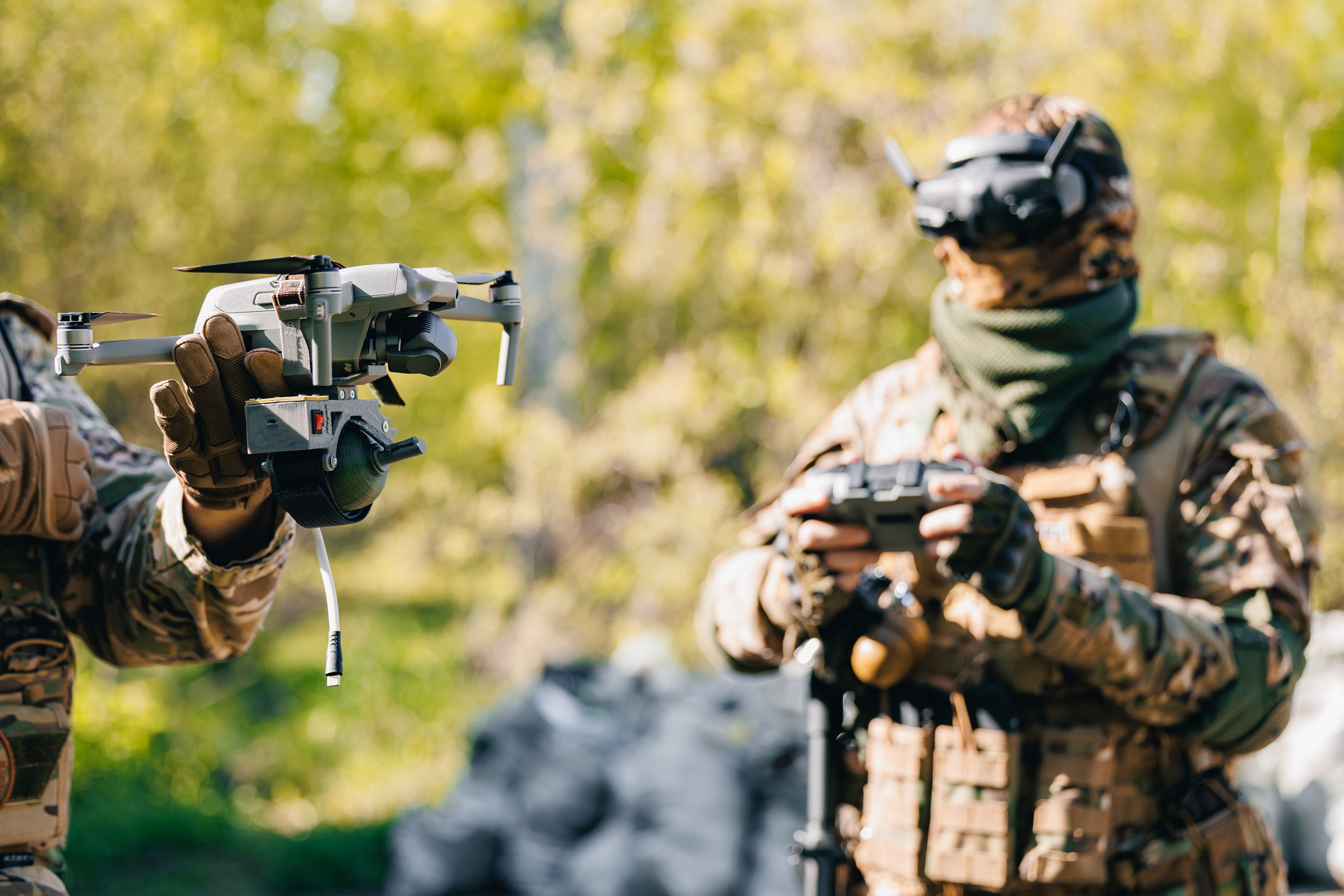
What started as commercially available quadcopters dropping hand grenades from duct-taped harnesses has evolved, with breathtaking speed, into something qualitatively different. FPV drones — first-person view — are now flown like fighter jets by pilots wearing goggles, guiding cheap, fast, lethal machines in one-way kamikaze strikes with remarkable precision. The cost? Sometimes under a thousand dollars. The effect? Destroyed armor, killed crews, disabled command posts.
When militaries began deploying jamming systems to knock drones out of the sky, engineers solved that too: fiber optic spools. A drone tethered to a spool of fiber optic cable that unwinds behind it as it flies — miles of it — cannot be jammed. The signal travels through glass, not through the air. You cannot disrupt what isn’t wireless.
The environmental cost of this innovation is, incidentally, staggering. Battlefields in eastern Ukraine are littered with what can only be described as miles of angel hair — thin, nearly invisible fiber optic strands tangled in fields, forests, and rubble. A toxic ghost of technological adaptation.
Speaking of technological adaptation… it won’t be long until Ukraine is able to use AI to find and target the enemy without human intervention, and/or one pilot will be able to fly multiple FPV drones at once, taking command in the final strike moments instead of flying the plane the whole way. I cheer these innovations on for Ukraine. They are amazing fighters and innovators. And we ought to be right next to them, helping, and importantly, learning for ourselves.
Then there’s what Ukraine did inside Russia — a maneuver that should have sent shockwaves through every defense ministry on earth. Ukrainian operatives loaded drones onto commercial trucks. Unbeknownst to the drivers. The trucks drove deep into Russian territory, bypassing every checkpoint, every air defense system, every early warning radar. When they reached their destination — a Russian air base — the truck beds opened, and the drones flew out and destroyed high-value aircraft sitting on the tarmac. It was an amazing and innovative act, came at the right time, and boosted morale.
But let that sink in.
Exposed planes are now prey. Expensive, strategically vital aircraft sitting in the open — near roads, near fences, near anybody with a truck — are fundamentally vulnerable in a way they weren’t even five years ago.
Here’s something worth thinking about the next time you fly commercially in the United States.
Look out the window as you land. Chances are decent that somewhere nearby, visible from the taxiway, you’ll see rows of cargo, fighter, or tanker aircraft parked on the flight line. Near perimeter roads. Near public highways. In some cases, near places that any motivated individual with a vehicle could get close to. Maybe a truck, filled with FPV drones.
America keeps a significant portion of its air power exposed.
This is not a new vulnerability, but it is a newly urgent one. Ukraine’s operation into Russia didn’t require stealth aircraft, satellite guidance, or billions in R&D. It required some drones, some ingenuity, and a truck driver who didn’t ask too many questions.
We are good — genuinely excellent — at the things we’ve always prioritized. Long-range precision strike. Power projection. Logistics. The ability to hit a target at a time and place of our choosing, with extraordinary accuracy. This matters enormously. It should not be minimized.
But our defensive posture, particularly against cheap, proliferating, non-attributable threats, has not kept pace. Not even close. Recent videos show attacks on US bases in the middle east by fibre optic drones, looking, gathering information, scoping targets, and picking one.
About fifteen years ago, I sat in a conference where a retired general spoke about what was then a nascent Obama-era initiative: thinking seriously about the future of warfare. His message was clear and, I think, largely unheeded.
The future isn’t bigger missiles. It isn’t faster planes, though planes and missiles still matter. The future is cheaper weapons, produced in mass quantities, fired and — where possible — recovered and reused. The future of war is not about men. It’s about machines. And the central question in any future conflict will not be which side has the most sophisticated weapon. It will be which side’s industrial base can out-produce the other.
This is precisely what’s playing out in Ukraine right now. Not a battle of wills. A battle of factories.
Ukraine is striking Russian oil depots, refineries, and infrastructure not out of spite but out of strategy — damage Russia’s ability to finance its war machine. Bleed the supply lines. Make the math unsustainable.
China, Russia, Iran, and to an extent terrorist groups all possess the capability to wage this kind of cheap, scalable, and critically — non-attributable — asymmetric warfare. An attack that can’t be confidently traced to a state actor creates a crisis of response. You can’t invoke Article 5 against a truck with a drone hidden in it if you can’t prove who sent it.
The mutual assured destruction logic, that great stabilizing terror of the Cold War, applies in some modified form here too. We are capable on offense. Our adversaries know this. There is deterrence. But deterrence is not a substitute for defense. And in an active conflict — say, oh I don’t know, a shooting war with Iran — I would fully expect an operation like Ukraine’s “Spider Web” to be attempted against us.
On our soil, or against our deployed assets, or against our allies.
The question is whether we’d be ready. Right now? I’m not sure the answer is yes.
Now Let’s Talk About the People in Charge
This is where I stop pulling punches.
Donald Trump and Pete Hegseth are, without any serious counterargument, two of the least qualified individuals to ever hold the offices of President and Secretary of Defense simultaneously in a moment of genuine strategic complexity.
This is not a partisan talking point. It is a factual assessment.
Hegseth, a Fox News host with a record of public intoxication and credible allegations of misconduct, has no strategic, administrative, or executive experience commensurate with running the world’s largest military bureaucracy. Yes, he was a National Guard officer… a major. Not exactly a rank that gets deep into strategic planning. And of course, a television personality. His primary qualification appears to be enthusiasm and loyalty to Trump. He has spent his brief tenure at the Pentagon reportedly purging experienced career officials and Ivy league schools, gutting institutional expertise, and presiding over a communications operation that — remarkably — accidentally included a journalist in a Signal chat discussing active military strike plans.
Let that settle in.
The Secretary of Defense, in a chain of text messages, casually discussed the timing and sequencing of real combat operations — in an unsecured app — while a reporter from The Atlantic read along in real time.
This is not the behavior of serious people. This is not how serious governments manage the machinery of war. The men and women in uniform — who are serious, who are professional, who are extraordinarily capable — deserve better than this. The American public deserves better than this.
Trump, for his part, has spent years treating NATO as a protection racket, flattering adversaries while undermining alliances, and viewing military power primarily as a prop for domestic political theater. He called generals “my generals” while systematically dismantling the advisory structures that exist to give commanders in chief accurate, unvarnished intelligence. He thinks its his military, not the American people’s. He governs on instinct and grievance. Neither is a substitute for strategic doctrine.
The current moment — technologically volatile, geopolitically unstable, with adversaries actively testing and adapting — requires seriousness, expertise, and institutional competence. What we have instead is a Defense Department run by a Fox host who can’t keep strike plans off his group chat.
What Democrats Should Actually Say
Time for some more unvarnished opinion. Here’s the thing that frustrates me about Democrats on defense: too many of them treat it like a trap.
They soften their language. They pivot to diplomacy before they’ve established credibility on strength. They let Republicans own the “we love the military” lane while quietly conceding it as territory too politically complicated to contest.
This is a mistake. Strategically. Morally. Politically.
Democrats should be clear, unambiguous, and proud about what they believe: America must be strong. The military must be prepared. Not to start wars — the exact opposite. The whole point of genuine readiness is that it makes wars less likely, and when wars are forced upon us, it means our troops come home.
Being pro-military means funding the right weapons systems, not the politically connected legacy ones. It means taking drone warfare seriously before we learn the hard way. It means making sure aircraft aren’t sitting exposed near public roads. It means procurement reform so the defense budget actually produces military capability rather than contractor profit. It means caring enough about troops to give them qualified civilian leadership.
Being pro-military means wanting them to win, and come home, and not be sent into conflicts built on lies or ego.
Democrats ended World War II. Democrats built NATO. Democrats have repeatedly overseen the projection of American power with more strategic coherence than the current administration could manage on its best day.
It’s time to say so, loudly, and without apology. We love America, and we want to keep her safe, and the best in the world.
We live in a world where the cost of a devastating attack has dropped precipitously, where attribution is harder than ever, and where industrial scale and adaptive thinking matter more than any single weapons platform.
We have real strengths. We should not minimize them. But strength and complacency should be mutually exclusive, and right now, we have elements of both.
The battlefield has changed. The threat environment has changed. Our vulnerabilities — from exposed airfields to vulnerable networks to a defense leadership that treats national security like a cable news segment — are real.
This conversation isn’t about fear. It’s about honesty.
And right now, honesty demands we say clearly: America is not as prepared as it needs to be, and the people currently responsible for changing that are not up to the job.
If you found this worth reading, share it with someone who thinks defense is a right-wing issue. It isn’t. It’s an American one.
Video for paid subscribers follows:
