


Video for paid subscribers follows article
I want to tell you something we didn’t get enough time to say publicly during the January 6 Committee hearings.
We covered a lot of ground — the pressure on state officials, the DOJ, Mike Pence. The lies. The people who told them. The people who helped spread them. All of it real, all of it important.
But there’s a piece of this story that deserves a lot more attention than it got. And it has to do with money.
In the weeks between Election Day 2020 and January 6, the Republican base was being hit with a flood of fundraising emails unlike anything I’d ever seen in politics. Not one or two a day. Eight, ten — sometimes more — landing in inboxes every single day. When investigators tallied the full volume of what went out during that two-month window, the number was staggering.
Hundreds of fundraising emails. Tied directly to the effort to overturn an election.
I’ve seen a lot of political fundraising in my career. I know how the machine works. But this wasn’t normal fundraising. The subject lines weren’t asking for support — they were telling people their country was being stolen. That America was on the brink. That you, personally, had to act right now or it would be too late.
When you hear something once, you might roll your eyes. When you hear it 900 times? It stops feeling like a message. It starts feeling like reality.
That’s not an accident. That’s the strategy.
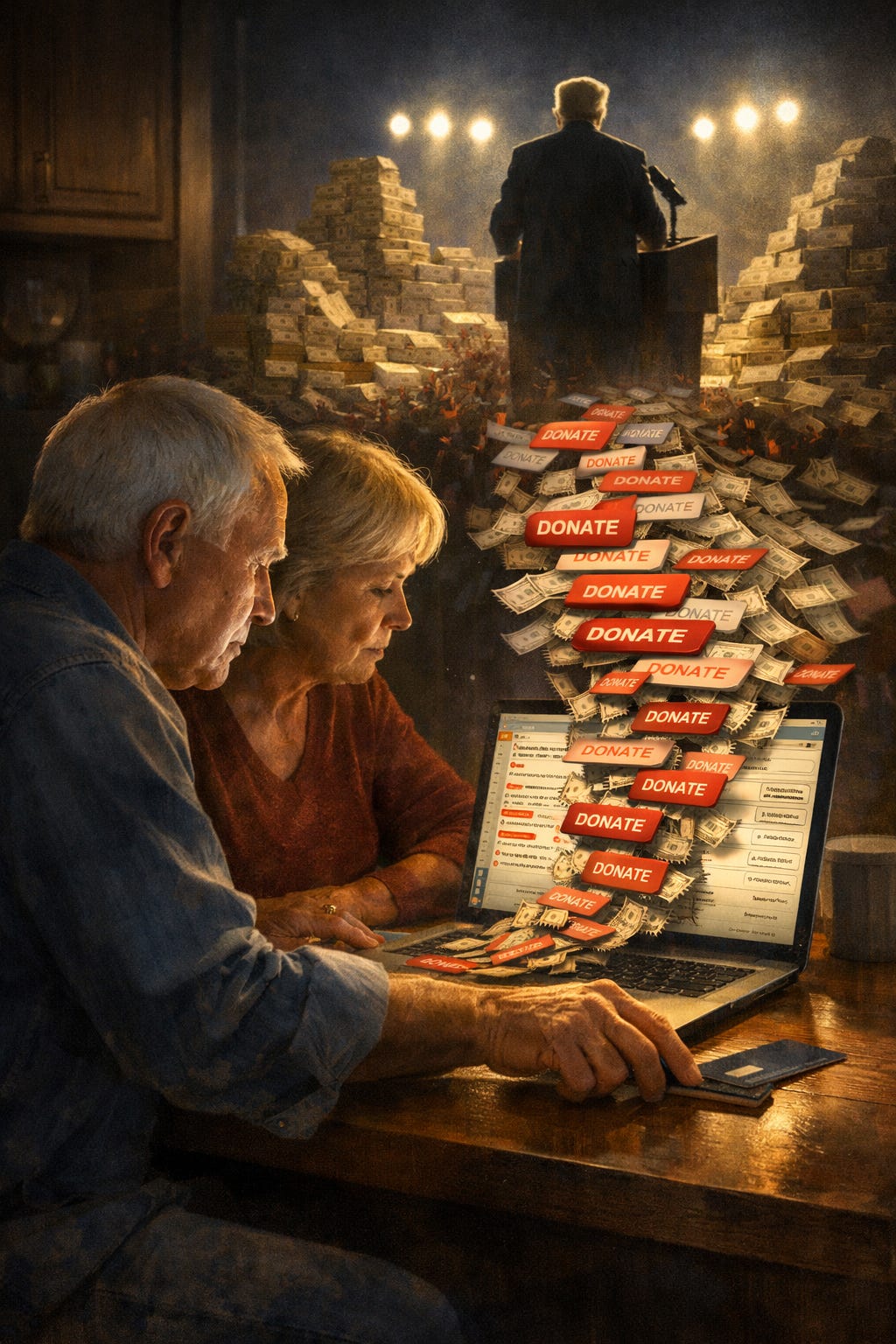
Here’s what really gets me though. A lot of the people responding to those emails were retirees. Older Americans on fixed incomes. Not political insiders. Not wealthy donors looking for influence. Regular people who genuinely believed their country had been wronged and felt a duty to help fix it. Ten dollars. Twenty dollars. Real sacrifices, made in good faith.
They thought they were funding legal challenges. Election integrity efforts. They thought their small contribution was going toward defending democracy.
What they were actually doing was feeding a machine.
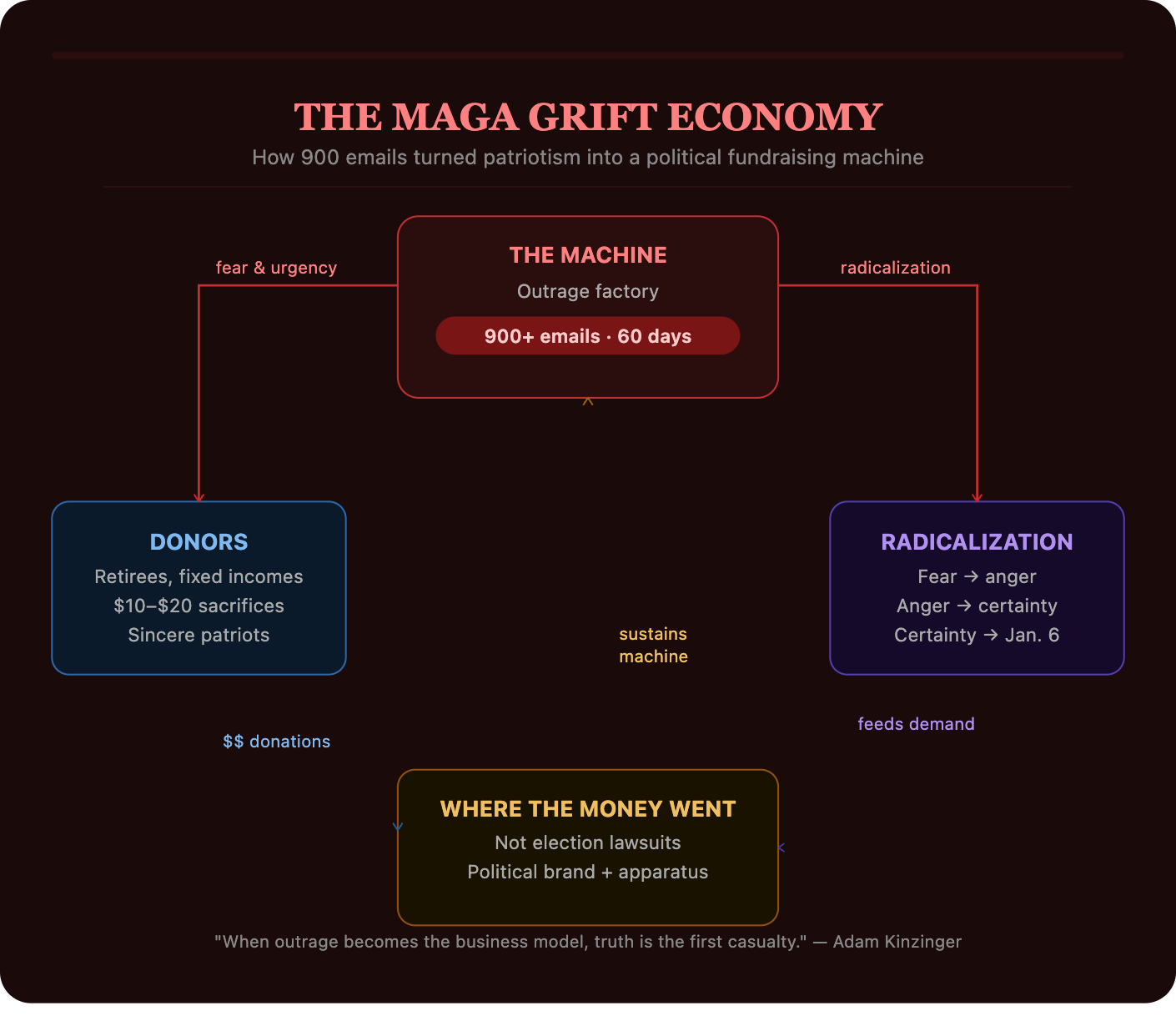
Trump figured something out that most politicians eventually learn but few exploit with this kind of ruthlessness: outrage is profitable. Fear keeps people engaged. Anger gets people to open their wallets. Combine that with constant messaging and a donate button, and you’ve built something genuinely dangerous — not just politically, but to the fabric of how people understand what’s true.
So the emails kept coming. The language got more dramatic. The stakes got described in more apocalyptic terms. Because it worked.
And while all of this was happening — while millions of Americans were being told every single day that their republic was being stolen — the money wasn’t going where they thought it was. Large portions flowed into political committees and operations that had almost nothing to do with actual election litigation and everything to do with maintaining a brand, a fundraising apparatus, and a political future. And to their own pockets.
The system rewarded itself. More outrage, more money. More money, more incentive to produce more outrage.
I want to be clear about something: none of this removes individual responsibility. Every American has a duty to seek the truth. People are responsible for their own actions. January 6 showed us exactly what happens when people choose conspiracy over reality.
But we can hold both things at once. We can say people made bad choices AND acknowledge that they were being systematically manipulated into making them. Those aren’t competing ideas.
What we’ve built — or what’s been built around us — is what I call the MAGA grift economy. It’s a political ecosystem where outrage isn’t a side effect. It’s the product. Every crisis is a fundraising opportunity. Every new conspiracy is another email blast. Every new scandal is another reason to ask for money before midnight tonight.
The worst part? The people being exploited by this system are often the most sincere people in the room. They love their country. They believe they’re fighting for it. Their patriotism is completely real — it’s the information being fed to them that isn’t.
And that sincerity is exactly what makes them a target.
When you convince someone their country is under attack, they’ll give whatever they can to defend it. The people running this operation understood that perfectly. They built an entire business model around it.
America deserves better than politicians who treat citizens as a recurring revenue stream. A real political movement persuades people with ideas and principles. A grift economy survives by convincing people the disaster is always one news cycle away — and that your $25 donation is the only thing standing between freedom and collapse.
When outrage becomes the business model, truth is the first casualty.
And the people who end up paying the price are the very Americans who believed, with everything they had, that they were fighting for their country.
Remember: No Kings day is coming up! Be sure to get your cool shirts and hats for it! LINK

Video for paid subscribers:
