

Video for paid subscribers follows article
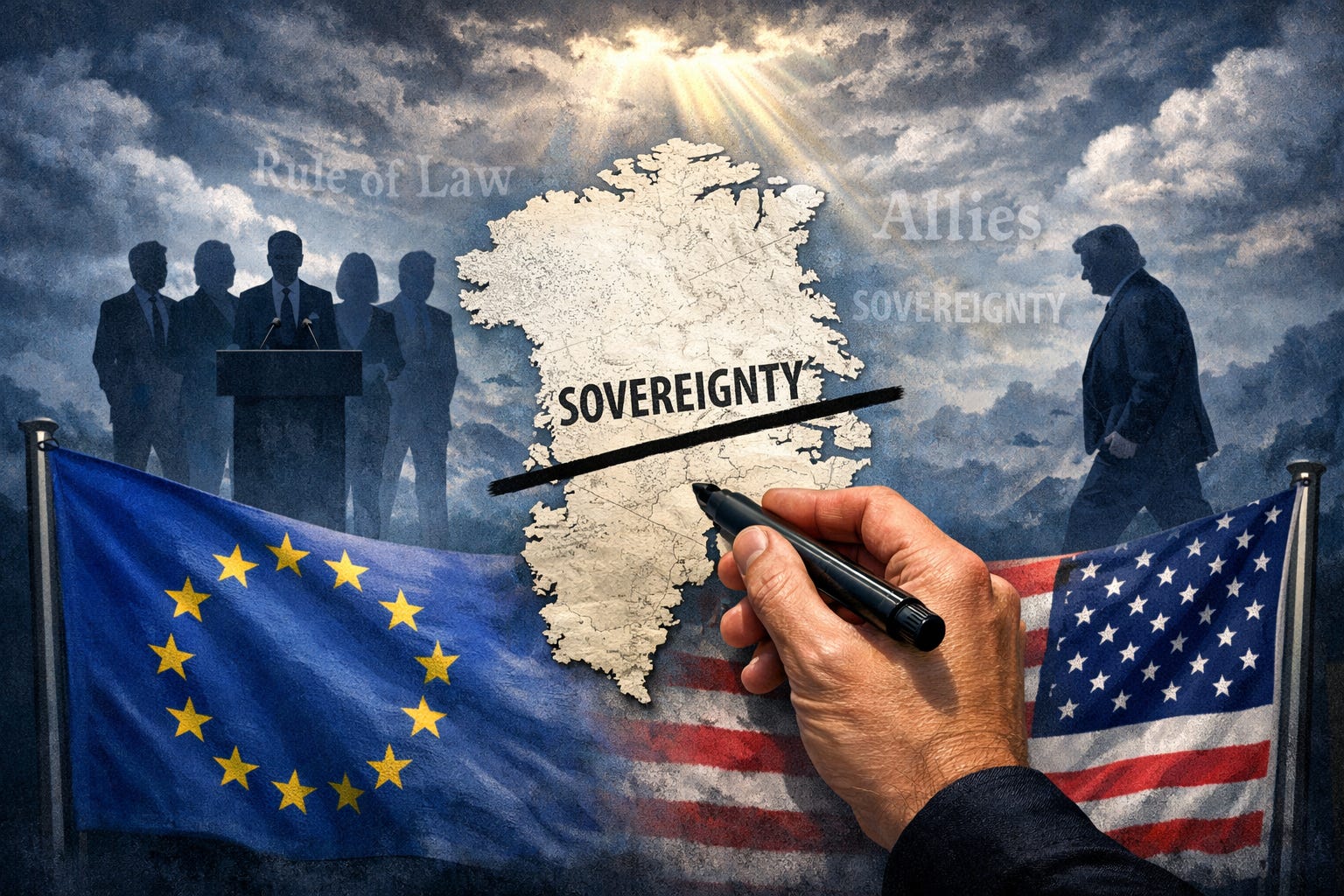
There was a revealing moment this month that should not be forgotten quickly. Donald Trump threatened to take Greenland—a sovereign territory belonging to Denmark, a NATO ally. He hinted at military force. He threatened tariffs. He spoke about the island as if it were a parcel of land in a real-estate negotiation rather than a place with people, history, and sovereignty. And then Europe stood up to him.
Not with quiet back-channel diplomacy. Not with flattery or appeasement. But with clear, coordinated public resistance. European leaders said no—unambiguously. They said Greenland’s status is not up for negotiation. They warned that any attempt to seize the territory would destroy NATO and fundamentally rupture the transatlantic alliance. They spoke with one voice and made clear that sovereignty is not a bargaining chip. And Trump blinked.
He ruled out the use of force. He softened his rhetoric. He walked back tariff threats. He shifted to vague language about frameworks and negotiations. In a matter of days, the tone changed from imperial swagger to diplomatic retreat.
This wasn’t a fluke. It was a case study in how power actually works with Donald Trump. (Quick aside: one glaring exception…NATO chief Mark Rutte, who infamously referred to Trump as “daddy.”)
For years, European leaders tried a different strategy. They tried to manage him, flatter him, and avoid confrontation. They worried about trade wars, about NATO, about the fragility of the alliance. They swallowed insults, tolerated coercive rhetoric, and offered concessions in the hope that Trump would be placated.
Instead, he escalated. He threatened tariffs, questioned NATO commitments, and floated the idea of territorial acquisition. Appeasement didn’t moderate him; it encouraged him.
But when Europe finally said no—publicly, collectively, and with confidence—he backed down.
This is the core truth about bullies, whether in schoolyards or in geopolitics: they push until they meet resistance. When they encounter unified opposition, they recalibrate. They look for an exit ramp. They retreat and reframe.
In that sense, Trump behaves remarkably like Vladimir Putin. Putin probes. He tests red lines. He exploits hesitation and division. But when confronted with unified, credible resistance, he pauses. He reassesses. He seeks ways to avoid overextension. We’ve seen this pattern repeatedly in Eastern Europe, in NATO expansion debates, and in moments when Western countries showed unity rather than fragmentation.
Trump operates on a similar psychology. He interprets hesitation as weakness and confrontation as a signal to step back.
The Greenland episode should be a wake-up call for Europe. Europe is not weak. The European Union and its allied states represent one of the largest economies in the world. European militaries are capable, technologically advanced, and increasingly integrated. Europe has political legitimacy, diplomatic reach, and enormous soft power. It does not need to kneel to Washington to survive.
Of course, we want Europe as a strong ally. A confident, secure Europe makes the United States stronger. But being an ally does not mean being submissive. It means being a partner—one that can say no when necessary, defend its interests, and uphold democratic norms even when Washington falters.
And here’s the part Americans should pay close attention to: Europe standing up to Trump helps us at home.
Authoritarian leaders thrive on inevitability. They cultivate the image that resistance is futile, that institutions will bend, that allies will fold, and that critics will eventually tire. The myth of inevitability is one of their most powerful tools.
When Europe stood up to Trump and he backed down, it shattered that myth—at least a little. It showed that intimidation can fail. It showed that institutions and alliances can constrain even the most aggressive leader. It showed that collective action matters. That lesson applies domestically as well.
Trump pushes hardest when he senses fear—when lawmakers hedge, when institutions hesitate, when media normalizes, when citizens disengage. He escalates when he thinks people will look away, when he believes opposition is fractured or exhausted.
But he retreats when confronted with unified resistance. Courts that enforce the law. Journalists who refuse to be intimidated (Don Lemon). Politicians who choose country over party. Citizens who organize, vote, document, and protest lawfully.
He is not invincible. He is not inevitable. He is testing the limits of what he can get away with. Greenland was one test. Europe passed it. The broader lesson is simple but powerful: standing up to Trump works.
It works abroad, where allies can collectively refuse coercion. It works at home, where democratic institutions and engaged citizens can constrain executive power. It works when people stop trying to appease and start insisting on norms, law, and accountability.
This is not about anti-Americanism or anti-alliance sentiment. It is about the health of democratic systems on both sides of the Atlantic. Strong allies and strong domestic institutions reinforce each other. When Europe shows backbone, it strengthens American democracy by demonstrating that even powerful leaders are accountable to rules and norms.
The optimistic truth is that this dynamic is already in motion.vEurope stood up, and Trump backed down. Courts continue to assert their authority. Civil society is active. Journalists are documenting. Voters are paying attention. The machinery of democracy is noisy, imperfect, and slow—but it is still moving.
Bullies lose their power the moment people realize they don’t have to comply. That realization is spreading—from Copenhagen to Brussels to Washington. And that is how democracies endure: not because leaders behave, but because citizens and allies refuse to stop caring, organizing, and insisting on the rule of law.
Greenland was a small episode with a big lesson. The more people learn it, the stronger our democratic future becomes.
Explainer Video for paid subscribers:
