

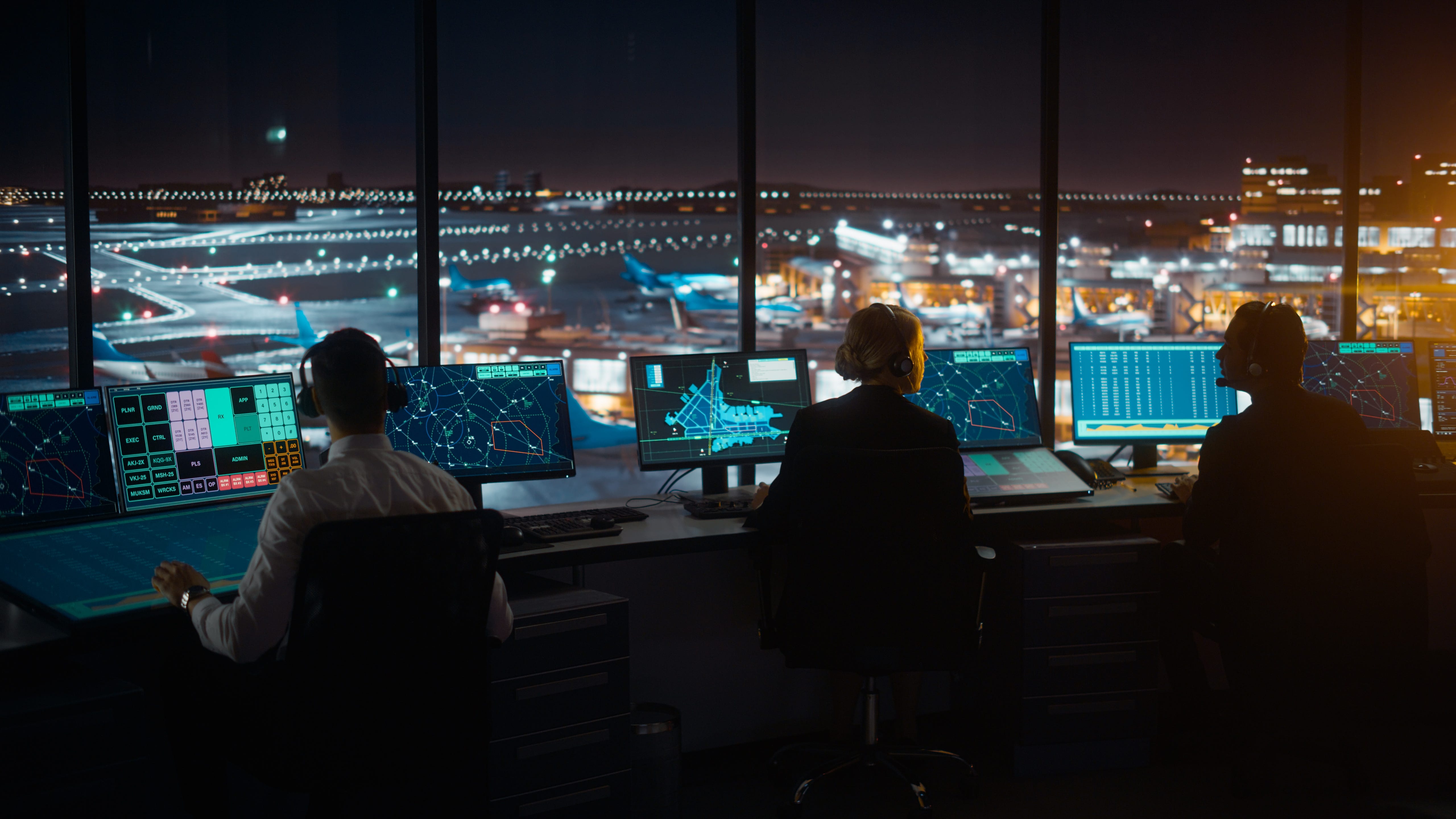
Two pilots are dead this morning. Dozens of passengers were injured. A flight attendant was found on a runway, still strapped into her seat, thrown from the wreckage of an Air Canada Express CRJ-900. And somewhere inside LaGuardia Airport, a single air traffic controller — by all accounts a well-regarded professional — is living through one of the worst times any human being in that line of work can experience.
The facts, as we know them right now: Air Canada Express Flight 8646, arriving from Montreal just before midnight on Sunday, collided with a Port Authority Aircraft Rescue and Firefighting truck that had been cleared to cross Runway 4 at Taxiway Delta. The truck was responding to a separate emergency — a United flight that had aborted its takeoff due to an odor in the cabin sickening the flight attendants. The controller, managing both situations simultaneously, cleared the truck to cross, then tried desperately to stop it. “Truck One, stop, stop, stop!” And then, moments later, the transmission no one ever wants to hear: “JAZZ 646, I see you collided with the vehicle.”
On one of the recordings, a controller’s voice is heard saying, simply: “I messed up.”
Those two words are going to echo for a very long time.
Here’s what’s going to happen next. The NTSB will investigate, as they should. The FAA will investigate, as they should. The recordings will be analyzed down to the millisecond. And at the end of that process, the likely conclusion will be that the controller issued a clearance he should not have issued, in a moment of cognitive overload, while simultaneously managing a landing aircraft and a ground emergency on the opposite side of the field.
That finding will probably be correct. And it will also be profoundly incomplete.
Because what the finding won’t fully capture is this: one controller was allegedly working both the local (runway) and ground (vehicle) positions simultaneously, late at night, at one of the most operationally constrained airports in the United States. That’s not an aberration. That’s policy. Under FAA Order 7110.65, positions can be combined during lower-traffic periods. And late-night shifts at LaGuardia are routinely staffed light.
Is it permitted? Yes. Is it wise, at an airport where the geometry alone forgives no errors and where simultaneous emergencies can arise without warning? That is now a question the whole country should be asking.
I want to be careful here, because the investigation is only hours old and I have information only from what I can observe and what filters through. But I’ve been around aviation long enough to know that what happened last night didn’t begin last night.
The FAA is running approximately 3,000 controllers short of what it needs. That’s not my estimate — that’s Secretary Duffy’s own figure. The Brookings Institution, citing a National Academy of Sciences workforce report, confirms that roughly 19 of the FAA’s largest facilities are staffed 15% or more below target. Those large, understaffed facilities account for 40% of all flight delays in this country. LaGuardia’s tower may not have “perennial staffing problems” in the chronic sense — one former FAA ATC chief noted that specifically this morning — but the broader system is under enormous strain, and overnight, low-traffic periods are exactly where the math gets thin.
The pipeline is the problem. Training a new controller from academy enrollment to Certified Professional Controller status at a complex facility takes anywhere from 18 months to four years. Drop-out and washout rates are significant. And we have been chronically under-recruiting for this profession for decades, across multiple administrations and multiple Congresses. I want to be clear: Republicans and Democrats alike have let this fester. Every administration that failed to push hard on hiring, every Congress that trimmed the FAA budget at the margins while congratulating itself on fiscal responsibility — they all bear a share of this.
But the record is not perfectly symmetric. The sustained resistance to infrastructure investment, the reflexive hostility to any revenue measure that might actually fund these systems, has been disproportionately concentrated in one place. I spent time in Congress. I supported increasing the federal gas tax as a user fee for roads — not because it was popular, but because infrastructure costs money and money has to come from somewhere. I was, as you might imagine, a fairly lonely voice on that.
Pilots know something about the difference between managing a situation and actually solving it. Managing is doing the minimum required to get through the current moment. Solving means identifying the root cause and fixing it, even when the fix is expensive and inconvenient.
We need Congress to raise controller pay and think creatively about the recruitment pipeline. The job is excellent — challenging, well-compensated, and genuinely consequential. But the pathway to get there is grueling, the washout rate is high, and right now we are asking the newer controllers — the exact people we need most — to take on second jobs driving for rideshare companies just to make ends meet during budget showdowns. That is insane. That is self-defeating. And it has to stop.
We need to invest in 21st-century ATC infrastructure. I remember visiting the approach sector for Rockford, Illinois, years ago. The controllers there pointed to their radar equipment and told me, with a kind of exhausted pride, that it traced its lineage back to the World War II era. That was not a metaphor. That was the actual equipment guiding actual aircraft in actual airspace. The situation has improved in places since then, but the pace of modernization has been fitful, underfunded, and politically contested every step of the way.
That investment requires revenue. Revenue requires honest conversations with the public about user fees, about what it actually costs to maintain the safest aviation system in the world, and about what happens when you stop paying for it. Those conversations are hard. They require politicians willing to operate beyond a two-year time horizon — to take the vote that might not pay off until the third term after they’re gone, if ever. That kind of leadership is rare in Washington. It needs to become less rare.
I’ll close with this. Whatever the investigation ultimately concludes, I want to say something plainly: the controller working that tower last night was, by every account I’ve heard, a respected professional. He was doing his job — likely managing two emergencies at once, likely staffing a position that the system required him to staff alone, likely making a split-second decision that in any of a hundred slightly different configurations would have been fine.
He said “I messed up.” That kind of honesty, in that kind of moment, tells you something about the person. The system that put him in that position — alone, managing complexity that was multiplying faster than any single human brain can track — that system failed him too. And it failed the two pilots who didn’t come home this morning.
We owe it to all of them to say so clearly, and then to actually do something about it.
We don't have money to upgrade critical systems like this, and other infrastructure. But we have money to waste on unnecessary wars.
I'm so sorry for the lives lost and for the controller who was put in an untenable position.
Your analysis of the true root cause is correct as I see the situation. Momentary lapses always have systemic root causes. One other factor I should mention is that the driver of the truck did not clear the runway visually, including looking for landing planes, before proceeding. Runways are like railroad tracks, always look both ways before crossing, regardless of the signals.