

Discussion video for paid subscribers follows article
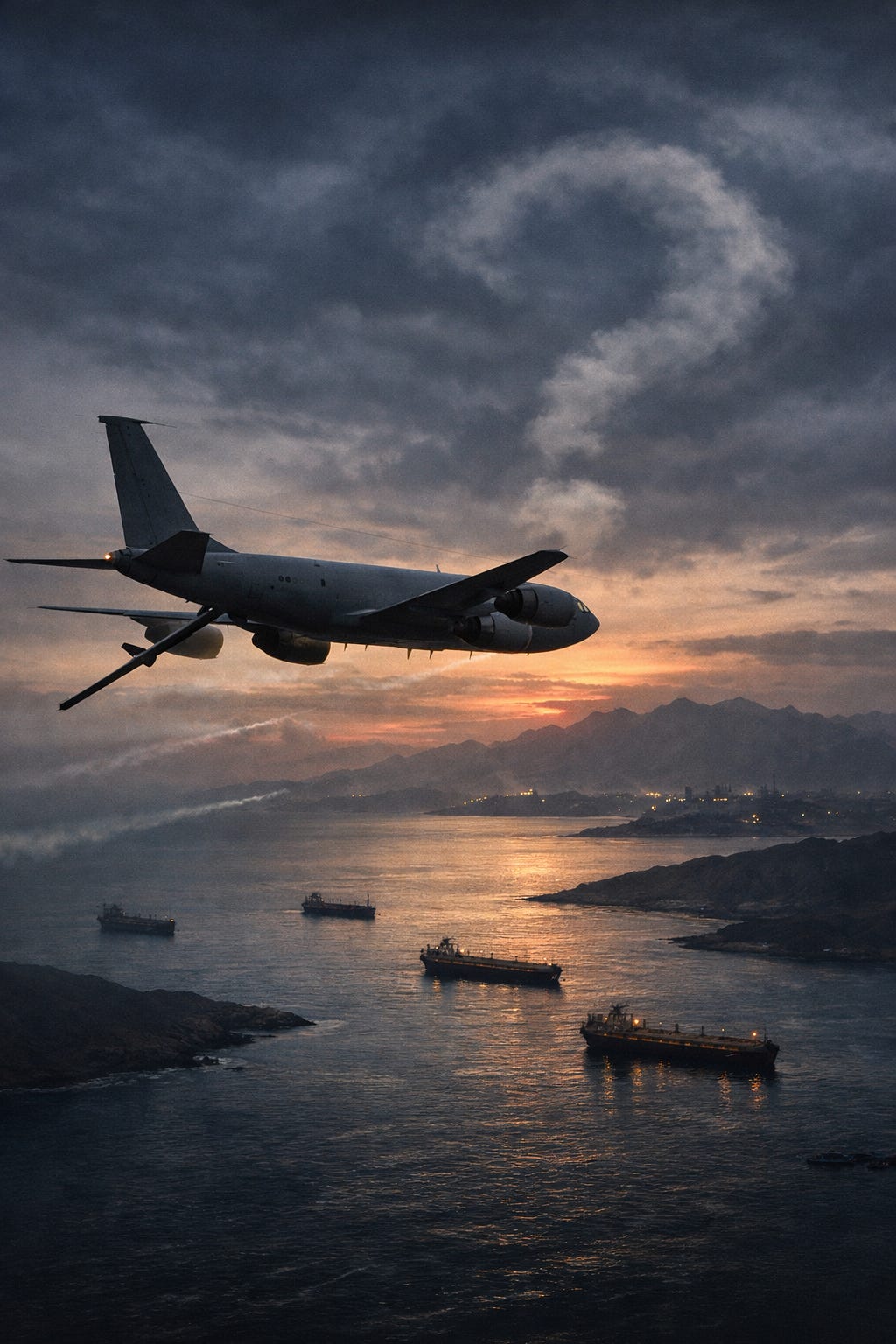
Yesterday, in the middle of this war with Iran, tragedy struck in a way that most Americans will likely only notice for a moment before moving on to the next headline. Two U.S. Air Force KC-135 Stratotankers collided during refueling operations over Iraq. One of the aircraft went down, killing the crew aboard. The other aircraft, damaged in the collision, was able to land. It’s a devastating loss, and like so many wartime losses, it happened far from the attention most Americans give to the conflict itself.
For me, that story lands differently than it might for others. I flew the KC-135 from 2005 to 2008 before moving over to the RC-26B. Tanker crews are rarely the ones people think about when they picture airpower. The fighters get the glory. The bombers get the headlines. But tankers are the reason any of those aircraft can stay in the air long enough to do their jobs. Every mission that reaches deep into hostile territory depends on someone quietly orbiting somewhere nearby with thousands of pounds of fuel on board.
Remove your personal data from Google and ChatGPT
Have you ever searched for your personal information on Google or ChatGPT? You’d be shocked to find out what people can find out about you.
Your name, phone number, and home address are just the beginning. Anyone deeply researching you can find out about your family members and relationships, SSN, health records, financial accounts, and employment history.
Incogni’s Unlimited plan puts you back in control of your online privacy, keeping you safer from harmful scams, identity theft, financial fraud, and other threats impacting your physical safety.
Get 55% off Incogni’s annual plan with code ADAM. I use it myself — and I highly recommend it.
It’s demanding flying. It’s technical. It’s routine until the moment something goes wrong. When you hear about a mid-air collision during refueling operations, you immediately understand how quickly a normal mission can turn into catastrophe. Tanker crews accept that risk because they know the entire air campaign depends on them. The airmen we lost yesterday were doing exactly that kind of work.
Their loss should force us to confront a question that Washington still seems unable or unwilling to answer clearly: what exactly is the objective of this war with Iran?
Right now, that answer feels unclear even to the people running it.
If the goal is to degrade Iran’s military capability, the United States can certainly do that. American airpower is capable of destroying targets at a pace and scale no other military can match. Missile sites, drone factories, command centers, radar networks — those things can be hit, destroyed, and hit again.
But destroying things is not the same as having a strategy. Military capability can be rebuilt. Factories can be repaired. Drone production can restart. The real question isn’t whether we can degrade Iranian military infrastructure today. The question is what the long-term objective is once that degradation happens.
At the same time we are carrying out these strikes, we are burning through enormous quantities of precision weapons. That brings us to another issue Washington has ignored for years: the state of America’s defense industrial base. Not the new weapons, those are being developed and overdeveloped. But the munitions that are the backbone of war. A long war.
During the Cold War, the United States built an industrial system designed to sustain long wars. Production capacity was enormous because it had to be. The assumption was that if conflict broke out with a major adversary, we would need to replace large numbers of weapons quickly.
That industrial capacity has steadily shrunk over the past few decades. Today we are expending precision munitions faster than we can easily replace them. Cruise missiles, JDAM kits, and interceptor missiles cannot simply appear overnight. Production lines exist, but they are far smaller than they were during the era when America expected to fight large-scale wars. Even when Ukraine kicked off, we kept just a slightly quicker pace, but not one we needed.
At the same time, warfare itself is evolving in ways that challenge the traditional approach to air defense. The war in Ukraine has shown just how dramatically the battlefield is changing. Cheap drones are now a central part of modern conflict. Iranian Shahed drones, which Russia has used extensively against Ukraine, cost tens of thousands of dollars to produce. The Patriot interceptors used to shoot them down cost millions.
That exchange ratio is a problem. It is not sustainable in a long war.
Ukraine understood this early in the conflict and developed cheaper ways to intercept those drones. Last August, Ukraine offered to help the United States and its allies deploy a system capable of intercepting Shahed drones at a fraction of the cost of Patriot missiles. The United States declined that offer at the time. Now, after Iranian drones are appearing across the region, the United States is reportedly asking Ukraine for help.
That reversal says a lot about how slowly large institutions sometimes adapt to new realities. And how the Trump administration can’t think past today.
Meanwhile, we are watching another predictable consequence of this war unfold. Iran has moved to close the Strait of Hormuz. Anyone who has spent even a little time studying the Persian Gulf understands the importance of that narrow waterway. Roughly twenty percent of the world’s oil supply passes through it. When that route shuts down, global markets react immediately.
Oil prices surge. Energy markets destabilize. Economies around the world feel the shock.
This outcome should not have surprised anyone in Washington. Iran has long signaled that the Strait of Hormuz would be one of its first tools in a major conflict. Yet the American public was never prepared for the possibility that the war could trigger exactly this scenario, and Trump clearly ignored it.
That lack of preparation suggests something troubling. Either the administration did not expect this conflict to escalate the way it has, or it did not believe the American people needed to hear the truth about the risks involved.
Neither explanation reflects serious leadership.
Reopening the Strait now presents difficult options. One path would involve negotiating with Iran to reopen the shipping lanes. That would likely be seen internationally as a strategic defeat after launching a major military campaign. The other path would involve securing the Strait through military force, potentially occupying the Iranian side of the waterway.
That second option would require a ground operation and likely a permanent American presence defending the area from Iranian attacks. Anyone who remembers the lessons of the past two decades should recognize how dangerous that path could become.
All of this leads back to the same problem. The United States entered this conflict without clearly defining the objective, to us, or to themselves. At different moments the rhetoric has suggested that the goal is to degrade Iran’s military capability. At other times Donald has talked about regime change.
Those are not the same thing. Degrading military capability could be a limited campaign. Regime change in a country of nearly ninety million people would represent a massive undertaking with unpredictable consequences.
If regime change is the real objective, the administration should say so clearly and explain the commitment required. If the objective is limited to degrading military capacity, that should have been stated from the start. When goals shift publicly during a conflict, it damages credibility and creates confusion about what victory would even look like.
There is also a broader strategic opportunity here that seems to be getting overlooked. Iran and Russia are deeply connected in this conflict. Iran has supplied drones and other equipment that Russia uses in Ukraine. Russia provides diplomatic and military support in return. Weakening one regime inevitably affects the other.
If the United States wants to weaken both, the most effective place to apply pressure is Russia’s war effort in Ukraine. Ukrainian forces are currently conducting a successful counteroffensive. What they lack is not determination but consistent support. Providing Ukraine with the resources it needs to continue that momentum would weaken the Russian regime that Iran relies on as a partner.
A coherent strategy would recognize that connection. It would support Ukraine aggressively, tighten sanctions on Russia, define limited objectives in Iran, achieve those objectives, and then end the fight.
Instead, the current situation often feels chaotic. Watching Donald Trump and Pete Hegseth oversee American national security increasingly feels like watching a strange sequel to the movie Idiocracy. War is not entertainment. It is not a meme or a campaign rally talking point. It requires preparation, discipline, and a clear understanding of what success looks like.
When leadership fails to provide that clarity, the consequences fall on the people doing the actual work. The six airmen who lost their lives yesterday in a KC-135 collision were carrying out a mission that made every other aircraft in that theater possible.
Their loss is a reminder that war is not theoretical. It is real, and it demands seriousness from the people who make the decisions.
Despite the frustration many of us feel watching this unfold, I remain optimistic about the long-term direction of the country. Democracies stumble. We argue, we make mistakes, and sometimes we elect leaders who are simply not prepared for the responsibilities of the office they hold, or they’re just straight up clowns.
But democracies also correct themselves.
The pro-democracy coalition in this country remains strong, and eventually it will reclaim the direction of American leadership. When that happens, we should remember something fundamental about what America represents.
Our mission has never been domination. It has been example. The United States exists to demonstrate that self-government works. For billions of people around the world living under authoritarian rule, the American experiment has long been proof that freedom and democracy are possible.
That mission is larger than any administration or any moment of political dysfunction. It is the mission that has carried this country through difficult periods before, and it is the mission that will guide us forward
Video for paid subscribers:
