


Video with further discussion follows article for paid subscribers
I read a story this morning HERE that I haven’t been able to shake. Not because it was shocking — we’ve almost lost the ability to be shocked — but because it felt familiar, like noticing a warning light that’s been blinking for a long time and finally realizing what it means.
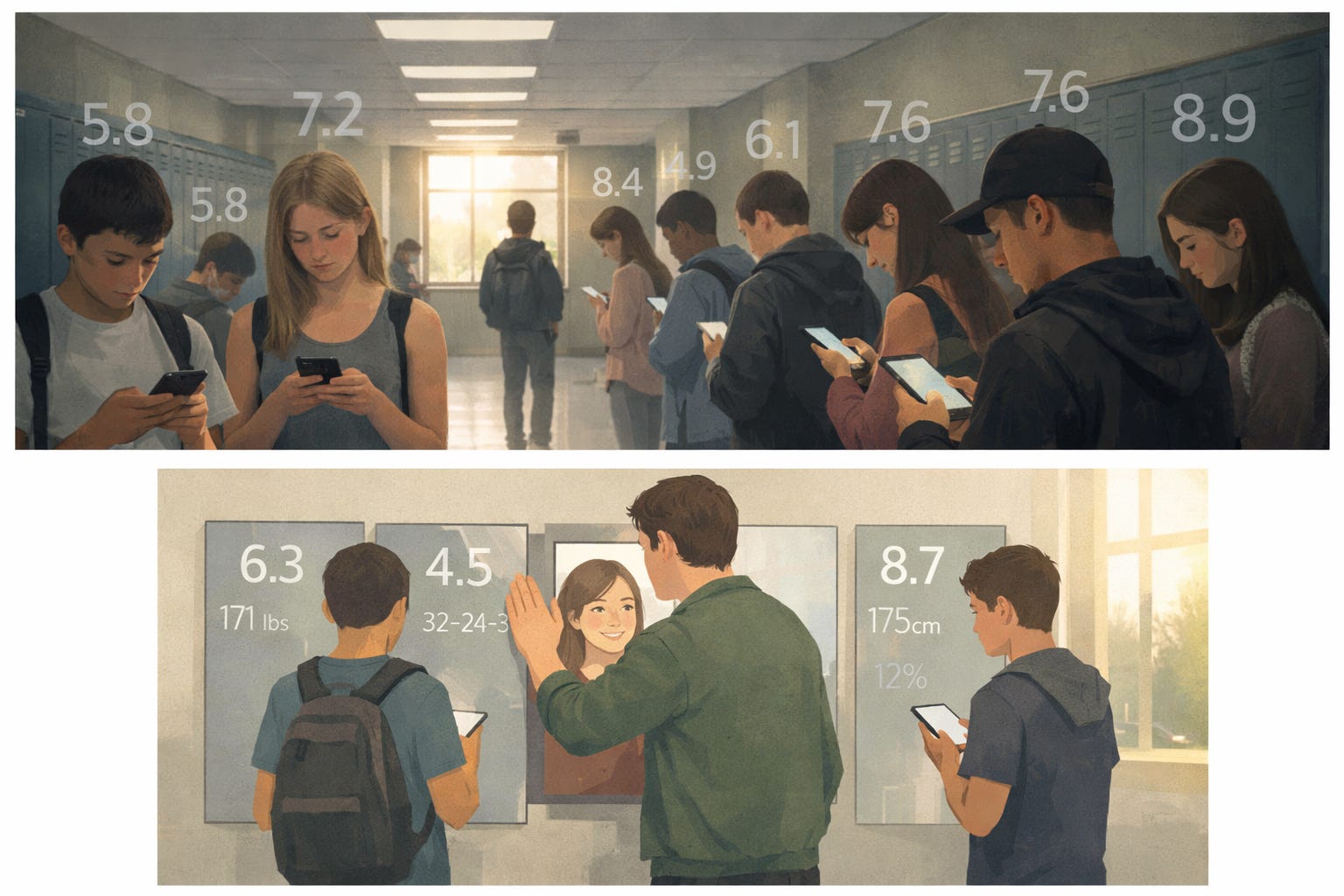
It described a young internet figure who built a following around something called “looksmaxxing.” Most adults over 35 have never heard the term, but millions of teenagers instantly recognize it. The premise is simple and deeply corrosive: your value as a human being is determined primarily by your physical appearance, and every decision in your life should be oriented toward maximizing it. This doesn’t mean ordinary self-care or staying healthy. It means extreme and sometimes dangerous behavior framed as discipline — obsessive comparison, starvation cycles, steroid use, surgical fixation, and the belief that personality, kindness, or character are secondary traits at best.
The disturbing part isn’t only the physical obsession. It’s the philosophy underneath. This culture reduces human beings into ranked categories of worth. Women are discussed as targets to acquire rather than people to know. Personality is treated as a weakness. Working on emotional intelligence or empathy is mocked as failure. In these communities, the central belief is that dominance determines value, and appearance determines dominance.
If that sounds ancient and ugly, it’s because it is. History periodically produces movements obsessed with categorizing people into biological worthiness. They always use new language — science, realism, strength, order — but the core idea never changes. Some people matter more than others, and you can tell by looking at them.
Here’s the uncomfortable truth. The backlash against “wokeism” did not only correct excesses. In certain spaces it overshot entirely and revived the worst instincts we’ve had before. Instead of the principle that immutable traits shouldn’t define human value, the pendulum swung toward the idea that immutable traits are the only things that define value. Instead of character, the focus became dominance. Instead of empathy, humiliation became entertainment.
What’s emerging online, particularly among young men, is not confidence culture. It’s control culture. The so-called alpha movement isn’t centered on health, responsibility, or maturity. It’s about power over others, particularly women. Strength is no longer framed as the ability to protect or provide stability, but as the ability to manipulate and rank people socially.
Now imagine being fifteen years old inside that environment. You’re told your face determines your worth. Your value is measured publicly and constantly. Your masculinity is defined as domination. Your personality is treated as weakness. Relationships are described as conquest strategies rather than human connection. The people delivering these messages profit directly from insecurity, and insecurity spreads quickly because it’s emotionally contagious and algorithmically rewarded.
We are placing absolutely unbearable and unachievable burdens on a generation that already lives under permanent comparison. Previous generations worried about popularity within a school. Today’s kids exist inside a global scoreboard that never turns off. The expectation is no longer to grow into a good person; it is to optimize yourself into a product.
Adults are largely sleepwalking through this because it arrives packaged as self-improvement, fitness, or dating advice. But the messaging underneath is profoundly different. It is not about becoming healthier. It is about becoming superior. It is not about confidence. It is about hierarchy.
There is a strange irony in all of this. The political figure (Trump) whose cultural energy often fuels this worldview does not personally embody the physical ideals being worshipped, yet still inspires a cult centered around physical superiority. That contradiction reveals the truth: this movement was never really about fitness. It is grievance dressed up as biology.
The long-term cost will not just be online arguments. We are shaping a generation that will spend decades untangling psychological damage — men taught they are worthless unless dominant, women taught they are objects to be optimized, and both taught relationships are transactional. That does not create stronger families or healthier communities. It creates isolation and distrust.
There is nothing inherently wrong with caring about appearance, exercising, or even cosmetic procedures. Humans have always cared how they present themselves. The danger comes when appearance replaces character as the primary measure of worth. Physical beauty inevitably changes with age. Character is the one trait that compounds over time. A culture that reverses those priorities sets people up to build their identity on something guaranteed to fade.
We cannot dismiss this as just another internet phase. This is a worldview forming in real time, and it ranks human beings by perceived biological value. History has repeatedly shown where that logic leads.
The response doesn’t need to be hysterical, but it does need to be intentional. Kids need models of discipline without cruelty, strength without domination, confidence without contempt, and attraction without dehumanization. They need to see that reliability, honesty, and empathy are not weaknesses but foundations for real stability in life.
If we fail to re-center those values now, the next generation will inherit more than our political divisions. They will inherit psychological scars reinforced every day by the systems shaping how they see themselves and each other.
Video for paid subscribers:
