


Hey everyone, happy Sunday. This week, Good News Sunday is going to look a little different.
Dolly Parton died on Tuesday in Nashville, surrounded by the people she loved. She was 80 years old. And I know what you might be thinking, because I thought it too. What is a death doing in a column about good news?
Stay with me, because I think the answer is the whole point.
When the news broke, something happened that almost never happens anymore. The tributes came from everywhere, and I mean everywhere. Country legends and rock stars. Faith leaders and Hollywood icons. Democrats and Republicans, in the same hour, saying the same thing. We are told constantly that Americans can’t agree on anything, that we’ve sorted ourselves into camps that can’t stand the sight of each other. And then Dolly Parton passes away, and for a few days a divided country agreed on something. We agreed on Dolly.
To understand why, you have to start where she started.
Dolly was born in 1946 in a one-room cabin in the Smoky Mountains of East Tennessee, the fourth of twelve children. Her family was, by any measure, dirt poor. Her father paid the doctor who delivered her with a sack of cornmeal. She grew up wearing clothes her mother stitched together from whatever scraps she could find. One of those coats, sewn from rags into something beautiful, became one of the most famous songs she ever wrote. Her father, Robert Lee, was one of the smartest people she ever knew, and he never learned to read or write. She carried that her whole life.
From that cabin, she built one of the most remarkable careers in the history of American music. She wrote hundreds of songs. Jolene. Coat of Many Colors. 9 to 5. I Will Always Love You, which became, in Whitney Houston’s hands, the best-selling single by a solo woman in history. Seven decades on stage.
She even built a theme park in the Tennessee hills that employs thousands of the people she grew up with. She became the wealthiest woman in the history of country music, and she did it while being underestimated at every turn by people who saw the wig and the rhinestones and missed the razor-sharp mind underneath.
That is a full life. Most people would have stopped there, and no one would have blamed them. Come from nothing, reach the mountaintop, enjoy it. She had earned every bit of the enjoying.
But that is not the part of her story that the world spent this week talking about.
Dolly took her success and turned it into a machine for lifting other people up. In her home county, she watched kids drop out of high school, poverty pulling them out of the classroom one by one. So she started offering every student who stayed and graduated a check for five hundred dollars. And the dropout rate, in a place where it had always been stubbornly high, fell through the floor. She didn’t give a speech about the value of education. She just used her personal resources to make it worth a kid’s while to finish, and it worked.
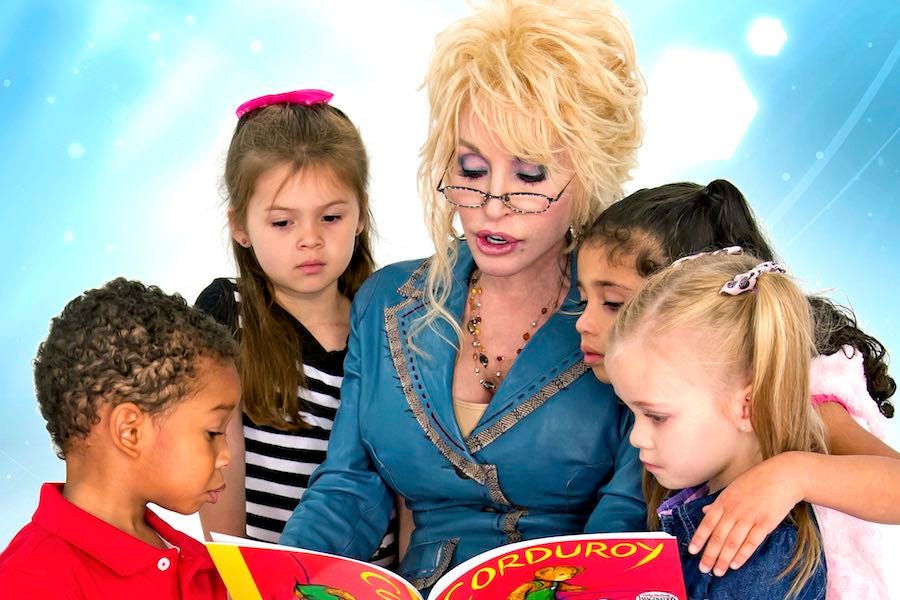
Then there’s the books. In 1995, thinking about her father and all the doors that stay closed to a person who can’t read, she started mailing free books to children in her home county. One book a month, from birth until age five, addressed not to the parents but to the child, so that a little kid in a cabin like the one she grew up in would get something in the mail with their own name on it. That program became the Imagination Library. It has now given away more than 300 million books across five countries. Today, one in every six American children under the age of five gets a Dolly book in the mail. The kids started calling her the Book Lady, and she loved that more than almost any other title she ever held.
She once said, when they lay her down, she’d be thinking of the Imagination Library. And she made sure it wouldn’t end with her. Her team says she worked right up until the day she died and spent her last years building a plan to keep the books coming for decades.
Once a child receives their final book at age five, Dolly includes a goodbye letter, congratulating them for graduating from her library. This week, parents all over the country shared photos of those letters. Some children received theirs on the very day she passed. According to her team, her last piece of mail to a five-year-old went out the same day she left us.
When the family asked that people honor her by giving to the Imagination Library, the donations came in so fast the website kept crashing.
Here is what I keep coming back to, and why this belongs in a column about good news:
Dolly Parton is proof of something we forget in a cynical age. She had every excuse to keep what she’d built for herself. She came from real poverty, clawed her way up through an industry that didn’t take women seriously, and earned a fortune with her own two hands, working 9 to 5 and then some. Nobody would have said a word if she’d simply enjoyed it. But she understood something that the loudest and most powerful people in our country today seem to have forgotten. Success isn’t the finish line. It’s the opportunity to spend some of it on somebody else.
The powerful people in politics and industry build monuments to themselves. They put their names on buildings and their faces on currency and they measure their worth by what they can take for themselves. Dolly measured hers by what she could give, and she gave until the last day of her life.
When it was all over, the world didn’t eulogize her for the platinum records or the money or the fame. It eulogized her for the books, and the kids, and the kindness. That’s the choice she made, over and over, and it’s the reason a divided country stopped and grieved together this week.
That’s the lesson, and it’s available to every single one of us, no matter how much or how little we have. You don’t need a fortune to give something away. You just need to decide, like she did, that the whole point of whatever you’ve been given is to make your corner of the world a better place.
Rest easy, Dolly. And thank you. For the songs, for the books, and for showing us how it’s done.
- Adam
In a world full of Donalds, be a Dolly.
RIP, Queen.
Thank you such a beautiful tribute. I am crying, yet again, with tears of gratitude for Dolly. The beautiful soul who valued connections and knew the joy of gratitude herself. Thanks, Adam, for posting. Gratitude for all you do, too!