

Video discussion for paid subscribers follows article
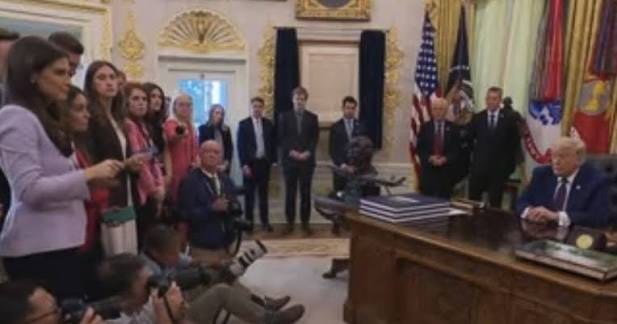
I was on CNNs “The Arena” yesterday when we interrupted to cover Trump in the Oval Office... and what happened there — with Trump turning on Kaitlan Collins in the middle of a press briefing — was not surprising. That’s the problem.
Trump was being asked about his abandoned “Anti-Weaponization Fund,” a Department of Justice initiative he had claimed would address the alleged persecution of his supporters. It was a legitimate question deserving a direct answer. Instead, when Collins asked about the status of the apparently abandoned $1.8 billion fund, it didn’t take long for Trump to get testy. His response: “I’d have to ask the lawyers. I don’t know.” That was it. The man who created the fund, who held it up as a monument to fighting injustice, couldn’t say whether it was alive or dead.
AI gave strangers his phone number
A software engineer says random strangers started contacting him after Google’s AI reportedly surfaced his personal number.
No hack. No breach. Just information already online. The scary part? Once one piece of your data is public, it becomes easy to uncover more—your address, relatives, workplace, and more.
That’s why we recommend Incogni. It helps remove your personal information from the web before scammers, strangers—or AI tools—surface it.
Collins, to her great credit, didn’t let it go. She prodded: “But what’s your decision on it?” That follow-up — calm, professional, simple — is what real journalism looks like. Not a gotcha. Just accountability. The kind of question that requires an actual answer.
What came next was a pattern we’ve seen before. Trump turned his attention to Collins, calling CNN “crooked as hell” and “a very corrupt organization,” then made it personal. “A corrupt reporter standing right there, never smiles,” he said. “You never see a young, beautiful woman who never smiles. I never see a smile on her face.” Then came the escalation: “I see her standing there with hatred in her eyes, like she has hatred, because we had borders, because we have a strong military, because we cut our taxes.”
Collins didn’t flinch. When Trump said she “was a conservative from Alabama” as a dig, she simply replied: “I’m still from Alabama, Sir.” No theatrics. No wounded expression. No attempt to curry favor. She was there to do a job, and she did it — even as the most powerful person in the world attacked her appearance, her character, and her network to her face.
This is not the first time. On February 3, 2026, when Collins questioned Trump about the Epstein Files, Trump snapped at her calling her “the worst reporter.” He frequently makes comments about her appearance and slams CNN’s reporting, and Vice President Vance called those comments “so perceptive.” The attacks on Collins — always focused on how she looks, whether she smiles, whether she’s grateful enough — reveal something that deserves to be said plainly: the standard applied to women in that briefing room is different. Men who challenge him get attacked on substance. Women who challenge him get told to smile.
Between Collins and Scott Pelley, we saw two versions of the same thing: journalists who prepared, pressed, and didn’t perform submission when things got uncomfortable. That’s not courage anymore — it shouldn’t have to be. It should be the baseline. The fact that it stands out so sharply tells you how low the bar has fallen elsewhere.
Because while Collins was holding her ground in the Oval Office, somewhere else in the media landscape, a network has fired most of its 60 Minutes crew in what looks uncomfortably like an audition for Trump’s approval. Others lob softballs calibrated not to inform the public but to avoid losing access. The contrast is not subtle.
What struck me most — and what perhaps should alarm all of us — is how unsurprised we were. The President of the United States told a professional journalist, on camera, in the Oval Office, that she had hatred in her eyes and should smile more. And the reaction, largely, was a shrug. We have normalized this. We have accepted that press briefings are now partly performance art for the president’s grievances, that female journalists must absorb personal attacks as a cost of doing business, that the press corps will absorb the body blow and keep going.
They keep going. But fewer and fewer of them exist.
That’s why independent journalism — spaces like this Substack — matter more now than at any point in recent memory. Not as a replacement for the major networks, but as a reminder of what the thing is supposed to be. No access to protect. No advertiser to appease. No corporate parent weighing whether tough coverage costs them a regulatory favor. Just the story, the question, and the willingness to follow up — even when someone powerful tells you to be quiet and smile.
Collins didn’t smile. She did her job. So should we all.
Video discussion for paid subscribers:
