



You know what happened last week. Republicans got walloped in the midterms. And like anyone who’s suffered a big loss, the party is now working through its grief.
So today, we are going to look at the five stages of grief, MAGA edition.
You probably know them:
Denial
Anger
Bargaining
Depression
Acceptance
They don’t always arrive in order, but the framework has stuck around because they describe something real. Grief is supposed to go somewhere. You work through it, you face the truth, and eventually you move on.
Over the last seven days, the Republican Party has hit every one of those stages, practically on schedule.
Well. Almost every one.
Denial
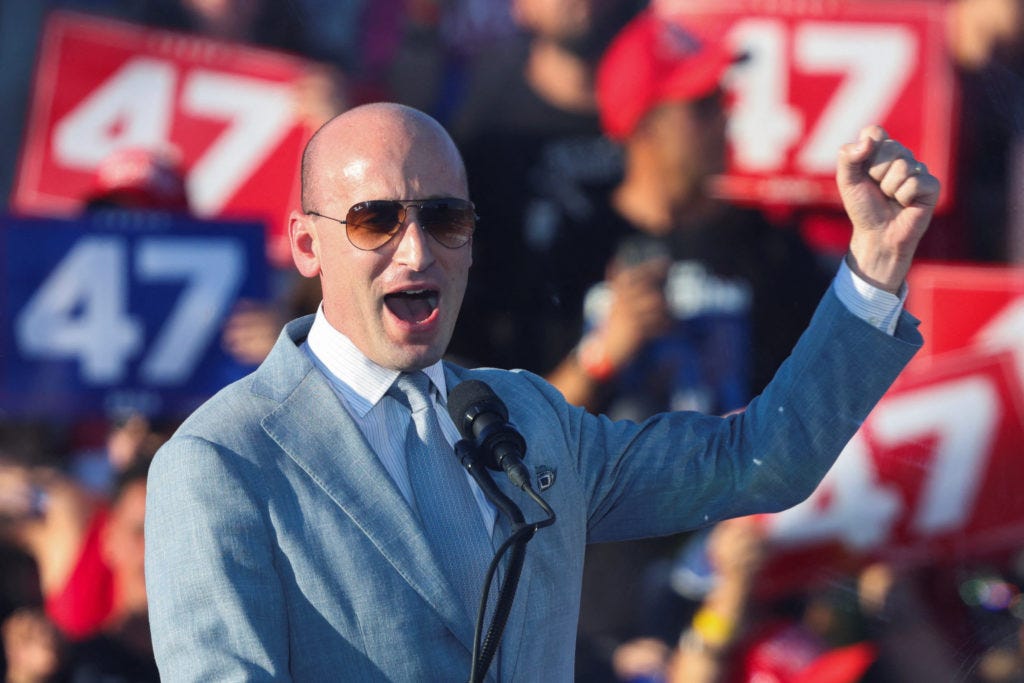
Three days after the elections, Donald Trump named Stephen Miller his new White House chief of staff.
If you wanted to send voters a message that said “we heard nothing,” you’d be hard pressed to find a better messenger.
Miller is the architect of this administration’s immigration crackdown, which happens to be one of the biggest reasons Republicans just got crushed. For years, immigration was the GOP’s home-field advantage. Then America got a good look at what Miller’s version of enforcement actually looked like, and recoiled.
It didn’t just cost them independents. It cost them their own people. In Texas, months of raids on construction sites caused delays and labor shortages that helped Democrats win up and down the ballot. Farm groups that helped elect Trump watched their members lose workers they couldn’t replace.
My favorite detail: when the head of Pennsylvania’s leading farm industry association first got word that something had happened with Stephen Miller, his first thought was, “Thank goodness he was let go.”
Then he found out Miller had been promoted.
Anger

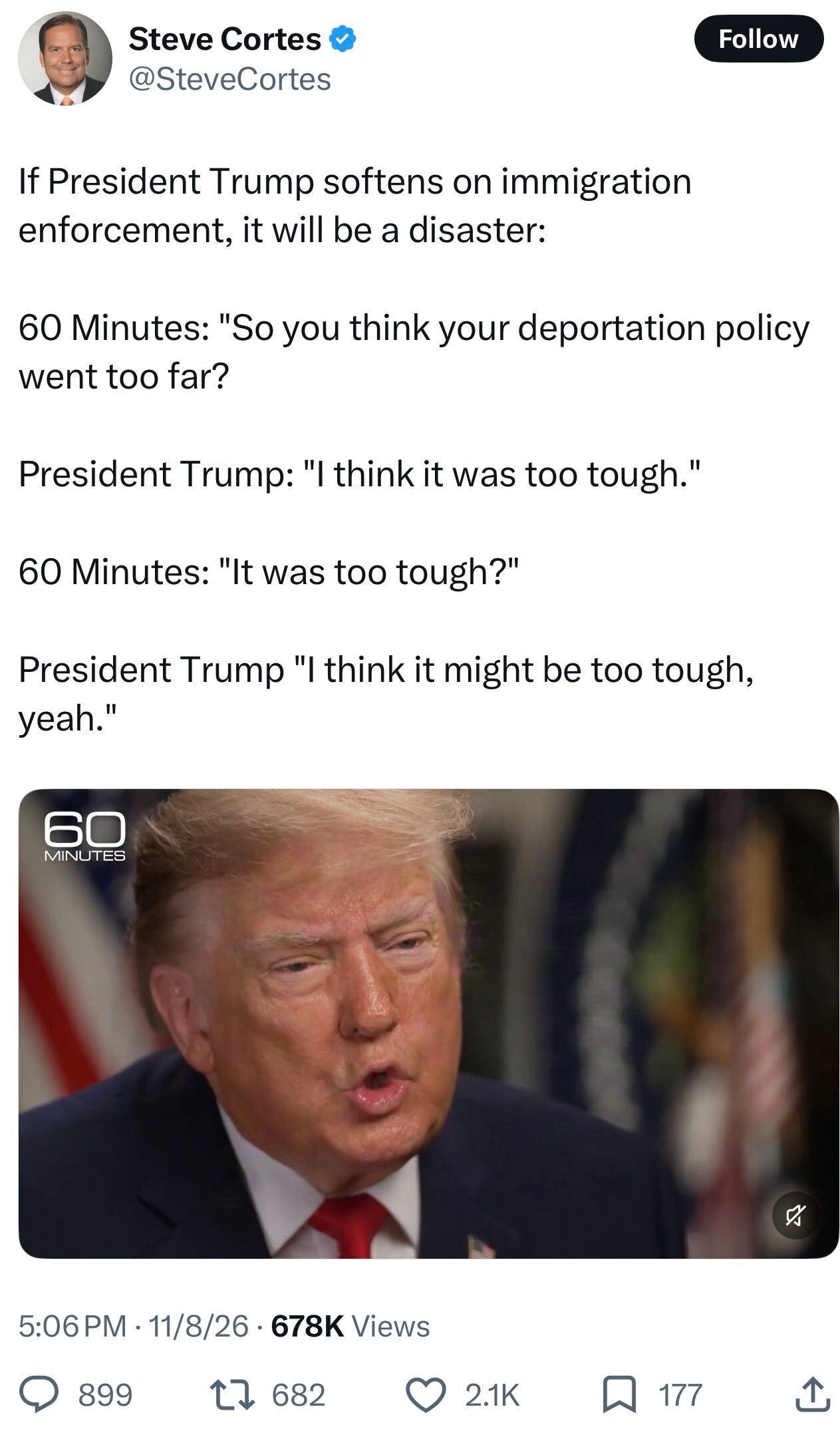
On Sunday night, 60 Minutes aired Trump’s first sit-down since the election. Ross Douthat asked whether immigration had hurt Republicans, and Trump, to the surprise of just about everyone watching, didn’t dodge.
His deportation push “might be too tough,” he said. He floated an immigration deal with the new Democratic majority. He even pinned part of the blame on “a group of people that I would say on the sort of pretty far right that would like everybody taken out.”
For Donald Trump, that’s practically a therapy session.
His own movement did not take it well.
“If President Trump softens on immigration enforcement, it will be a disaster,” warned former Trump adviser Steve Cortes.
Nick Sortor, the same right-wing influencer who brought you the fake story about James Talarico in a mental hospital, demanded that Stephen Miller “CLEAN HOUSE of advisors, because this is a HORRIBLE take.”

So, to recap. A week after voters rejected their agenda, the right’s loudest anger wasn’t aimed at the agenda. It was aimed at the President, for admitting, ever so slightly, that maybe it went too far.
Bargaining
Next up: bargaining. The results are too painful to accept, so maybe, just maybe, they aren’t real.
On election night, Trump told The New York Times he was “absolutely willing” to accept the results and was looking forward to working with Democrats.
That lasted six days.
On Monday, the day after his base revolted over his immigration comments, he dusted off his greatest hit. “Does anybody really believe that this ‘Election’ was honest,” he posted. “It’s all about the machines, which are far more important than the voter!”
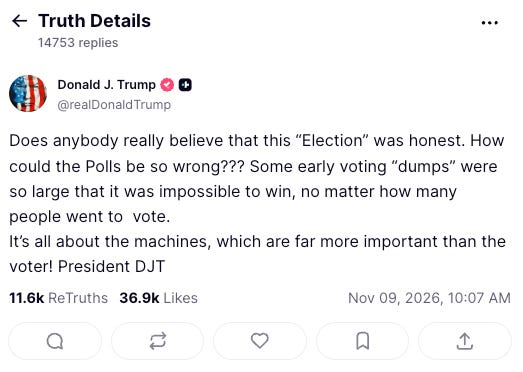
Funny timing. One day the base is furious with him, the next day the old election lies are back. Call it a peace offering: don’t blame me, don’t blame Stephen Miller, don’t blame the policies. Blame the machines.
None of this is new, of course. In Trump’s world, every loss is fraud and every win is proof of how great he is. That’s the bargain MAGA made with him years ago: you never have to admit you lost, no matter how many voters tell you that you did.
Depression
Here’s the problem. It isn’t working, and they know it.
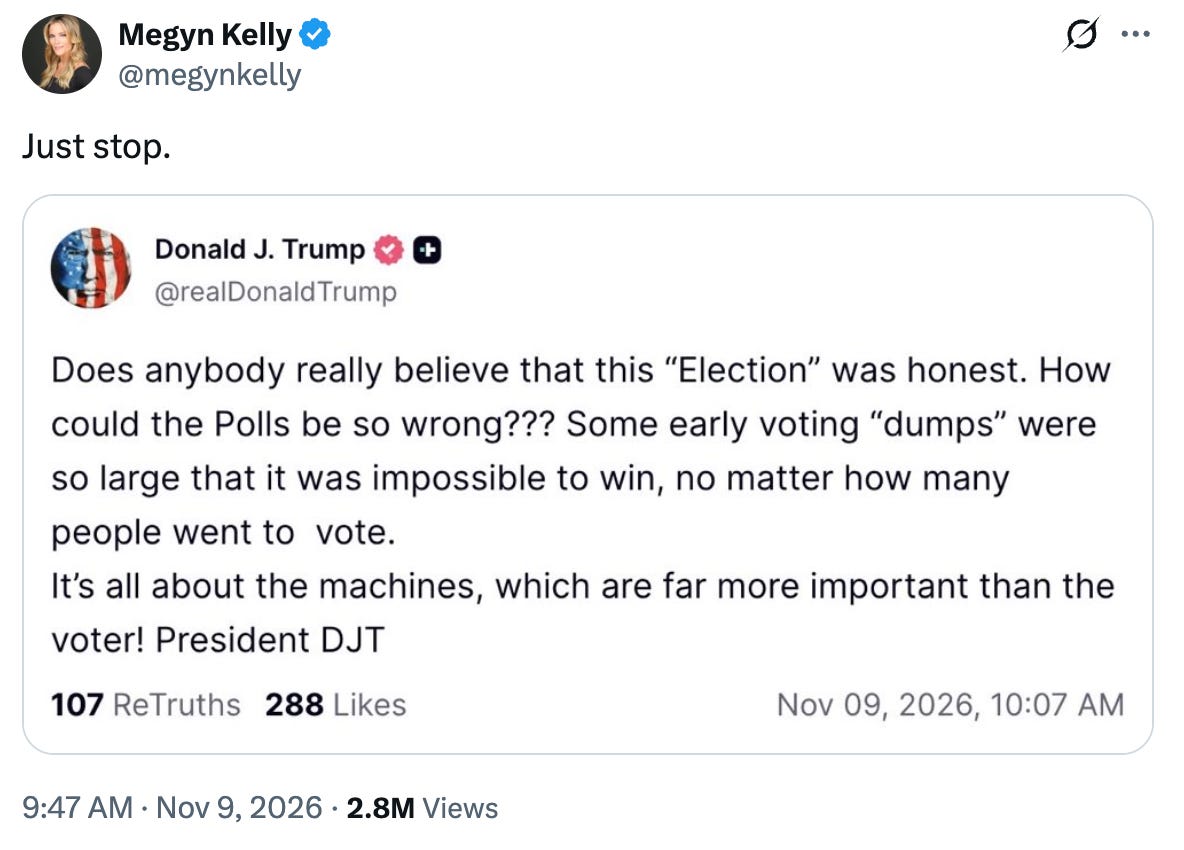
In 2020, the stolen-election lie spread like wildfire. This time, it’s barely a birthday candle. Megyn Kelly, who is no enemy of Trump, summed up her reaction in two words: “Just stop.”
Even DC_Draino, a right-wing influencer who has been pushing stolen-election claims since 2020, admitted that whatever fraud he imagined was “not enough to explain what happened.” When you’ve lost DC_Draino on election fraud, you’ve lost the entire argument. He took his post down on X, but his comments are immortalized in the quotes pulled by the Washington Times:
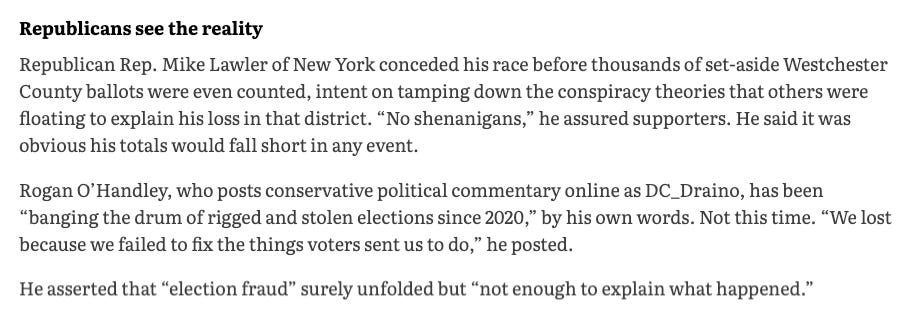
A researcher who studies online misinformation put her finger on what’s missing this time: there’s no “widespread shared grievance.” Voters aren’t buying it, because they know exactly what they did and why they did it.
For a movement that runs on grievance, it doesn’t get much more depressing than that. The go-to lie fell flat, and not just with the rest of the country. With the base.
Acceptance

Which brings us to Tuesday, and to the twist.
Yesterday, I published an open letter to my former Republican colleagues ahead of their vote for new House leadership. This was their chance to do what they should have done in 2021, and finally break with Trump and his enablers.
A few hours later, they chose Jim Jordan. He’s the man expected to lead the charge defending Donald Trump against the new Democratic Congress.
So Republicans did reach acceptance after all. Just not the kind where you learn anything.
They didn’t accept that voters rejected them, or that they need to change. They accepted that they can’t. They looked at the worst midterm defeat in half a century and chose more of the same.
For years, Republicans told me privately that they went along with Trump because they were afraid. Afraid of primaries, of his voters, of the threats. That excuse died yesterday behind closed doors. This isn’t fear anymore. It’s who they’ve decided to be.
My Own Five Stages
Now, something personal. I went through my own version of these stages after January 6th.
At first, I believed the party would come back to its senses. Then I was angry, at the people who knew better and folded anyway. I spent a long time convinced I could help fix it from the inside. There were some hard, lonely months. And eventually I reached acceptance: the party I joined wasn’t coming back, and the only thing left to do was to help build something better for the country I love.
That’s what acceptance is supposed to do. It frees you to move forward. The Republican Party has chosen the opposite. It’s accepted that it would rather stay stuck than change.
I’d love to be wrong about that someday. But until then, don’t mistake their paralysis for permanent defeat. A party that can’t change doesn’t simply disappear. It waits.
Our job, for the next two years and beyond, is to make sure the country has better choices than the one they keep making.
— Adam
Thank you Adam for upholding honesty and decency. My sincere appreciation on this Veterans Day.
This is an incredible synopsis, Adam!