

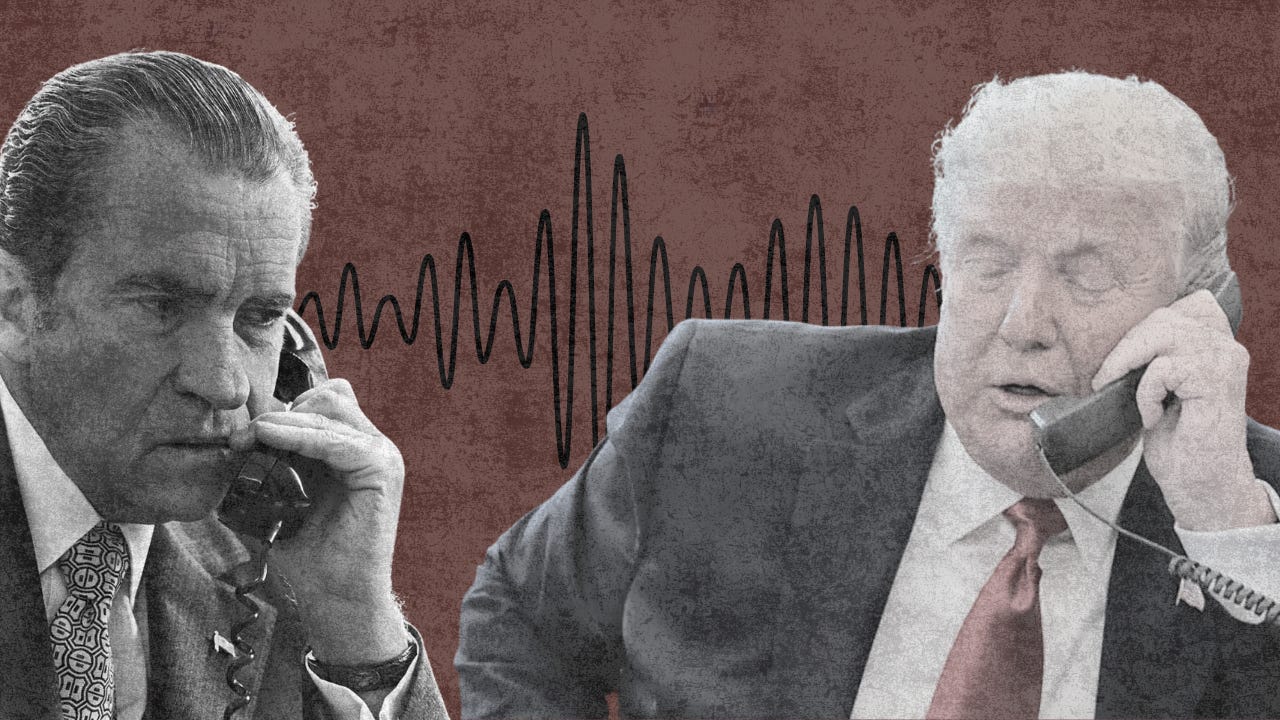
Fifty-two years after Richard Nixon resigned, Donald Trump’s Justice Department wants to know whether Nixon was treated unfairly.
According to The Wall Street Journal, the DOJ is reviewing whether the special prosecutor’s office that investigated Watergate committed misconduct. A senior official invited Geoff Shepard, an 81-year-old former Nixon aide who has spent decades arguing Nixon was set up, to department headquarters. He gave a two-hour presentation titled “Watergate as Lawfare.” The department insists the presentation “does not constitute an investigation.”
Then on Thursday, a Republican congressman went further.
Nixon, Rep. Riley Moore of West Virginia said, was “absolutely couped out of office” and “framed.” He said people now feel liberated to talk about “what an amazing president he was.”
Then came the part where the whole thing clicked for me: Moore explicitly compared what happened to Nixon with what Trump faced over what he called the “fake Russia collusion hoax.”
Of course.
Please consider subscribing today to support my independent journalism. Nobody funds this work but you and paid subscribers keep it free for those who are struggling and cannot. With the impending midterms and threats to democracy on all sides, calling out the corruption and lawlessness is more important than ever. Thank you to those who are paid subscribers who keep this operation running. If you support this work and want the best for this country, I invite you to become a paid subscriber today!
If You Can’t Change the Comparison, Change the History
For half a century, Richard Nixon has been the yardstick. Watergate is the scandal every other presidential scandal gets measured against. Nixon is the only president ever to resign, and he did it because the House was about to impeach him and the Senate was about to convict. When people need shorthand for abuse of power or corruption, they use Nixon.
After a couple decades of relative obscurity, Nixon’s name has been called on frequently over the last 10 years. Donald Trump’s corruption and indifference to the laws of our government have inevitably drawn the comparison to “Tricky Dick” Nixon over and over again.
And it’s clearly gotten under the skin of the only president in history to be impeached twice. According to the Journal, Trump has asked some of Nixon’s former aides why Nixon resigned instead of fighting impeachment.
Trump, tired of getting compared to the most disgraced president of the modern era, had two options: change his behavior until the comparison stops fitting. Or change the history until the comparison becomes a compliment.
Naturally, Trump picked the second option. If Nixon and Trump were both victims of the same “Deep State,” then being compared to Nixon isn’t an insult anymore. It’s a badge of honor.
There’s just one problem. Nixon recorded himself and this whole thing has been settled business for 50 years.
There are thousands of hours of tape from Nixon’s Oval Office. On one of them, recorded six days after the break-in, Nixon signs off on a plan to have the CIA tell the FBI to back off its investigation. That’s the tape historians call the “smoking gun.”
When it came out, support in his own party collapsed almost overnight. Barry Goldwater and the Republican leaders of Congress went to the White House and told him the votes to stop impeachment and conviction were gone. Nixon resigned two days later.
I can’t believe I have to say this. Nobody “couped” Richard Nixon. Tim Naftali, the historian who once ran the Nixon Presidential Library, put it simply: “The evidence is overwhelming.”
Lies That Keep Losing
This goes well beyond Nixon. Losing, in life or politics, provides valuable feedback about your past AND future actions.
When a political party loses an election, it can be honest with itself, figure out what voters were telling it, and change. Or it can decide the loss wasn’t real. That the election was rigged, or stolen, or something as simple as a messaging problem.
If a party takes the second road, it goes on making the same mistakes and losing winnable races.
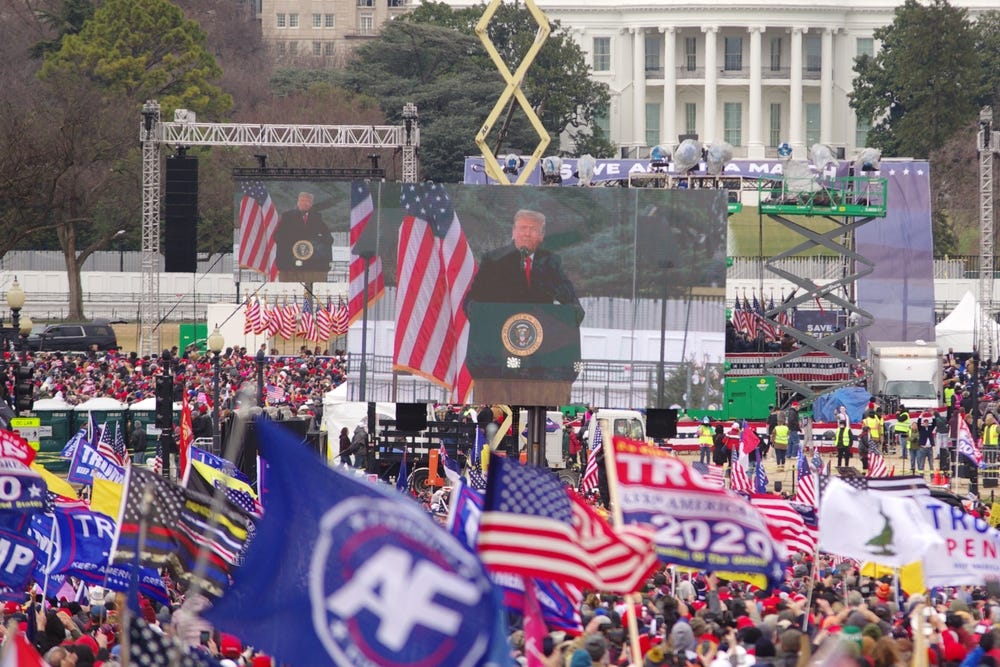
I watched the GOP make that choice after 2020. Trump lost, and instead of standing up to Trump’s lies and learning lessons to improve their chances in 2022 and beyond, the party caved and embraced election denialism.
That lie gave Republicans a wave of candidates whose main qualification was promoting it. Kari Lake lost a race for governor and then a race for the Senate. In 2022, election deniers running to oversee elections in the swing states lost nearly across the board. And it gave us the Justice Department’s “grand conspiracy” probe, the investigation that was supposed to prove Obama-era officials plotted against Trump. Fourteen months in, it has burned through three lead prosecutors and produced zero indictments.
That’s what six years of refusing to be honest with yourself gets you. The Nixon review is the same impulse.
Own It
This isn’t only a lesson for politicians.
Every one of us has messed up. I have, plenty of times. The mistake usually isn’t what defines us. What we do next is.
You can tell yourself a story where it wasn’t your fault. You were set up, or misunderstood, or unlucky. That story feels good for as long as you can avoid accountability. Then you make the same mistake again, because you never learned anything from the first one. Or you can say the three words most of us hate saying: I was wrong.
Boy oh boy, does it sting.
Then it frees you, because now you can actually fix it. People who can admit their mistakes get better at their marriages, their friendships, and their work. They stop stepping on the same rake.
Countries work the same way.
In 1974, America made a mistake, saw it, and owned it. Congress tightened campaign finance laws and created the Federal Election Commission. It made public officials disclose their finances. It passed the Presidential Records Act, so the records of a presidency would belong to the American people instead of the man who made them.
That’s what owning a mistake looks like for a nation.
Whatever the Justice Department wants to call its Nixon review, it’s an attempt to unlearn that lesson.
So, let’s be honest with ourselves today: Donald Trump was the biggest collective political mistake in modern American history.
But are there going to be enough of Americans willing to admit that to themselves? And then will our leaders do the work of making sure it never happens again, the way Congress did after Watergate?
That’s how this country climbs out of the spiral we’re in. Not by everyone agreeing on everything, but by enough of us agreeing on this.
Nixon’s tapes are why no presentation at the Justice Department will ever change what he did. But Trump never needed a secret taping system. He did it all on camera and on Truth Social, for ten years.
The only question is whether we’ll admit it. I said it in 2021, and I’m still saying it.
And I believe that an overwhelming number of American will say the same thing on November 3rd of this year.
— Adam
You can manipulate the record, but you cannot change the truth of what happened—or the lives it changed. That is why authoritarian governments so often try to control history: because a population that remembers is harder to deceive.
History belongs to the people who lived it, suffered it, fought it, and survived it. No politician, administration, or government gets to retroactively decide what is true.
Erasing history does not make the past disappear. It makes the attempt to erase it part of history, too.
What in the hell is wrong with these people? There is something really rotten in the Republican core. So really sad to see what has happen to "The Grand Ole Party".