


Two weeks ago the Republican Party had its worst midterm in fifty years. The Blue Wave washed across Senate and House races from coast to coast, but also rocked the GOP up and down the ticket.
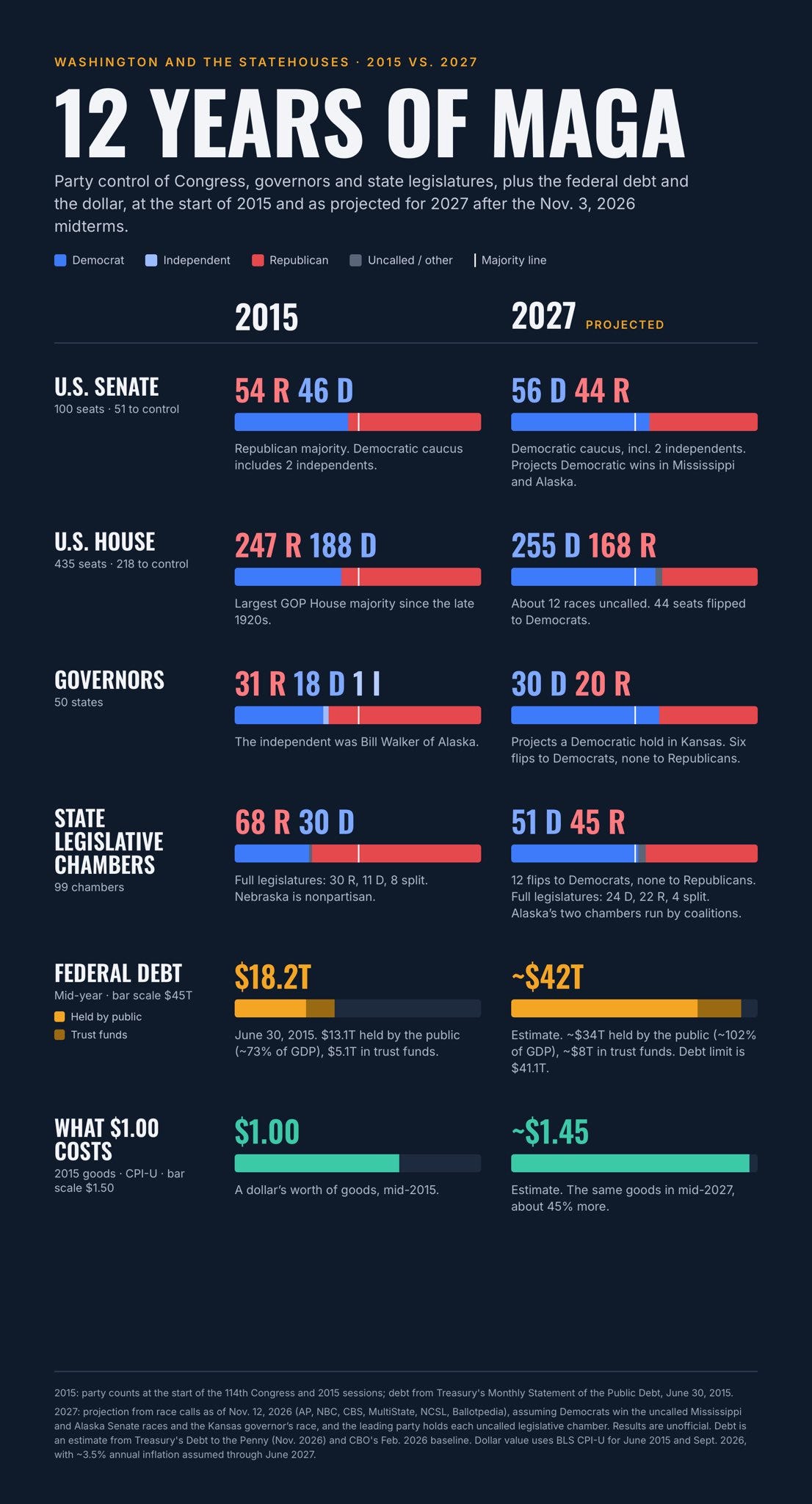
When the new Congress is sworn in on January 3, Republicans will have fewer than 180 seats in the House and just 44 senators. They’re down to 20 governors, and Democrats control most of the country’s state legislative chambers for the first time since 2010.
It gets worse the closer you look. Texas, of all places, elected a Democratic senator and a Democratic governor. A Democrat won a Senate seat in Kansas for the first time since 1932. Democrats beat Republican senators in South Carolina and Mississippi, and now in Alaska too. Two years ago Trump carried every one of those states without breaking a sweat.
Watching the results come in, I couldn’t help but think back to a promise that Trump made just three months into his first campaign. He stood on the West Lawn of the Capitol and told a group of Tea Party activists that if he got elected, there would be so much winning they might get bored with it. They laughed and cheered. “You’ll never get bored with winning,” he added.
Years later, with his father in the White House, Eric Trump was warming up rally crowds by asking, “Are you guys tired of winning yet?”
Republicans do look tired this month. It just isn’t from winning. It’s from everything they gave up to win, and how little of it they have left.
What They Had
Start with what Republicans had before they made the trade. When Donald Trump came down the escalator in June 2015, Republicans held the House with 247 seats, the most they’d had since the 1920s. That’s at least 68 more than they’ll have in January. Seven months earlier they had taken the Senate too, picking up nine seats in the 2014 midterms for the biggest gain by either party since 1980.
The story was the same outside Washington. Republicans had 31 of the country’s 50 governorships, eleven more than they will have next year. In 23 states they held the governor’s office and both chambers. Across the country they had more than 4,000 state legislative seats, something the party hadn’t managed in almost a century.
And the wins were coming in places Republicans weren’t supposed to win. In that 2014 election, voters elected Republican governors in Maryland, Massachusetts and Illinois, Barack Obama’s home state. The party that pulled that off just lost Texas.
But one prize was missing. Republicans had lost the White House twice in a row, and they were hungry to get it back. That hunger is where the story really starts.
That was the party Donald Trump set out to take over. He had never held office. Thirteen months later, it made him its nominee.
What They Gave Up
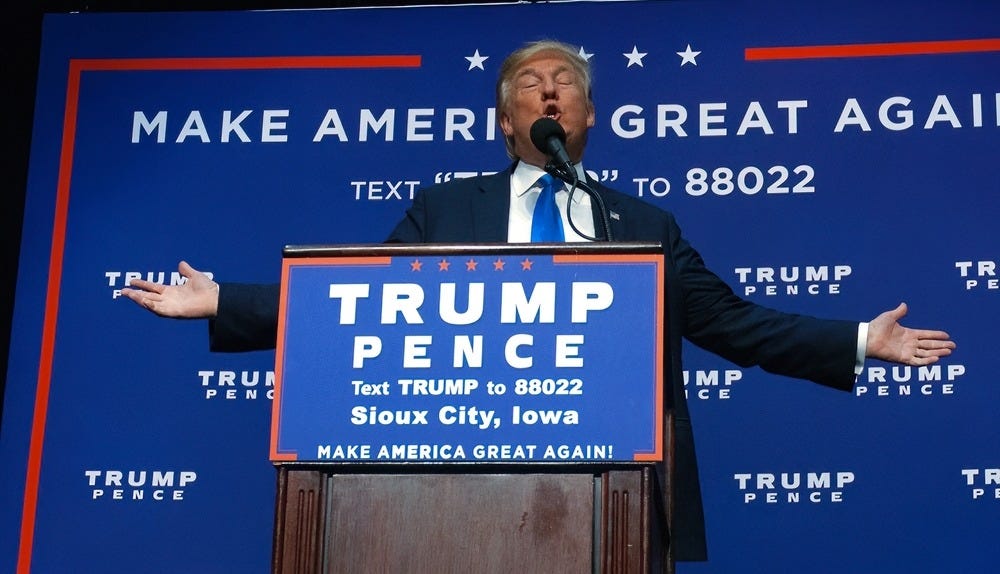
The night Trump accepted the nomination, he stood in an arena in Cleveland and told the Republican Party how it was going to work from that night on. Nobody knew the system better than he did, he said. “I alone can fix it.”
The crowd got to its feet.
Trump would get them the White House, and they would let him decide the rest. He meant it more literally than anyone in that arena understood. From then on, what the Republican Party believed and what Donald Trump believed were the same thing. When he changed his mind, so did the party. And he changed his mind a lot. The party’s job was to keep up.
Positions the party had held for decades went that way. Free trade went first. The line on Russia went next. Nobody wrote a paper or held a vote. He took a position, and soon it was the Republican position.
In 2020 the party made it official. It held its convention and didn’t write a platform. It passed a resolution instead, saying Republicans would “enthusiastically support the President’s America-first agenda.” Donald Trump was the agenda.
What It Cost
The deal got them the White House in 2016. But things quickly went downhill from there. Republicans lost the House in 2018. They lost the White House and the Senate in 2020, and in 2022 they came out of a promised red wave with barely a majority. Every one of those losses came with an excuse. It was never the guy at the top.
But the seats are the part you can count. They aren’t the biggest thing the party gave up.
The moral compass went first. This was a party that spent decades lecturing the country about character and law and order. Then it stood behind a man who mocked a prisoner of war, and it never found its way back.
After that, there was always a reason to go along. A lot of the time it was just not wanting to be his next target. Once you’ve made that trade the first time, the next one comes easier. Pretty soon there’s nothing you won’t put up with, and you can’t remember where you used to draw the line.
The next thing to go was any room for the people who wouldn’t go along with the circus. For years, anyone in the party who questioned any of this was told they were destroying it. Eventually the party even put it in writing. In February 2022, the Republican National Committee met in Salt Lake City and voted to censure Liz Cheney and me for investigating the attack on the Capitol. The resolution called our behavior “destructive” to the Republican Party and to the republic itself.
What’s Left
Republicans kept their end of the deal for a decade, and what they have to show for it is a party smaller at every level of government than the one Trump inherited.
Somewhere along the way the party stopped knowing what it believed. Then it stopped being able to tell right from wrong. Now it can’t tell you what happens after him. The party has no positions of its own to fall back on, and it has spent a decade teaching its next generation of leaders to fall in line and keep quiet. And the one man it dropped everything for has turned into a wrecking ball, taking the party’s own candidates down with him.
That’s a lot to hand over for two terms in the White House. And it’s the same price any party would pay for deciding one person matters more than what it believes.
Trump promised Republicans they’d get tired of winning. What actually wears out a party, or a country, is having nothing left to stand for.
—Adam
What it has cost the Republican Party...what it has cost the country. So much losing. So much hypocrisy. So much cruelty. So much unrestrained greed. So many cheezy, fake golden hillbilly Versailles gewgaws all over the White House. So much infantilism, incompetence, fuckupery.
So proud to say that I left the Republican party having never voted for Trump.