

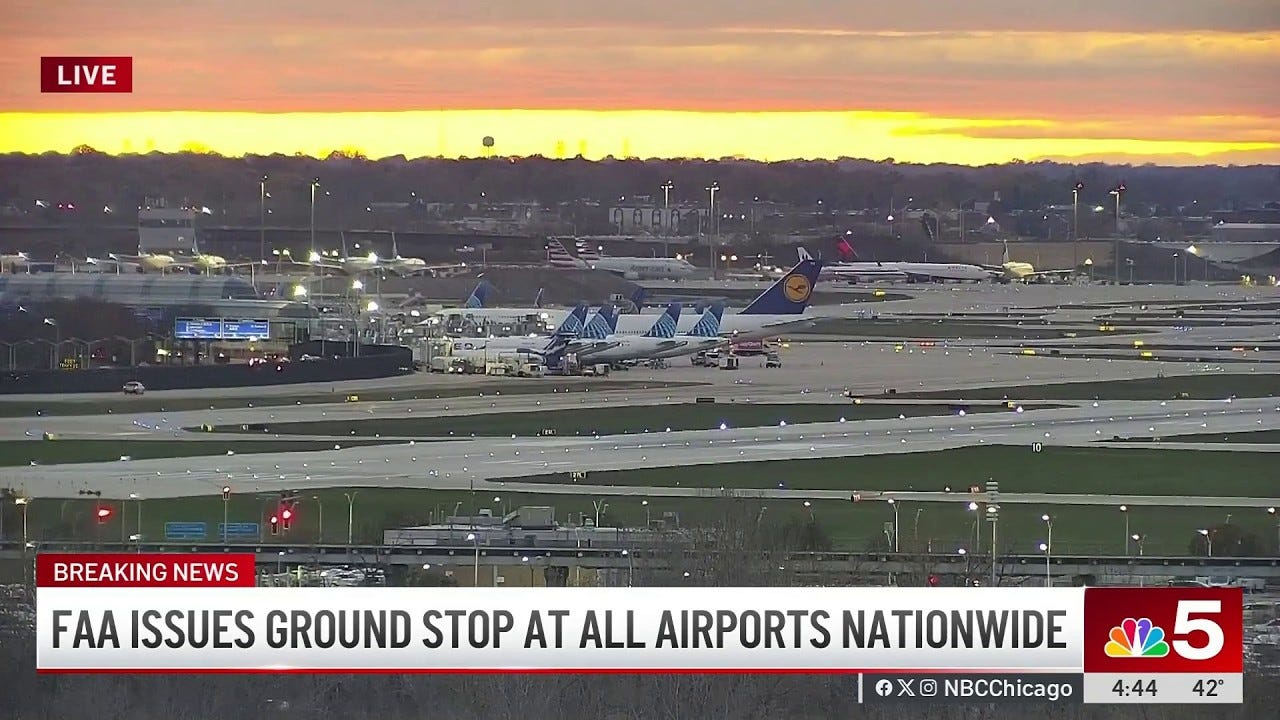
Roughly 3,500 aircraft were already airborne when the FAA halted departures nationwide on Friday because radar and communications data had become unreliable. Controllers and pilots relied on still-functioning equipment and established safety procedures to bring those thousands of aircraft down safely.
They did their jobs. Now the officials overseeing the system owe Americans a clear explanation of what went wrong and how they intend to prevent another disruption.
That evening, Homeland Security Secretary Markwayne Mullin and Transportation Secretary Sean Duffy appeared at the White House to explain what had happened.
Mullin welcomed reporters to Friday the 13th, said investigators had found no evidence of a cyberattack and acknowledged the inquiry was continuing. Yet before investigators had established the cause, he, without a hint of irony, credited the president’s team.
“This is what the leadership of President Trump looks like,” he said.
Duffy followed with an account of aging equipment, an appeal for billions and more praise for Trump.
The aviation network had faltered. However, the presidential praise system was functioning beautifully.
The ground stop was a necessary safety precaution, not the underlying failure. Some radar feeds and radio frequencies remained operational, critical flights continued, and the FAA says every aircraft landed safely. But the aviation network had experienced a serious disruption, and investigators had not established its final cause
That distinction should have been central to the briefing. Americans deserved answers about what went wrong and how officials intended to prevent another disruption.
Instead, questions about government performance kept giving way to presidential praise.
An Audience of One
Watch the rest of that briefing and a pattern emerges. Every time a question got close to something Americans needed to know, the answer drifted back toward the one man whose opinion these two secretaries seemed most worried about.
An NBC reporter asked a fair question. Donald Trump has been president for nearly six of the last ten years, and Republicans have controlled both chambers of Congress since January of last year. So why hadn’t fixing the air traffic control system been a higher priority?
Duffy’s first response was a question of his own: “What network?” Once he heard the answer, he criticized NBC‘s coverage, noted that “I know Fox has” been paying attention to his work, and suggested the question “should be from NBC to every member” of Congress instead.
Later, when a reporter pressed him on the network’s reliability, Duffy wrapped up by calling America “the greatest country… with the greatest president.” The president’s greatness was apparently easier to establish than the network’s reliability.
This matters more than it might seem. A crisis briefing has one job: give the public accurate information. Families are deciding whether to get on a plane Monday morning. Congress is being asked to spend billions. And when the people in charge seem more worried about how the president will review their performance than about how the system performed, Americans have every right to think twice about the information they’re receiving from these officials.
A Cabinet That Performs for One Man
If this were one bad briefing on a bad Friday, it wouldn’t be worth a column. But it is much, much more than that.
Earlier this year, The New York Times reviewed more than a dozen hours of Trump’s televised Cabinet meetings and found that at least one out of every six sentences his Cabinet spoke was praise for the president.
The same habit follows these officials to Capitol Hill, where they’re supposed to answer to the people’s representatives. Last year, Senator Dick Durbin asked Attorney General Pam Bondi what legal basis the administration had for sending the National Guard into Chicago. She didn’t answer him. Instead she said, “I wish you loved Chicago as much as you hate President Trump.”
I served in Congress for twelve years, under presidents of both parties. Cabinet officials defended their bosses, sometimes aggressively, and that’s part of the job. But the expectation was that when a member asked you a question, you at least pretended to answer it, because that member represented hundreds of thousands of Americans who deserved to know.
But the shameless flattery isn’t really the disease. It’s the symptom. The disease is fear. When a president makes clear that loyalty is the only qualification that matters, and that one honest answer on television can cost you your job, the people around him learn very quickly what they’re supposed to say.
What Every Pilot Learns
In military aviation, every flight ends the same way, with a debrief. Everyone who flew sits down and walks back through the mission, mistake by mistake, and the tradition is that rank doesn’t count in that room. A young lieutenant can tell a colonel he got something wrong, and the colonel is expected to listen. You do it because in aviation, the mistakes nobody talks about are the ones that eventually get people killed.
That’s the culture the pilots and controllers brought to work on Friday. The procedures that got every one of those aircraft safely onto the ground were written by people who spent decades being brutally honest with each other.
The people at the top of that system brought a very different culture to the briefing room. Systems like our air traffic network don’t fail overnight. They fail slowly, over years, because the people who know what’s broken don’t feel safe saying so to a boss who would rather hear that everything is great.
This country needs leaders who care more about the people they serve than about applause from the man who appointed them. That isn’t a liberal value or a conservative one. It’s the most basic thing we ask of anyone we trust with our safety.
A Higher Standard, Starting Now
Ten days before that briefing, Americans voted for change. In January, a new House majority will take the oath, and with it comes the power to ask the questions this administration would rather not answer.
To those new leaders: when Sean Duffy or Markwayne Mullin sits across the hearing table, ask the question the NBC reporter asked, and don’t accept “What network?” as an answer. Find out exactly what failed before deciding how to spend the next billions.
And hold yourselves to the same standard. The cure for a Cabinet that worships one man isn’t a new set of leaders who expect to be worshipped. When your own side gets it wrong, say so in public. That’s how trust gets rebuilt.
The pilots and controllers faced an emergency and did their jobs. They brought thousands of passengers safely to the ground without needing to tell anyone how great their president was.
The people running the system owe Americans the same seriousness. Tell us what went wrong, explain how you’re going to fix it and show us you can follow through.
And, please, leave the presidential flattery on the tarmac.
— Adam
Have they not learned yet that no one believes the garbage they spew about 'the great leadership ' provided by trump?
Great summation Adam. You are exactly right. I am tired of hearing about how great Trump is and how it's always somebody else's fault. The thing the Republicans conveniently forget is that Trump 1.0 didn't do anything about this issue, but he is more than happy to blame Biden. We have money for the reflecting pool, that monstrosity Trumnp calls his ballroom, upgrades to the flying palace, and on and on. But they don't have enough money to fix the air traffic control system. Duffy and Markwayne Mullin should be ashamed of themselves. They have shirked their responsibility to the American people to curry favor with the idiot-in-chief. Very sad.