


Video for paid subscribers follows article
Let’s start with what’s unambiguous: what happened over Iran was extraordinary.
The rescue of the WSO was the kind of operation that reminds you what the American military actually is at its best — disciplined, courageous, and willing to pay a steep price to bring its people home. We lost aircraft. We lost assets that took years and billions of dollars to build. People put themselves in harm’s way in one of the most contested airspaces on the planet, against an adversary that was actively trying to kill them. And they succeeded, because the American military has a creed that it actually lives by: we do not leave our people behind.
That deserves to be said out loud, without asterisks, without hedging, without immediately pivoting to a “but.” The men and women who executed that rescue are heroes. Full stop. The planning, the coordination, the nerve required to pull something like that off under those conditions — it’s the kind of thing that should make every American, regardless of politics, feel something real.
So let me say it clearly before anything else: I’m proud of them. We should all be proud of them.
And yet here’s where I have to push back — hard — on what’s being done with that pride.
The White House has spent the last several days trying to collapse all of this into a binary: if you praise the rescue, you support the war. If you oppose the war, you’re not supporting the troops. This is one of the oldest and most cynical moves in the political playbook, and it needs to be called out for exactly what it is. It is an attempt to use the heroism of our service members as a shield against legitimate criticism of the people who sent them there.
You can hold two things at once. You can be genuinely, deeply proud of what those service members did — and simultaneously believe this overall Iran operation was launched recklessly, without adequate planning, without allied buy-in, and by a president who clearly did not foresee what would happen next.
That’s not contradiction. That’s called having a complete thought.
The Execution Has Been a Mess
Even if you’re not opposed to military pressure on Iran in principle — and I know plenty of serious, hawkish people who aren’t (and I would include myself in this group), people who have argued for years that Iran’s nuclear program represents an existential threat that diplomacy alone cannot resolve — the execution here has been deeply troubling.
Start with the Strait. The closure wasn’t some unforeseeable black swan event. It was a predictable Iranian response, the kind of thing any serious war-gaming session would have put near the top of the escalation ladder. The fact that it appears to have caught the administration flat-footed is not a small thing. It is a window into the level of planning — or lack of it — that preceded these strikes.
And then watch the messaging. One day we’re told we’ve won. The next the president is threatening destruction that would be, in his words, “unthinkable.” Deadlines are announced, then quietly abandoned. The goalposts move. There is no coherent strategic framework being communicated — not to the public, not to Congress, and apparently not to our allies. What is the objective? What does success look like? What are the off-ramps? These are not abstract academic questions. These are the questions any president ordering military action is obligated to be able to answer.
This is not what competent wartime leadership looks like. And saying so is not an attack on the military. It is, if anything, a defense of it — because our service members deserve leadership that matches their professionalism.
On NATO: Rational Actors Don’t Respond to Ultimatums With Trust
I replied to Ari Fleischer this week, and I want to expand on what I said, because I think it gets at something important that keeps getting lost.
Ari was suggesting that European NATO allies refusing to grant airbase access or overflight rights amounts to freeloading — a failure to show up when it matters. And I understand the surface appeal of that argument. In a vacuum, you could make the case. But we are not in a vacuum, and Ari knows we’re not in a vacuum. He’s been inside the room. He understands how alliances actually function. Which is why his framing here is so frustrating.
Here’s the context that keeps getting stripped out of this conversation:
There is the largest land war in Europe since World War II happening right now, on NATO’s doorstep. Not a regional skirmish. Not a frozen conflict. A grinding, full-scale land war with hundreds of thousands of casualties, active missile strikes on civilian infrastructure, and a nuclear-armed aggressor that has explicitly threatened escalation. These countries are not sitting in comfortable peacetime security doing threat calculations from a distance. They are already stretched. They are already calculating. They are already dealing with energy insecurity, defense procurement crises, domestic political fracture, and the daily reality of a war that is not abstract to them the way it might feel from Washington.
And into that environment, the President of the United States has spent years — not weeks, years — publicly questioning the value of NATO, floating the idea that Article 5 commitments are conditional on whether member states are paying what he thinks they should pay, and casually talking about acquiring Greenland from a fellow NATO ally. The signal sent to every European capital has been consistent and unmistakable: you are on your own when it’s inconvenient for us.
So now those same countries are being asked to extend themselves further — to offer bases, airspace, logistics — for an operation they had no role in shaping and weren’t meaningfully consulted on, led by a president who has made clear he views alliances as either transactional leverage or inconvenient constraints depending on the news cycle. They are being asked to do this while managing an active war on their continent, while nervously watching to see whether American commitments to their own security are real or rhetorical, and while knowing that if things go sideways they will be left managing the consequences.
And we’re surprised they’re hedging?
That’s not freeloading. That is the textbook rational response to uncertainty that we created. You don’t expand your commitments when the terms of the alliance have been rendered ambiguous by the most powerful member of it. You consolidate. You protect your flanks. You wait to see which way the wind is blowing before you let someone else determine your exposure.
To be clear: I disagree with the decision to deny airbase and overflight rights. I think it’s a strategic mistake, and I think it signals a fragmentation of Western cohesion at exactly the wrong moment. But I understand it completely. If I were a defense minister in Warsaw or Tallinn right now, trying to explain to my parliament why I’m further exposing my country for an operation I wasn’t consulted on — what would I tell them? What would anyone tell them? “Trust the president who questioned whether we’re worth defending?” That’s not a speech anyone can give with a straight face.
Yes, some European countries have underinvested in defense for years. That’s a legitimate critique, and many of them have begun correcting it — particularly since Russia’s full-scale invasion of Ukraine, which concentrated minds considerably. But the defense investment conversation and the trust conversation are not the same conversation. You can push allies to spend more and still treat them as allies. You can hold them accountable on burden-sharing and still consult them before launching a major regional military operation. These things are not mutually exclusive.
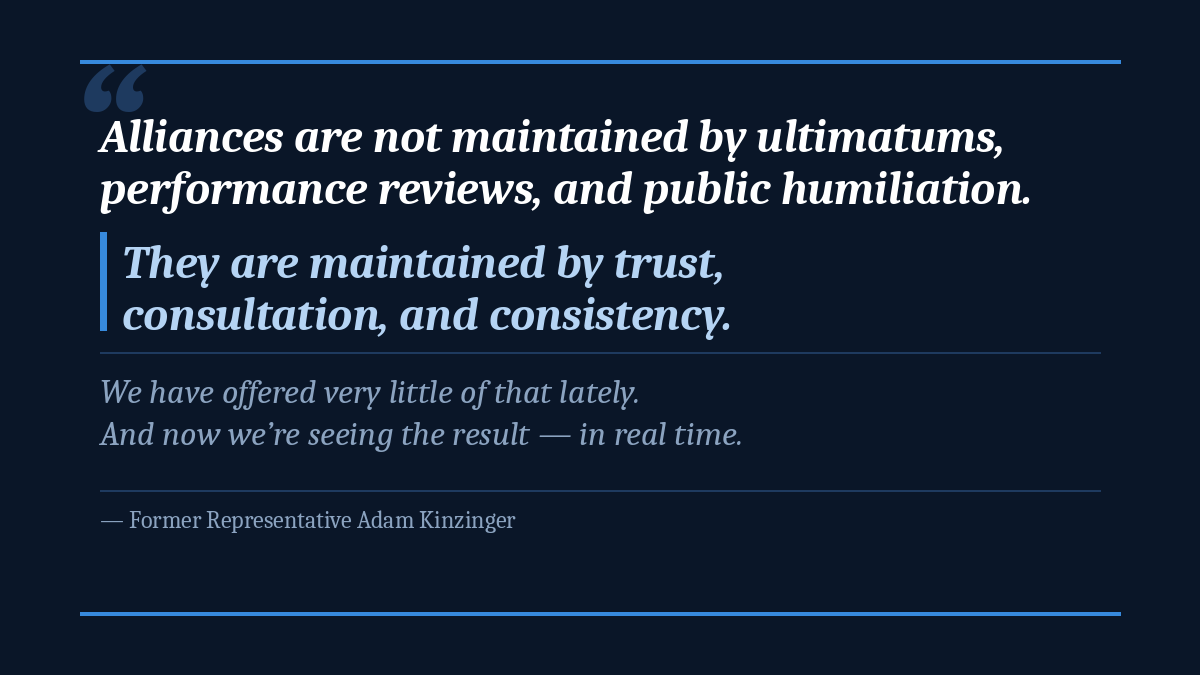
Alliances are not maintained by ultimatums, performance reviews, and public humiliation. They are maintained by trust, consultation, and consistency. We have offered very little of that lately. And now we’re seeing the result — not as some distant foreign policy abstraction, but in real time, as we conduct military operations with fewer partners, less coordination, and more exposure than we should have.
The False Choices Have to Stop
Back to the binary. The White House wants you to pick a side: hawk or dove, pro-rescue or anti-military, America First or America Last. These are not the choices in front of us.
The real choice is between serious and unserious. Between leadership that can hold complexity and leadership that can only hold a slogan. Between a commander-in-chief who prepares for the predictable consequences of military action and one who seems to be improvising the strategy in real time between social media posts.
You can support the troops and demand better strategy.
You can be proud of a rescue and furious at the conditions that made it necessary.
You can believe Iran is a real threat and still think this president is handling it dangerously.
You can be skeptical of NATO’s burden-sharing record and still recognize that torching alliance trust during an active European war, while simultaneously expanding military commitments in the Middle East, is a level of strategic overextension that should alarm anyone who has thought seriously about American power and its limits.
None of these positions require you to be anti-American. They require you to take America seriously enough to demand it be led well.
A Call, Finally, for Something Real
To people who oppose this president: now is not the time for the usual fragmentation. The instinct to fight each other over ideological purity, over who opposed him most clearly and earliest, over who has the correct position on every satellite issue — set it aside. The moment is too serious. The stakes are too high. Unity among people who understand what’s at risk is not a compromise of principle. It’s arithmetic.
To Republicans in Congress: I know you’ve been here before. I know the cycle by now — the stern statements, the “serious concerns,” the carefully worded criticisms that stop just short of any actual consequence. I know the political math you’re doing, and I know why you’re doing it. But consider what you’re watching. An active military operation with no clear endgame. A NATO alliance being stress-tested at the worst possible moment. A president whose strategic messaging on this conflict has been incoherent at best and reckless at worst. Allies who no longer feel they can trust us. And a Strait closure that is going to have economic consequences that land on your constituents.
This is the situation your oath was written for. Not the easy votes. Not the bipartisan moments that cost you nothing. This one. The hard one. The one where the political cost of accountability is real.
Words are not enough anymore. They haven’t been for a long time. But they are especially, urgently not enough now.
The rescue was heroic. The men and women who executed it deserve every bit of honor we can give them. And the best way to honor them — the most meaningful thing we can do — is to demand that the people who send them into harm’s way are worthy of them.
At some point, courage has to be more than a tweet.
Further video discussion for paid subscribers:
