


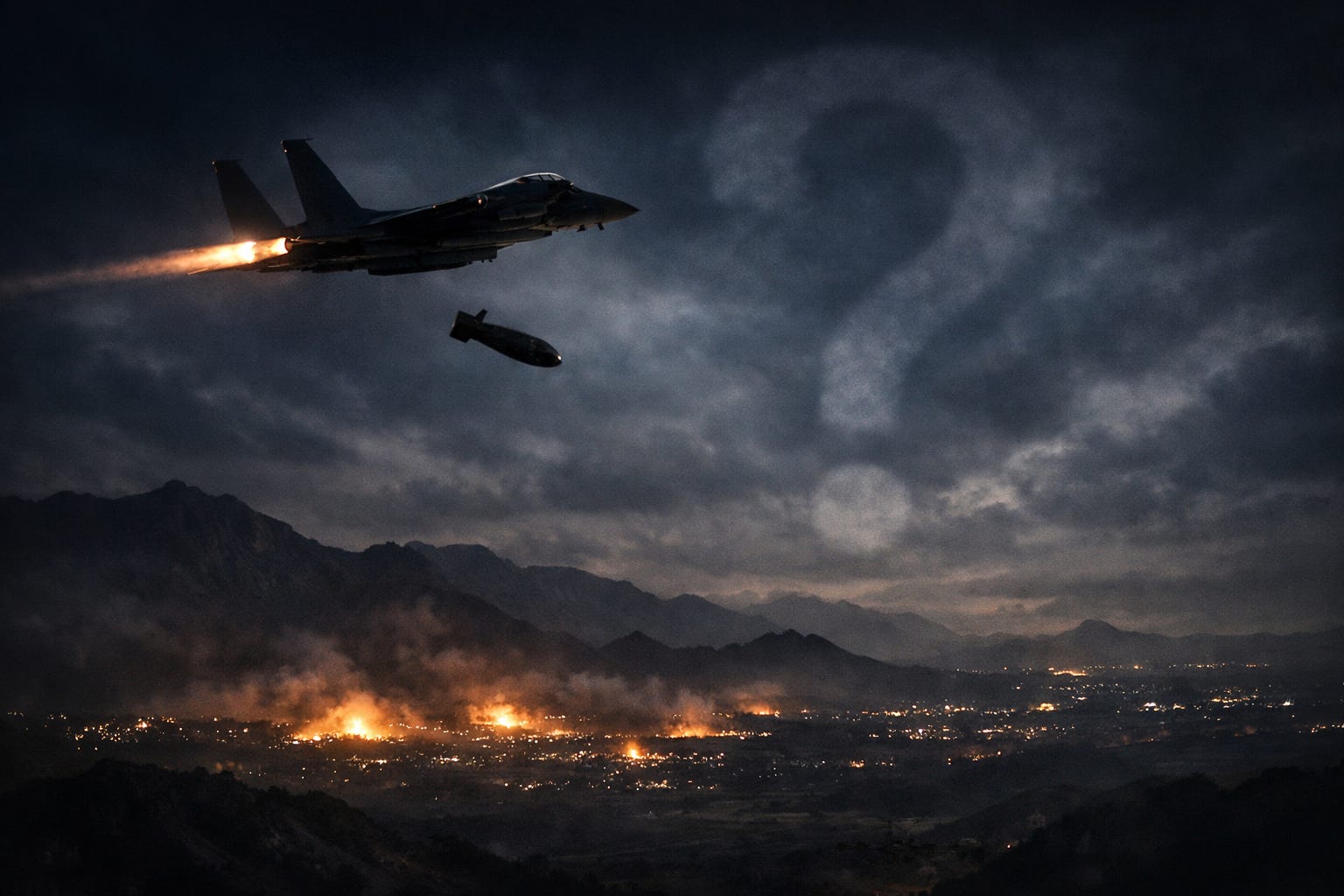
The world woke up this week to one of the most consequential military developments in decades. The United States, alongside Israel, launched a massive strike campaign inside Iran. In those strikes, Iran’s Supreme Leader, Ayatollah Ali Khamenei, was killed along with several senior regime officials. Iranian state media confirmed the death after an airstrike targeted his compound in Tehran.
Khamenei had ruled Iran since 1989 and spent decades building the security state that defines the modern Islamic Republic. Under his leadership, Iran developed a sprawling system of militias and proxy groups across the Middle East designed to attack adversaries while giving Tehran plausible deniability.
And let me say something clearly before anything else: I shed no tears for the Ayatollah.
This was a man whose regime armed and funded groups responsible for the deaths of Americans. During the Iraq War, Iranian weapons—especially explosively formed penetrators—were used by militias to kill and maim U.S. troops. Many of the men and women I served with in the region were operating in an environment shaped by Iranian interference and Iranian weapons. Iran didn’t just oppose the United States diplomatically. It actively worked to bleed American forces through proxies.
Beyond Iraq, the Iranian regime under Khamenei spread instability across the region. Hezbollah in Lebanon, militias in Iraq and Syria, the Houthis in Yemen—these were not random actors. They were built, funded, trained, and armed by Tehran. Iran’s strategy for decades has been simple: avoid direct war with the United States while surrounding its enemies with armed proxies.
Even outside the Middle East, the regime played a destructive role. In the early days of Russia’s invasion of Ukraine, Iranian drones and weapons helped keep Vladimir Putin’s war machine afloat. Those Iranian Shahed drones became a symbol of the partnership between authoritarian regimes determined to challenge the democratic world.
So yes, the death of the man who oversaw that system is not something I mourn.
But here is the uncomfortable truth: eliminating a dictator is not the same thing as having a strategy. And that is where my concern begins.
War is not a television episode. It is not a moment designed to generate a headline or project toughness. War is the most serious decision a nation can make. When the United States uses military force, Americans deserve clarity. They deserve to know why we are fighting, what the objective is, and how the mission ends.
Right now, that clarity does not exist.
Within hours of the strikes, the messaging from the administration began to shift. At times it sounded like the goal was to eliminate Iran’s nuclear capability. At other moments the rhetoric suggested regime change. Then officials backed away from that idea, insisting that this was not about overthrowing the government. Meanwhile the president himself has alternated between threatening further destruction and suggesting negotiations could happen quickly.
That is not strategy. That is improvisation. And improvisation is dangerous when American lives are on the line.
Already American service members have been killed as the conflict expands.
These are sons and daughters of American families. They are not political props. They are not characters in a show of strength.
One of the core principles of American democracy is civilian control of the military. But that principle carries with it an equally important truth: the military ultimately belongs to the American people. It is their sons and daughters who serve. It is their tax dollars that fund it. And it is their democracy that authorizes it.
That means when the United States goes to war, the American people deserve an explanation. What is the objective? Is it regime change? If so, what replaces the regime? How do we prevent chaos in a country of nearly ninety million people?
Is the goal simply to degrade Iran’s military capabilities? Then define the metrics for success. Is the goal deterrence? Then explain how bombing campaigns lead to deterrence rather than escalation.
War can be necessary. History proves that. There is a reason there has long been bipartisan support in the United States for maintaining a strong military. A capable military deters aggression and protects freedom around the world. But strength is not measured by how quickly you pull the trigger. Strength is measured by discipline, clarity, and purpose.
America should use military force rarely, carefully, and with clearly defined goals.
If the goal is regime change, then there must be a plan for what comes after the regime falls. We have seen what happens when that planning is absent. Iraq taught us that lesson at enormous cost. If the goal is destroying Iran’s military capability, then say that—and stick to it. But shifting objectives midstream, or worse, appearing to lose interest as the conflict unfolds, is how nations stumble into wars they never intended to fight.
Normally I would have no sympathy for the Iranian regime. It is oppressive, violent, and responsible for decades of suffering both inside Iran and across the region. But what worries me today is not the fall of a dictator. What worries me is that this entire operation increasingly feels like another Trump show of force without a defined end state—another moment designed to project toughness without the hard work of strategy behind it.
Wars do not end successfully because a president gets bored. Wars end because leaders define clear goals and pursue them with discipline.
If we are going to fight, then fight with purpose.
Explain the mission to the American people. Define the objective. Show how success will be measured. And most importantly, demonstrate that there is a plan for what comes after the bombs stop falling.
Because when America goes to war, it is never just about the president.
It is about the people.
All this not to mention another great distraction from the Epstein nitty gritty.
Europe’s response to the US-Israel strikes on Iran tells you everything.
They’re not silent because they don’t have opinions, they’re silent the way you go silent when someone on the street pulls out a knife and starts talking to themselves (I’m from chicago, I’ve seen this happen). You don’t engage. You cross the street. You make sure your own house is locked.
The United States has become that person, and Europe is backing away with the quiet, deliberate calm of someone who has stopped expecting the situation to resolve itself.
The strategic irony is that this accelerates exactly what Russia feared most:
A Europe that stops outsourcing its security and starts building its own.
Every reckless U.S. move: launching a major combat operation against Iran while actively in nuclear negotiations with them, without allied consultation; is another argument for European defense autonomy. Russia bet on Western fragmentation. What it may get instead is a Europe that finally takes itself seriously, no longer anchored to an unpredictable partner.
The honest bottom line: America has spent the credibility it accumulated over 80 years in roughly 18 months. And Europe’s careful silence isn’t diplomatic caution…it’s what you sound like when you’ve stopped expecting someone to return to who they were.