



Video discussion for paid subscribers follows article
There is a question circulating in the quiet spaces of American life right now — at kitchen tables, in text threads, in the hollow aftermath of yet another dispiriting news cycle. The question goes something like this: Is it still worth it? Is the project, after 250 years, still worth the effort? The frustration, the division, the daily assault of bad news — is this country still worth saving?
The question deserves a serious answer. Not a flag-waving deflection. Not a lecture. A serious, honest answer rooted in what this country has actually survived — and who did the surviving.
Philadelphia, 1776: They Expected to Die
Begin at the beginning. The men who gathered in Philadelphia in the summer of 1776 were not heroes in their own imaginations. They were lawyers, farmers, merchants, and landowners committing what the most powerful empire on earth called treason. They knew what happened to traitors. They had read history. When Benjamin Franklin quipped that they must all hang together or they would all hang separately, the room laughed — but only a little, because he was not entirely joking.
Here is what is easy to forget: most colonists were not with them. Historians estimate that roughly a third of colonial Americans were loyal to the Crown, a third were patriots, and a third wanted nothing to do with any of it. The founders were not riding a wave of popular consensus. They were making a decision that the majority of their neighbors either opposed or couldn’t be bothered to support. They signed that document in August knowing that British warships were already in New York Harbor, that Washington’s army was outgunned and undersupplied, and that the odds of their new republic surviving even its first winter were, by any rational calculation, poor.
They did it anyway. Not because they were certain. Because they believed the idea was worth dying for.
“They were not riding a wave of popular consensus. They signed that document knowing the British fleet was already in the harbor — and they did it anyway.”
Lincoln’s Daily Decision
Eighty-five years later, the idea nearly died. The Civil War was not a quick, clean conflict with obvious momentum toward justice. It was four years of almost unbearable cost — 620,000 dead, cities burned, a nation literally tearing itself in half along the question of whether some human beings could own other human beings. There were moments — many of them — when the math of the war seemed to argue for stopping. For letting the South go. For accepting a smaller, more manageable union rather than continue paying the price.
Abraham Lincoln made the decision every single day not to stop. Not because he was certain of victory. In August of 1864, he was so convinced he would lose the upcoming election that he had his cabinet members sign a sealed memorandum committing to cooperate with the incoming administration in finishing the war before the new president took office. He thought he was done. He kept going anyway. He issued the Emancipation Proclamation.
He preserved the union. He freed four million people from bondage. And then, five days after Lee’s surrender, he was murdered for it. He did not live to see what he had built. He paid the highest possible price for refusing to give up — and the country he saved is the one we are arguing about today.
Changing How You Read the News: Here’s Why It Matters
We don’t just consume the news differently anymore.
We’re experiencing completely different versions of the same story.
Take this one.
Hungary is considering unblocking a $106 billion EU aid package for Ukraine while negotiating with Brussels to release billions in frozen funds previously withheld over concerns about corruption and judicial independence.

Same story. Uneven coverage:
• 72% of coverage comes from the Left
• Only 21% from the Right
• Almost no Center representation

Even with 79% high factuality, accuracy doesn’t guarantee the full picture.
If you rely on one side of the media spectrum, you could miss this story entirely, not because it isn’t credible, but because it doesn’t align with certain editorial priorities.
That’s the problem.
That’s why I use and recommend Ground News.
It’s a website and app designed to make the news easier to understand and more transparent.
It doesn’t tell you what to think. It shows you the full picture: who’s covering a story, who isn’t, and how reliable those sources are.
That kind of visibility is rare, and it changes how you understand the news.
If you want that level of insight every day, head to GroundNews.com/AdamK and subscribe to get 40% off the Vantage plan, the one I use.
Seeing the full picture shouldn’t be hard. Ground News makes it possible.
The Doughboys, the Greatest Generation, and the Wars They Weren’t Sure About
The men who went to France in 1917 were not universally celebrated for doing so. America had spent three years watching Europe bleed and had no particular appetite for joining in. Many Americans of German and Irish descent were actively opposed. The Espionage Act was passed to criminalize dissent. Young men shipped off across the Atlantic to fight in trenches for objectives that were, at best, murky — and they went.
Twenty years later, their sons went again. The Second World War is remembered now as the “good war,” its moral clarity burnished by the passage of time. But in 1942, after Pearl Harbor, after the fall of the Philippines, after Bataan and Corregidor, after months of relentless bad news from both the Pacific and European theaters — it did not feel inevitable. Families sent their boys off knowing the casualty rates. Gold star mothers hung their flags in windows across every small town in America, and kept sending their remaining sons.
Korea was murkier still — a war that ended in armistice rather than victory, a conflict so ambiguous it was called “the Forgotten War” even while it was being fought. But a view of the peninsula at night reminds us what American’s fought for, and achieved:
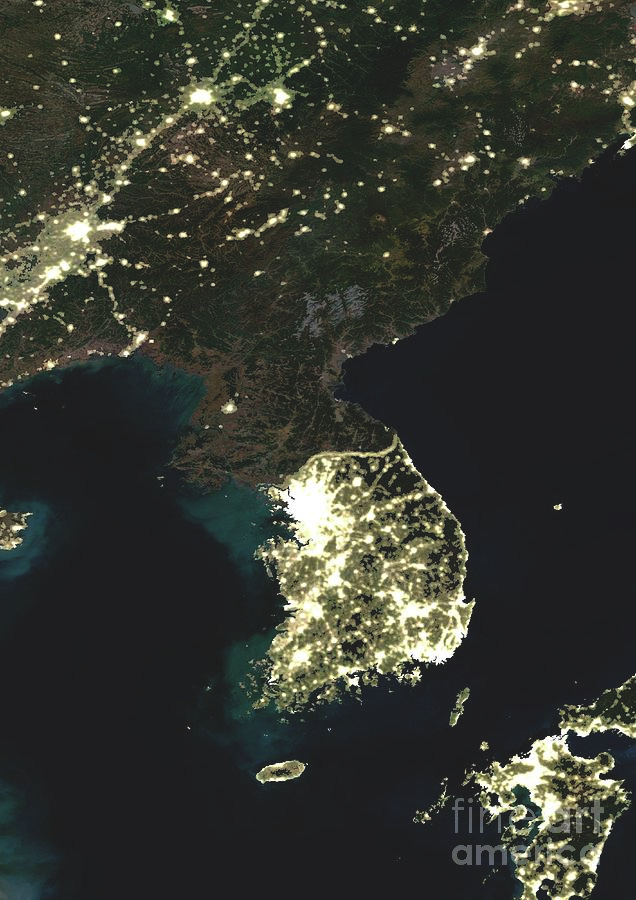
Vietnam broke something in the national spirit that has never entirely healed, and yet the men who served there — draftees many of them, not volunteers, sent by a government they often didn’t trust into a cause they often didn’t believe in — served.
The Wars Fought at Home
Between and around every foreign conflict, there were the wars fought on American soil — not with rifles but with courage of a different and arguably harder kind.
The men and women of the civil rights movement faced dogs and fire hoses and billy clubs and bombs. Medgar Evers was shot in his driveway. Four little girls were killed in a Birmingham church on a Sunday morning. Martin Luther King Jr. received death threats so routinely that he had made peace with the idea of his own assassination long before it happened. John Lewis was beaten on a bridge in Selma by state troopers and came back the next day.
They were asking for the fulfillment of promises that were already in the founding documents — promises that had been deferred for nearly two centuries. They did not have the luxury of despair. They marched anyway.
The Great Depression saw one in four Americans out of work. Families who had spent lifetimes building something lost everything in months. Dust Bowl farmers watched the earth itself turn against them. The country did not fall apart. It built things — dams, roads, parks — and held itself together through collective grind and mutual aid until it could breathe again.
The 1918 influenza pandemic killed more Americans than all the country’s wars combined up to that point. There was no vaccine, no treatment, no CDC, no coordinated response. Cities shut their churches and banned public gatherings. And then, when it was over, America stood back up.
“Every generation has faced its moment when quitting seemed rational, even merciful. Every generation has looked at that choice and made a different one.”
My Generation: After the Towers Fell
Those of us who came of age around September 11, 2001 remember the specific quality of that silence after the towers fell — the way the country held its breath for a moment before deciding what it was. Young men and women enlisted in the days and weeks that followed in numbers that recruiting offices couldn’t process. Others went later, through two long wars in two countries that most Americans couldn’t have located on a map before they began, wars that would stretch across two decades, consuming the better parts of entire generations of service members.
The post-9/11 era has not been America’s finest hour in many respects. Mistakes were made — catastrophic ones, moral ones. But the impulse that sent people to enlist, that bound a country together in grief and then in purpose, was real. It was the same impulse that has animated every generation before: the belief that this place, for all its failures, is worth defending.
What Is Actually Being Asked of Us
So here we are. And here is the honest reckoning: what is actually being asked of us right now?
We are not being asked to sign a document that will get us hanged. We are not being asked to sit in a trench in the mud under artillery fire, as the young men of Ukraine are doing this very moment — ordinary people who had ordinary lives until history came for them, and who chose to stand anyway. We are not being asked to march into a wall of police batons. We are not being asked to watch our children go hungry for years while we rebuild from economic ruin.
We are being asked to stay engaged. To resist the seductive pull of despair. To form alliances with people we don’t entirely agree with, because the alternative is worse. To keep showing up — to vote, to organize, to speak, to refuse to normalize what should not be normalized — even when the news is relentlessly bad and the progress feels glacially slow.
That is the ask. It is not nothing. But by the measure of what every previous generation was asked, it is not very much.
We Cannot Be the First
There is a specific shame available to us if we choose the alternative. We would be the first generation in 250 years of American history to look at the difficulty of the moment and say: this is too hard. We give up. We would be abandoning a project that people died for — not in the abstract, but specifically, with names and faces, in fields and trenches and churches and jails — because we find the current climate too discouraging to bear.
The world is watching. That is not a figure of speech. Democracies in Europe, in Asia, in South America are watching the American experiment with a mixture of anxiety and hope — because they know that what happens here has consequences everywhere. History has a way of recording who stood up and who sat down in the critical moments. The history books about this era are already being written in the first drafts of people’s memories.
Look to Hungary for instruction — not as a cautionary tale alone, but as a reminder of what happens when democratic norms erode incrementally, and also as proof that people resist, that opposition persists, that the fight does not end simply because the odds are long. People have always found ways to resist. People have always chosen hope over the alternative, not because hope was easy, but because the alternative was unacceptable.
The Answer
Is the United States worth saving? The question almost answers itself when you hold it up against what has already been spent on the answer. The Revolution was worth it. The preservation of the Union was worth it. The defeat of fascism was worth it. The civil rights movement was worth it — imperfect and unfinished as its work remains. Every generation has paid into this account, often at terrible personal cost.
We did not earn that inheritance by being born here. We earn it by deciding, in our own moment of difficulty, to do what every generation before us did: stay in the fight, hold the line, and refuse — absolutely refuse — to be the ones who let it go.
The founders pledged their lives, their fortunes, and their sacred honor. Lincoln gave his life. The soldiers in the trenches gave their lungs to mustard gas and their names to stone walls. The marchers on the Edmund Pettus Bridge gave their bodies to police batons. Our Ukrainian counterparts are giving everything, right now, today, in real time.
We are being asked to stay awake and stay engaged. To choose hope as an act of will, not as a feeling. To make common cause across our differences because the idea — the stubborn, improbable, unfinished idea of this country — demands it.
We can do that. We have no right not to.
Video for paid subscribers:
