

Sixteen years ago this week, I was 32 years old, just home from military service overseas with the Air Force, and my name was on a ballot for Congress for the first time. A week before Election Day, I remember thinking, half joking, “Boy, can you imagine if I got sick on Election Day?”
You can guess what happened next. But I’ll get to that in a bit.
Many of you reading this know me from my vote in Congress to impeach a president of my own party and then my service as one of two Republicans on the January 6th Committee. But more than a decade before all of that, in 2010, I was elected as part of one of the biggest political waves in modern American history.
Sixteen years later, all signs point to a wave again, this time in the other direction.
I can’t help but feel a little disoriented with what’s happened in politics over the last ten years. My career began riding a Republican wave into Congress. Now, I find myself hoping for a Democratic one.
Many of you are anxious about Tuesday (I get it) and looking for predictions and prognostications. There are plenty of smart people who can walk you through polling averages and early voting data, and you should read them.
This column isn’t that. I wanted to give you a different kind of insight. A real, human look from the other side of the ballot at what it actually feels like to be a candidate on the edge of a wave in the final days before everything is decided.
My Long Shot Race
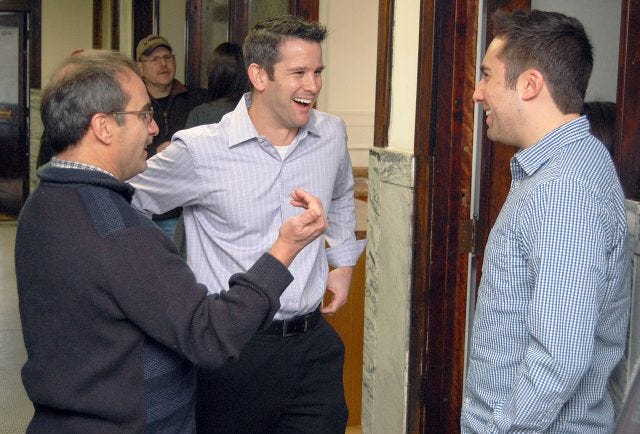
When I came home from my military service and decided to run, my odds didn’t look good. Just two years earlier, Illinois’s 11th District had sent Democrat Debbie Halvorson to Congress with 58 percent of the vote. She’d won by 24 points, in an open seat, in a district Barack Obama also carried. I was a young former county board member with a flight suit and big ideas. She was an incumbent with a head start and a bigger bank account. By the end of the race, her campaign would raise about $2.7 million to our $1.9 million.
Nobody gave us much of a chance when we started. And that’s the hardest part of any campaign. Not the long days, though those aren’t fun. The real struggle is the early slog, when the finish line is a year away and the only thing keeping you going is your belief in why you’re doing it. You learn to block out the noise. You knock the doors. You sit in a little room making fundraising calls for hours, asking strangers for money, which is exactly as fun as it sounds. You go to every county fair, every parade, every Lincoln Day dinner that will have you.
And amidst all that work and all that pressure, sometimes you find yourself needing to blow off a little steam.
One sweltering Midwest afternoon, my campaign manager handed me a list of doors to knock and I hopped in my car and headed out. But instead of pounding the pavement, I found myself instead at a local tavern, sitting on a barstool with a cold beer. Was it worthy of a chapter in “What It Takes”? No, probably not. But the doors got knocked eventually, and I was better for the reprieve.
And while we knew discontent with Democrats was building, the data took a few months to catch up with the national mood. But by late summer of 2010, the ground had shifted under all of us and my own polling had us up 11 points in August.
That’s the thing about a wave. It doesn’t exist, right up until the moment it does. And if you read between the lines of the recent comments from Republican operatives, you can be pretty sure that their polling has confirmed that Democrats are about to go surfing.

NOTE: Be sure to check out Substack’s Election Hub! This column will be featured there along with plenty of other work by incredible authors to help you track everything election related this week.
How Tuesdays Feel As A Candidate
I think Democrats are going to have a very big night on Tuesday.
But I promise you the candidates on the ballot don’t feel confident right now. They’re anxious. They’re running on no sleep. And they’re looking for every last, little thing they can do to move any remaining undecided voters into their corners.
Here’s a tactical truth about campaigning: with just hours remaining before the polls open, the time for persuasion is over. The final hours of a campaign are about one thing: getting your people to vote.
That means volunteers knocking on doors or phone banks calling down lists of supporters who haven’t voted yet. It means rides to the polls for the elderly, lawyers on standby for problems, and staffers who haven’t seen their families in weeks.
It’s exhausting, and it’s invigorating, and it’s how elections are actually won.
And Election Day brings a whole different experience for first time candidates. There’s no feeling quite like voting for yourself for the first time. You look down at the ballot, see your name, and then the kaleidoscope of emotions begins.
First, you’re proud. Not because you did everything right during the campaign or even believe you’re going to win. But because you actually stepped into the arena instead of just complaining from the cheap seats.
But then you feel a little embarrassed, because what you’re really saying by running is that you believe you’re uniquely qualified to help fix the country’s problems.
As much as I’d like to pretend that I went into my first Election Day without a shade of hesitation, the truth is that it’s impossible not to feel some impostor syndrome. Every first time candidate on Tuesday’s ballot, in both parties, is going to feel some version of that.
My Election Night

Remember that joke about getting sick on Election Day? Well, it may be funny now but it wasn’t then.
On Election Day, 2010, I actually did have the flu. I spent the entire day in bed, sick as a dog. My cousin, who’s a doctor, prescribed me something for the nausea just so I could make it to my election night party in New Lenox.
I knew our campaign had energy, but the actual event was something else altogether. More than 3,000 people had packed in, and the energy was incredible. Some elections last long into the night or even the next couple days. But, that night, I pretty much knew we’d won as soon as the first results started coming in.
Before I went out to give my speech, I had a good, quick conversation with my opponent. Then I walked out onstage, in front of the crowd and the television cameras, and tried very hard not to look like a man who’d spent the day in bed. I didn’t make many phone calls that night. I was too sick to do much more than wave and get home.
Even sick, I remember the feeling of it. You’re surrounded by the people who believed in you, your family, your friends, the volunteers who knocked all those doors I skipped.
It’s one of the best nights of your life.
And it’s still lonely in a way that’s hard to explain. Because it’s your name on that ballot. If it goes badly, you’re the one who gives the concession speech. You’re the one whose loss is in the morning paper. Everyone else gets to go home. You have to stand there and own it. Luckily, that night, the only thing I had to endure was the flu.
Putting It All Together
On Tuesday, some candidates will win and some will lose. But almost all of them will feel what I felt: the nerves, the exhaustion, the pride, the loneliness, and that strange mix of hope and dread as the first numbers come in. Whatever their party, anyone who puts their name on a ballot deserves a measure of respect for stepping into the arena.
My hope is that champions of democracy prevail across this country on Tuesday night, and that we can start repairing the damage the very next morning.
The truth is, our assignment doesn’t end on Election Day. In a lot of ways, that’s when it really begins.
— Adam
Thank you Adam for everything you've done for this country and continue to do!! Grateful for your insights and calming effect on the events we're living through.
Thank you for fighting for the USA!