

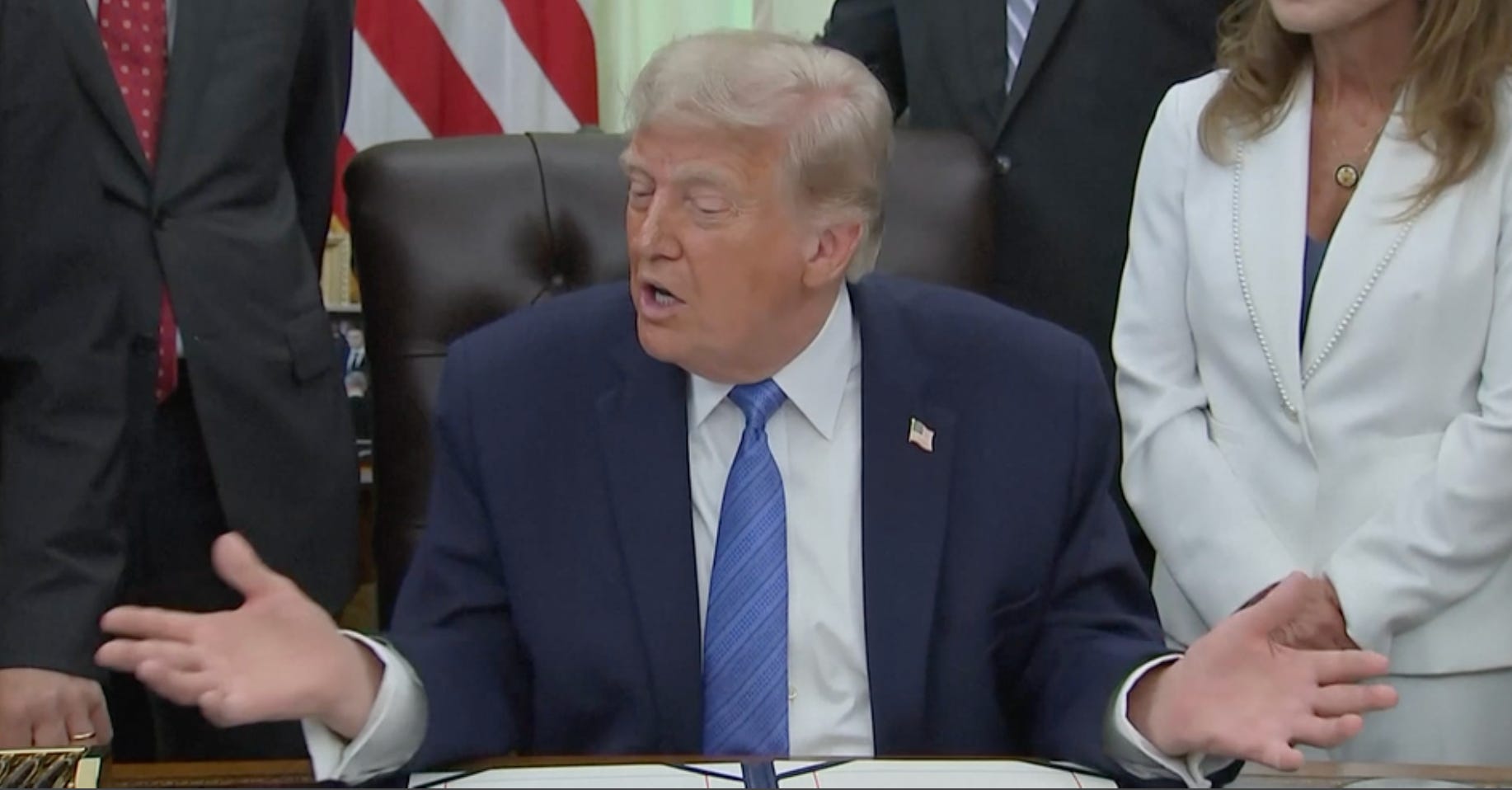
Yesterday morning, a reporter in the Oval Office asked the President of the United States if he was worried about the latest inflation numbers. The Bureau of Labor Statistics had just reported that consumer prices in May were up 4.2 percent from a year ago, the steepest reading since early 2023. Back in January, inflation was running at 2.4 percent. It has climbed every single month since.
Donald Trump did not hesitate. “No,” he said. “I love it. I love the inflation.”
He said it with the particular ease of a man who has never once had to choose between filling a gas tank and buying groceries. He said it in a room where the walls are hung with gold curtains and the furniture has been reupholstered to his specifications. And then he explained that prices would fall “like a rock” once the Iran war ended, as though the war were something that had happened to him rather than something he started.
I have been trying to find the right word for that moment since I watched the clip this morning. Not the lie embedded in it, because we have documented those for a long time now. What stopped me was the ease. The complete absence of any visible awareness that the people who would see that clip are the same people paying $4.81 for a gallon of gas on the way to work. The same people who have watched their grocery bills climb every month for four months. The same people who were told, over and over again in 2024, that Donald Trump would end inflation starting on day one and make America affordable again.
He said that. Dozens of times. On stages across the country, with flags at his back and crowds cheering, he promised the people in those arenas that prices would come down the moment he took office. Eighteen months later, with inflation at a three-year high and energy prices up 23 percent in a single month, the man who made that promise sat in the Oval Office and said he loves it.
The driver is not complicated. Gas prices are up roughly 40 percent over the past year. Iran’s blockade of the Strait of Hormuz has knocked a significant share of the world’s oil supply offline, and the war that created that blockade is now in its fourth month with no negotiated end in sight. Economists are largely in agreement about the cause. The administration is largely in agreement too, which is why Trump’s answer this morning wasn’t a denial. It was a promise that the pain will stop once the war stops. What he did not say is when that will be, or what he plans to do about it, or whether the people who are making hard choices right now are expected to simply wait.
That might be enough on its own. But this week brought something else, and the two things together form a picture that I think is undeniable for anyone connecting the dots.
Yesterday, House Speaker Mike Johnson told reporters that if Republicans maintain their majorities in the House and Senate after November, the party has a plan to address what he called the unsustainable trajectory of entitlement programs. He used careful language, as he often does, but the meaning was not ambiguous. Social Security and Medicare, he said, “have to be adjusted and fixed.” He did not say the tax cuts would be revisited. He did not say the war costs would be examined. He said the programs that working Americans have been paying into for their entire careers need to be cut.
The timing could not have been sharper, because this week the Social Security trustees released their annual report. It was not reassuring. The trustees moved the date the retirement fund is projected to run dry forward by a full year, to 2032. Without congressional action before that date, benefits would be automatically cut by roughly 17 percent. Part of what accelerated that timeline, the report notes, is the Republican tax law passed last year, which sent most of its benefits to the top of the income scale and is now drawing money out of a fund that working people have spent their lives filling.
So here is the picture as it stands today. Prices are rising at the fastest rate in three years, driven by a war the administration started and has no plan to end. The President says he loves it. The Speaker of the House says that if his party wins in November, the next item on the agenda is cutting the retirement and healthcare programs that the Americans absorbing those rising prices are counting on.
There is a phrase that comes to mind: when the bill comes due, it never lands on the people who ran it up. I used to think of that as a cynical observation about politics. I am no longer sure it is cynical. It seems, more and more, like an accurate description of the operating principle.
The people who will absorb a 17 percent Social Security cut in 2032 are not the people who wrote the tax law that helped accelerate it. The people paying $4.81 for gas today are not the people who started the war that caused it. The people who will face reduced Medicare benefits are not the people who spent the past year cutting the government agencies that negotiated drug prices on their behalf. The costs are distributed one way. The benefits flow another.
I want to be careful here. Every government, to varying degrees, makes decisions whose costs fall on people who had no hand in making them. That is one of the oldest complaints in democratic politics, and it is not always unfair. Governing involves trade-offs, and sometimes the trade-offs are genuinely difficult.
But there is something different about saying “I love the inflation” on the same day the inflation number comes in at a three-year high. There is something different about announcing plans to cut retirement benefits in the same week the trustees report reveals that the fund was shortened by your own tax policy. The difference is not merely incompetence or bad luck. It is the open declaration that the people absorbing the costs are not the audience this administration is playing to. They are the price of doing business.
In 2024, Trump told working people that he understood what they were going through. That he had heard them. That he would fix it. Today, asked if he was concerned about the numbers those same people are living inside, he said no. He said he loved it. And then he went back to talking about the war.
I keep thinking about the people in those 2024 arenas who believed him. Not the donors, not the insiders, not the people who understood exactly what they were getting. The people who just needed prices to come down. The people who are still waiting. I don’t know what they made of yesterday morning’s clip. I hope they are paying attention, because the people in charge of this government have made it very clear what they think about the rest of the bill.
How in the world can any sane, decent person still support this raving idiot?
MAGA cult will forgive him. They will now love inflation too!