


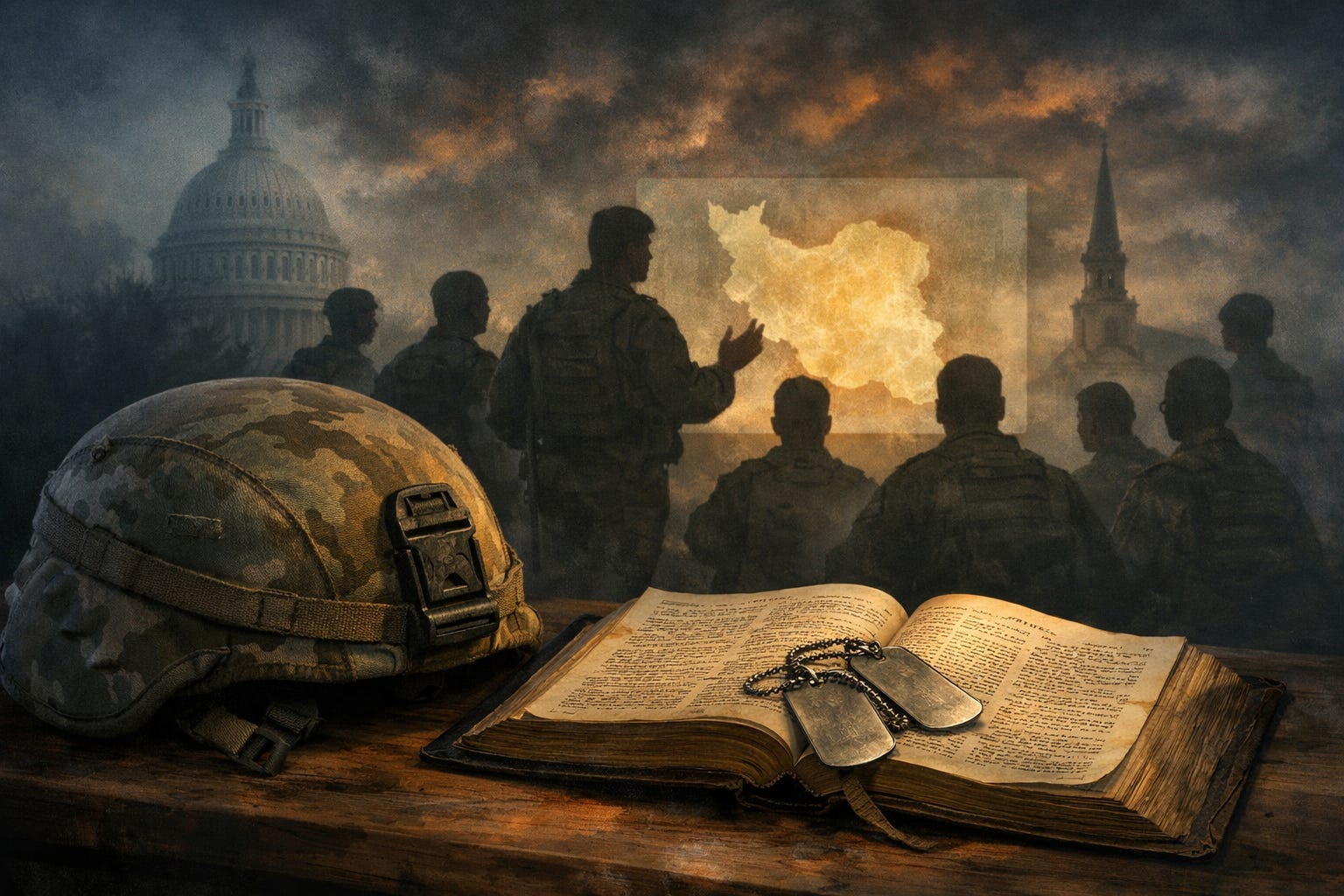
With America launching a ferocious attack on Iran, one aimed at regime change, at least 200 troops have reported that their superiors have told them that the bombs and rockets will fulfill America’s role in bringing about the Armageddon of the New Testament. The Guardian reported that, according to one officer, his commander
“…urged us to tell our troops that this was ‘all part of God’s
divine plan’ and he specifically referenced numerous citations
out of the Book of Revelation, referring to Armageddon and the
imminent return of Jesus Christ. He said that ‘President Trump
has been anointed by Jesus to light the signal fire in Iran to cause
Armageddon and mark his return to Earth.”
The End Times view of the war Trump is waging against Iran holds that while some individuals can be “good people,” all of Islam is evil, and Muslims will stand in the army of Satan in a world-ending war centered on Israel. Jews and Christians will prevail in this battle, ushering in Christ’s 1,000-year reign of peace. This view is the ultimate expression of the Christian Nationalism that occupies much of Donald Trump’s Make America Great Again movement. It is a belief system that defies both Christianity and American history. And it represents a danger to our democracy and the Christian faith. The danger is not in the view of the end times, it’s in the idea that we have a responsibility to usher it in.
As a Christian myself, I take this issue seriously and want to give it the deep attention it deserves in this week’s Going Deeper.
A Long History
The idea that America is a Christian nation goes back at least to the late 1600s, when we should remember that what became America was made up of colonies that were loyal to England. The blending of church and state was natural for these subjects of the King, and communities were organized around Protestant congregations. As the monarch’s rule became tyranny, God was invoked in the Declaration of Independence, but when it came time to create the government, He disappeared.
Instead of creating a Christian theocracy, the Founders formed a democratic republic and explicitly forbade the mixing of church and state, declaring, in the First Amendment:
Congress shall make no law respecting an establishment
of religion, or prohibiting the free exercise thereof; or abridging
the freedom of speech, or of the press, or the right of the people
peaceably to assemble, and to petition the Government for a
redress of grievances.
Two years after the Constitution was ratified, in a letter to a Jewish congregation in Newport Rhode Island, George Washington assured them that in the United States, “All possess alike liberty of conscience and immunities of citizenship.” In 1797, under President John Adams, a treaty with the Muslim authorities in Tripoli declared, explicitly, that our country was “not, in any sense, founded on the Christian religion…”
Christian Nationalists can’t get around the First Amendment, but they can argue that Christ lived in the hearts of the Founders and thus inspired their work. There’s little doubt that most, if not all, who signed the Constitution would have said they were Christians of one sort or another. Many, if not most, were regular churchgoers. But several, including Benjamin Franklin, were Deists who did not believe Jesus was God and did not believe in the supernatural.
The most influential doubter among the Founders was Thomas Jefferson, who considered Jesus a great moral teacher but not divine. He famously created his own “Jefferson Bible” by cutting and pasting passages he deemed to be vital moral instructions. He excluded Scripture that dealt with the supernatural -- no virgin birth, no miracles -- but included the story of Christ’s life and ethical teachings. Although they respected Christianity, Jefferson and others were also influenced by the philosophy of the Enlightenment, which stressed individual liberty and limited government. There should be, Jefferson wrote, a “wall of separation” between Church and State.
In the generations that followed the Founding, American Christians have struggled over whether faith should rule over government. Politicians routinely waved the flag and thumped the Bible while preachers picked and chose from the Old and New Testaments. Some stressed Scriptures that held that all authority originates with God and read this to mean the Church should rule. Others saw that religion could be threatened by government and preached strict separation of the two.
Modern Christian Nationalism
The big change came in the mid-1970s with the rise of an evangelical/fundamentalist TV preacher named Jerry Falwell and his organization, which was called the Moral Majority. Falwell urged his followers, who numbered in the millions, to reject Jimmy Carter’s style of Christianity -- one of love, accommodation, and service -- which was, in American tradition, mostly a private matter. In its place, Falwell offered a blend of conservative religion and intensely patriotic politics; the flag and the cross. He spoke ominously of a country threatened by liberals. He backed Ronald Reagan and mobilized his followers to vote. They were crucial in his election in 1980 and re-election in 1984.
Falwell and his allies didn’t say the church should formally seize control of the three branches of government. Instead, the movement was devoted to promoting the idea that the American people -- well, actually just the evangelicals and fundamentalists -- have been chosen by God, and constitute a nation above all others. Christian Nationalism is not mere patriotism. It is a system of thought that makes conservative religious and political beliefs the norm and sets-up an “us vs. them” dynamic. At the same time, a chosen nation would consider itself justified and confident in entering conflicts with others. (Hence the words of commanders who framed the war in Iran as a matter of religious destiny.)
At home, Falwell’s Christian Nationalists demonized so-called “secular humanists” who were considered the enemy because they promoted an agenda that violate their views. Chief among them -- the Equal Rights Amendment (ERA) to the Constitution, legal abortion, and equal rights for gay and lesbian Americans. With his TV broadcasts, Moral Majority chapters, and aggressive fundraising, Jerry Falwell took in tens of millions of dollars per year. Other preachers -- notably Pat Robertson -- saw his success and jumped on the bandwagon. Robertson ran for the Republican nomination for President in 1988 and then created his own aggressive grassroots political organization -- the Christian Coalition. This is where the story gets personal, for me.
My Personal Experience With Fundamentalism
In 1992, at the age of 14, my father took me to the national convention of Robertson’s Christian Coalition. He was getting involved in Republican politics in our hometown of Bloomington, Illinois, and went because the organization was influential even on a local level. Held in a hall decorated in red, white, and blue, the “Road to Victory” convention’s main event was an address by President George H. W. Bush. Though he was an Episcopalian who rejected fundamentalism, Bush paid homage because he was running for reelection and needed the votes. (He eventually lost the election.)
I was raised in the type of fundamentalist church that made up the base of the coalition, but my parents were not that intense in their practice. They didn’t like the way that pastor controlled the lives of many members, and while they appreciated the emphasis on the Bible, they didn’t think members of the Church were, by definition, better than other people. Neither did I.
As I grew up, I recognized the flaws in fundamentalism and experienced the world beyond its constraints. I noticed that people outside the church were not evil. My beliefs changed as I realized the church was important but calling us to be separate from people, unlike Christ who lived among them. Like many, I developed a rebellious streak in high school and college and discovered that there was a whole world of people who didn’t believe exactly as I had.
I didn’t stop being a Christian, but I stopped being so one-dimensional and judgmental. I guess you could say I became a moderate Christian. As such, I accepted the science behind the theory of evolution (while being the tool God used to create the world) and valued charity and compassion. My role models included my father, who ran a faith-based agency that provided services to the poor and homeless. He didn’t preach; he served.
The Pursuit of Power
While I was adopting a more loving and service focused form of Christianity and entered politics as a moderate Republican, the party and its religious base moved steadily toward the Right. Together, they formed what might be called a social identity that went beyond politics to include a long list of concerns that Jesus never spoke about, such as taxes, gun rights, and school choice.
Within the movement, most believed that America was founded as a new Israel, which makes our country God’s instrument. This can only happen if Christians control our institutions -- especially political institutions -- so that their religion can guide leaders who will implement policies that are consistent with their agenda. And they prayed for a national leader who would become their standard bearer.
When I first ran for Congress in 2010, the strength of Christian Nationalism was obvious in the so-called Tea Party, which started as an anti-tax/anti-deficit movement but quickly developed a religious flavor. At rallies, crosses appeared next to flags and were raised as evangelical/fundamentalist preachers blessed the proceedings in Jesus’s name. According to the polls, nearly half of Tea Party members were also devoted to the Christian Right, and 69 percent of conservative Christians were supportive of the Tea Party.
Anyone who was around during the peak Tea Party period (roughly 2009-2013) remembers the true-believer fervor they brought to their protests and gatherings, where the demographics -- white, middle-aged, middle-class -- matched the profile of Christian Nationalists.
Often mobilized to replace moderate Republicans with uncompromising, Christian Nationalists, the Tea Party backed primary candidates who supported their views and then turned out in sufficient numbers to see many of them elected. Many Incumbents, desperate to keep their jobs, moved to the Right. Those who didn’t were often primaried out of office by newcomers who fit the Christian Nationalist bill.
I managed to survive because my district was home to lots of moderates (at first), my voting record was reliably conservative, and my challengers were weak candidates. But all around me, regular politicians, the kind who got things done, were replaced by people who were as rigid in their politics and their religion as their constituents. Then came 2016, and Donald Trump.
In Trump They Trust
Donald Trump is a profane man whose sexual affairs, two divorces, and habitual lying would seem to turn off serious Christians. This assumption ignores the role that redemption plays in churches where the fallen who declare themselves “born again” become heroes. In Trump, pastors and laypeople alike saw a man who fit the Bible’s description of “imperfect vessels” who nevertheless carry the faith forward.
In his policies, Trump adopted the Christian Nationalist agenda. Though once pro-choice, he declared himself anti-abortion. He aligned himself with a strict, pro-gun interpretation of the Second Amendment, and he supported using public funds for religious charter schools. He speaks often of the supposed persecution of American Christians and promised to reinforce protections for religious freedom.
In 2016, Trump made a point of campaigning at Christian institutions and events. He visited lots of churches, spoke at Falwell’s Liberty University (the TWO Corinthians speech), and addressed the annual Values Voter Summit, where he sounded all the right notes. He said the media demeaned Christians and that faith “built this nation.” And he committed himself Christian Right culture. “ [In] A Trump administration, our Christian heritage will be cherished, protected, defended, like you’ve never seen before,” he said. “Believe me. I believe it. And you believe it. And you know it. You know it. And that includes religious liberty – remember, remember.”
As he traveled the country, spouting all the right buzzwords, Trump bonded with Christian Nationalists in a way that, to use his own way of talking, “people have never seen before.” He has condemned the “radical left” that supposedly wants to “tear down crosses” and repeatedly described America as a “Nation of believers.” In a symbolic (and slightly nauseating) nod to Christian Nationalists, he even began selling a special Bible that includes, along with Scripture, the Declaration of Independence and the Constitution.
Is Trump himself a true believer? That’s between him and God. But we know he’s not a churchgoer, and his knowledge of the Bible seems limited at best, and he has never declared himself “born again.” In fact he famously said he didn’t “need forgiveness.” And surely his policies of intentional cruelty defy the precepts Jesus taught his followers. Nevertheless, conservative Christians remain the foundation of the MAGA movement, with tens of millions putting their faith in him.
For the rest of us, the combination of Trump and Christian Nationalism presents a true threat to our country and the world. Nothing illustrates this more vividly than the reports of military commanders who spread the word that the president, who controls nuclear weapons, has been chosen by God to bring about Armageddon. There is, according to the faith I know, and the patriotism I feel, nothing but terror in this belief.
Thank you for finally saying something about this. Your thoughts are exactly how I feel. I don’t want anyone telling me how to worship.
This is frightening! I am appalled that Trump and Christian are even used in the same sentence…is this really what Jesus would do??? Jesus really meant it when He said Love thy neighbor!