

Welcome to the second addition of my new weekly column “Going Deeper.” We’re going to take a look at how the cruelty of Trump’s decisions can impact real people.
Washington has always been a myopic place. With a few exceptions, the powerful and their hangers-on can’t see past their own political interests and prejudices. They relish partisan fights over “policies” that are really choices —some life and death choices — that affect billions of dollars and millions of lives, and then they go home, or to a fundraising reception, and rarely think of the individuals whose lives they have changed.
Meanwhile, in the real America and around the world, real people suffer real effects. Under Trump, our leaders and representatives have inflicted immediate pain in the realms of health care, education, disaster relief, and even household finances. Executive orders, bills passed by Congress, and bureaucratic decisions impact individuals, families, and communities. This is something that we need to keep in mind as the actions taken in DC pile up.
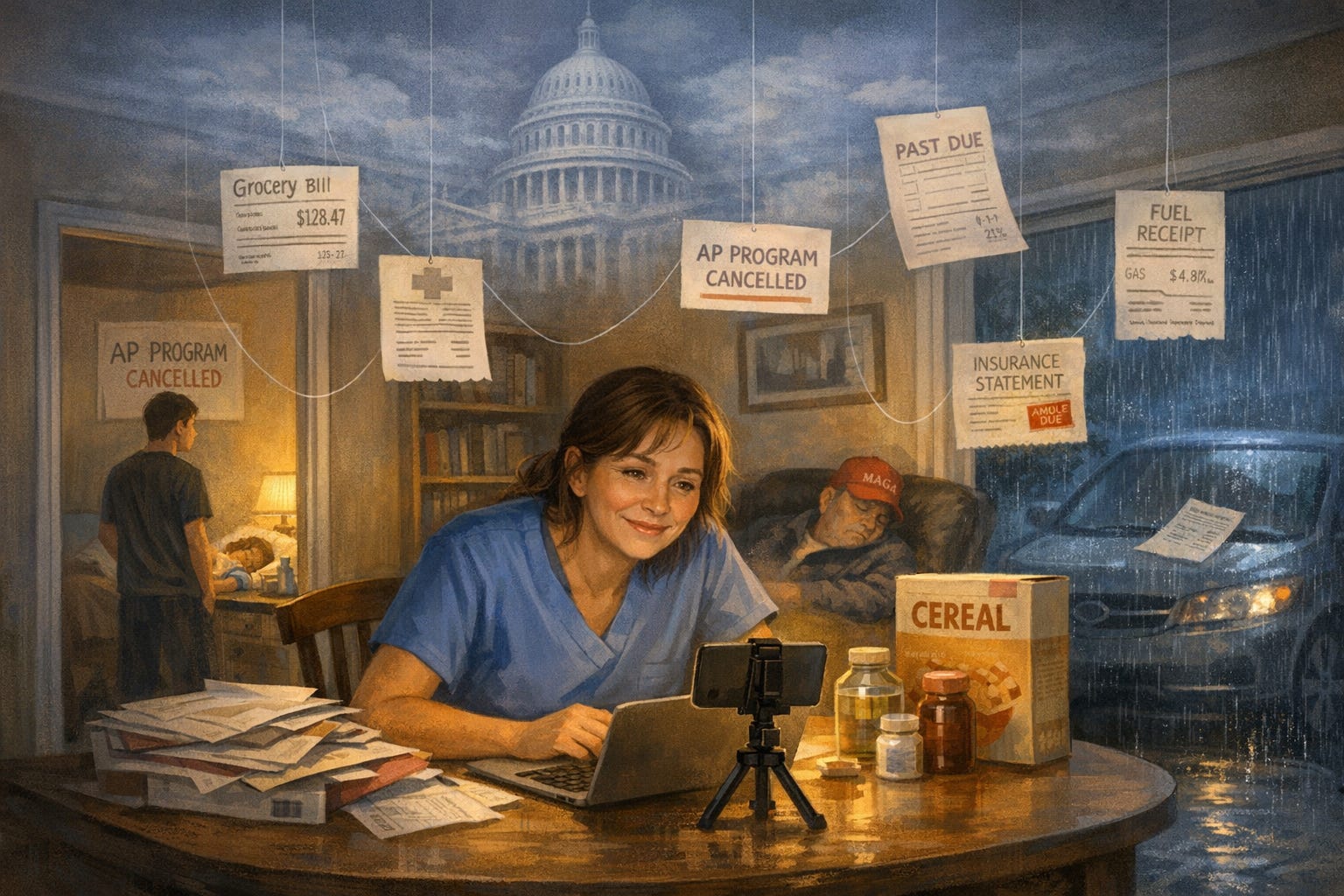
In this post, I’ll be considering the price paid by a busy working mother — let’s call her “Mary” — her family, her friends, her neighbors, and her community. She lives in a working-class neighborhood of a fictional North Carolina community called Shoredge, attends the Lutheran church, and works as a nurse at the community hospital. She has three kids — aged eight, twelve, and seventeen — and a husband named Ed who wears his red Make America Great Again cap to work at a giant warehouse/fulfillment center on the edge of town.
Unknown number calling? It’s not random
The BBC caught scam call center workers on hidden cameras as they laughed at the people they were tricking.
The BBC caught scam call center workers on hidden cameras as they laughed at the people they were tricking. One worker bragged about making $250k from victims. The disturbing truth? Scammers don’t pick phone numbers at random. They buy your data from brokers.
Once your data is out there, it’s not just calls. It’s phishing, impersonation, and identity theft. That’s why I recommend Incogni: They delete your info from the web, monitor and follow up automatically, and continue to erase data as new risks appear. Try Incogni today and get 55% off annual plans with code ADAM. I use it myself, and it’s a service that’s really important to me.
Mary is the busiest person you will ever meet. On a typical day, she copes with the effects of decisions made by distant powers she knows are not on her side. She worries about her community and the future. But most of all, she struggles to care for everyone she loves. And she is always exhausted. Let’s look at her life and how Washington under Trump affects it.
***
The alarm clock buzzes at 6, and Mary reaches out to switch it off. In this moment, she thinks it’s Saturday, so she rolls over to put her arm around her husband. Ed isn’t there. He left an hour ago to make his warehouse shift. And so Mary knows it’s Friday, which means the weekday routine. She sighs and gets out of bed. Grateful to have the bathroom to herself, she washes and puts on a little makeup. Back in the bedroom, she puts on some scrubs. Now it’s time for Job One -- getting three kids, Ed Jr, Merry, and Nora out of bed.
Ed, the eldest, doesn’t take much prodding. Two knocks on his door, and he’s up and rushing to be first into the bathroom. He takes the bus to high school, which he actually enjoys. He gets to see guy friends and flirt with girls, and he likes his classes.
But there’s just one problem. Shoredge is a small, lower-income community, and the Advanced Placement classes he used to thrive in have been cancelled. Program cuts in the Trump Department of Education budget cut funds that had supplemented the district’s budget. AP classes, all of them, have been discontinued. So has his after-school debate club.
Mary has managed to rouse Merry and Nora, who are brushing their teeth and getting dressed while she is setting out cereal bowls. Inflation, which Trump promised to eliminate, has hit grocery prices hard. So it’s generic raisin bran and cornflakes and apple juice instead of the orange juice that once was a staple. Mary notices the change in the menu and sighs a bit. Thank God for that new discount grocery store — Aldi — that opened in the neighboring town. Shopping there costs her a buck or two in gas and an extra 30 minutes, but it saves her $20 a week, which she puts into her secret “someday” (as in “someday we’ll buy a house”) savings account.
At the table, Merry complains about the generic cornflakes. She’s right. They aren’t quite the same as the brand name. The flakes are smaller. They get soggy faster. But it’s not just the taste and texture that bother her. It’s that they are generic. Generics are uncool. Merry thinks, “Thank goodness the kids at school can’t tell” that the peanut butter and jelly sandwiches Mary packs for their lunches are generic, too.
Before they leave for school, Mary checks to make sure that Norah has an albuterol inhaler in her backpack. She’s asthmatic and never knows when she’ll need a “rescue” dose. In the days before Congress and Trump slashed Obamacare, the inhalers used to cost about $20 per month. Forced to pay $400 per month more for far less coverage and higher deductibles, Mary now shells out $150 per month for the same medicine.
At 7:20, Mary is out the door, and everyone is loaded into the car. It’s a 2017 Subaru Forester with 76,000 miles on it, but it’s generally reliable. The last time she had a problem, the mechanic she uses apologized for the extra cost. The made-in-China parts he used had doubled in price due to Trump’s tariffs. There was nothing he could do about it.
After backing out of the driveway, Mary turned on the radio. She likes National Public Radio. It keeps her up on what’s going on around the country, and the local station presents area news at just the time she’s going to work. Of course, with Washington eliminating federal funding for NPR, the station seems to interrupt the news for fundraising appeals all the time. They’ve already let some familiar reporters go, and Mary already feels like she’s lost a connection to her community. It was NPR that told her about the cuts to school funding that affected Ed Jr.
At 730 Nora and Merry get dropped off first at Shoredge Elementary and Middle School. Six teachers stand on the sidewalk where a single bus disgorges noisy kids. One greets the students. The five others scan the road for official-looking SUVs. The Immigration and Customs Enforcement agency (ICE) is in town, and school officials are well aware that agents have been scooping up immigrant kids in front of schools. No one knows what they would do if this happens here, but the possibility has everyone on edge. At the very least, the teachers want to witness what’s happening.
“Hernando hasn’t been in class for a week,” says Nora as she gets out of the car. “Somebody said he doesn’t even go outside.”
The start-of-class bell rings as Nora steps out of the car, and Mary has just enough time for an “I love you!” as her daughters rush inside. Mary makes a mental note to talk to her about Hernando. Of course, she doesn’t know what she could possibly say that would be both honest and reassuring.
A ten-minute drive takes Mary to the hospital, a one-story brick building named for the town doctor Joseph Hallock, who founded it. As she walked inside, heavy rain started to fall, so she skipped ahead to duck out of the downpour. Inside, she turns left after the reception desk and passes through double doors and into the maternity ward. With a stop at the nurses’ station, she learns that three women had delivered babies the night before and two were to be discharged with their babies this morning. But before she could start filling out the paperwork, her supervisor, Liz, pulls her aside.
“It was the Tylenol,” says Liz.
What?”
“They’re saying that if you take acetaminophen during pregnancy that causes autism.”
“That can’t be true.”
“I know, it sounds crazy. But it’s coming from HHS.”
Lots of crazy stuff had been coming out of the Department of Health and Human Services, which, until Trump named Robert F. Kennedy, Jr. secretary, had been a credible source of information about science and medicine. Now he was dumping guilt on women like Liz who have autistic children.
“It’s bullshit,” said Mary. “That guy’s been obsessed. You know my sister Laurel’s son Freddy is autistic too. He’s a lot like your John, I read up on this. It was one study, and it’s been disproven. The guy is a lunatic, and he doesn’t care what he does to anyone.”
Liz looked slightly relieved as Mary gave her a hug and went off to see her patients. She didn’t know it. But three of the five -- and their babies -- were insured by Medicaid. She did know that the Congress and the president had approved future cuts in Medicaid funding, which will be devastating to small-town hospitals that see a large number of Medicaid patients. As the number of uninsured patients increases, cash flow would dry up. Pretty soon, Hallock Hospital would be in the red and headed for shutdown. The nearest hospital was thirty miles away. Not much bigger, its future would be threatened by Medicaid cuts, too.
As she went about her work, Mary let go of her worries and found some peace in the routine. She had always wanted to work in obstetrics. She liked caring for the women and babies. She even liked doing some of the social service outreach -- connecting them with daycare providers for older siblings, for example -- that she sometimes did to help mothers. Other hospitals had social workers to help with these tasks. Hallock could not afford one.
At noon, when she had a break to eat her own peanut butter and jelly sandwich, Mary found a quiet corner of the nurses’ lounge, took out her cellphone, and dialed up her mother Lucy, who lived in Western, North Carolina. Astonishingly, their county, Avery County, was still waiting for aid to clean up and repair infrastructure that had been wiped out by Hurricane Helene in 2024. The county was still a mess, and the damage done to Lucy’s house, where she had lived alone since her husband had died, had not yet been repaired. She had been living with Laurel for a year and a half.
After a brief chat with her mother, Mary asked to speak with Laurel.
“How’s it going,” asked Mary.
“The same,” replied Laurel, who explained that her husband Luke was still looking for a job. In early 2023, he got a position as a ranger at the Great Smoky Mountains National Park. One of the last people hired, he was among the first to be fired as the Trump administration cut more than 1,700 Park Service jobs. The number was tiny compared with cuts at places like HHS and the Veterans’ Administration, where the cuts ran into the tens of thousands. Nevertheless, when it’s your job, that’s the one that matters. Laurel and her family had been scraping by as Luke did odd jobs, Laurel worked at Walmart, and Lucy threw her monthly Social Security check into the pot.
As Mary’s lunch break ended, her phone rang. She looked at the caller ID -- Shoredge Schools -- and immediately answered. It was the high school, calling about Ed Jr. He had gotten into a heated argument with his history teacher, Mr. Walker, who had sent him to the principal’s office. The subject of the debate? The separation of church and state. In the weeks before his AP history class was canceled, Ed had learned that the Constitution prohibited the mixing of religion and government. Mr. Walker said that America was a Christian nation. And that the founders were all Christians. Ed. Disagreed. Started shouting, and he was thrown out of the class.
As Mary listened to the principal, she imagined her stubborn son standing up for his point of view AND she remembered how devastated he had been to lose his AP classes. This incident wasn’t about the Constitution. It was about her son losing something that had given him a reason to come to school in the first place. Mary told the principal that she thought this was why Ed had acted out. The principal didn’t care. Ed was being sent home.
There was no way that Ed Sr. would be able to leave his job and get Junior at school. This left Mary to explain the emergency to her supervisor, Liz. “You don’t have to explain,” said Liz. “It’s quiet. Just go take care of things.”
Mary got drenched by the rain as she ran to her car. As she turned right out of the parking lot, she ran into water that was at least a foot deep. Another storm had obviously stalled over the coast. “Right,” thought Mary. “There’s no such thing as climate change.”
Ed Jr. was waiting near the door when Mary pulled up. He ran to the car, opened the door, and flung himself in. Mary didn’t have it in her to chew him out. Instead she looked at the time -- 1:30 -- noted that her daughters wouldn’t be dismissed for another hour. She asked her son if he had eaten. He said yes, but he was still hungry. They drove to McDonald’s and sat in the car to savor secret burgers.
Ed Jr. wanted to talk politics, and Mary was happy to do so. But once they agreed that Donald Trump was a terrible president and had divided the country, they wound up on the same old topic-- how their family was divided by Ed Sr. and his MAGA mania. Mary’s husband went MAGA in 2016, certain that a big businessman like Trump could fix what was wrong in the country. (He believed that taxes were too high, spending was out of control, and everyone was looking for a handout.) Once he had joined up, that had been it. He fell into a community of like-minded people who held little rallies, disrupted City Hall meetings, and flew MAGA flags. (Mary put her foot down on that one.)
Ed Sr. remained a MAGA loyalist, and it affected everyone in the family. Ed Jr. rejected his father’s ideas, and Merry was headed in that direction. Nora didn’t know what to make of things but understood that her parents disagreed about something very serious. During the first Trump term, Ed had enjoyed the tax cuts but then lost his job at a small manufacturing company. (Trump’s promise to “bring back” manufacturing jobs has never been realized.) His warehouse position paid half as much and provided no health insurance. But still, everything was someone else’s fault. Not Trump’s. Most recently, he had been obsessed with transexual athletes in schools. Mary couldn’t have cared less. She was upset by the prices at the grocery store.
After McDonald’s, Mary and Ed Jr. picked up both Merry and Nora. Merry’s day had been “fine” as usual. Nora reported that Hernando was still missing.
That night, Ed Sr. came home with some good news. He was getting some overtime hours over the weekend. They could use the cash, he said, and it would keep him out of Mary’s hair. She agreed on both counts.
After dinner, Mary went out by herself. The rain was still pouring down, but a returning missionary from her church was going to give a presentation, and she wanted to attend. She would get to drink some awful coffee, mingle with people she loved, and she wanted to hear about the world beyond Shoredge, North Carolina, and Donald Trump. Then the speaker began her presentation.
As slides flashed on a screen, she described her journey to Ethiopia to join up with a Christian missionary group that delivered food to people in the countryside. Economic shocks, drought, and other crises had left millions of people, including one million children, short on food. The missionary said that as her assignment ended, people were hungrier than when she had arrived, but that thanks to assistance from China, which was filling the gap, the population’s minimum needs were being met.
Depressed by what she had heard, Mary did not stay for coffee and chatting with friends. She had one more thing to do at home, and she had to get to it.
It was 10 o’clock when Mary got home. Ed was already in bed and asleep, with Fox News blaring on the TV. The girls were asleep too. Ed. Jr. was in the living room on his laptop. Mary kissed him on her way to the kitchen, where she set her phone in a stand on the table. She reached for a spin brush she had bought from Amazon for cleaning in the kitchen. It worked pretty well, and so she was going to do a video review.
“I just used this spin brush and let me tell you, it got into spaces I never could get clean and made them shine…”
Mary had been doing Amazon reviews for a few months. Every once in a while, she received a small payment -- commission on sales made thanks to her reviews -- that augmented her income. It helped her family with the affordability crisis that has worsened under Trump’s tariff regime.
When her busy day was done, Mary went upstairs, turned off Fox, and enjoyed the quiet she had to herself as she took off her makeup and got ready for bed. But it took a while to fall asleep because she got caught up in her day. She thought about health insurance, keeping the Subaru running, Liz and the Tylenol scare, the “someday” fund, her sister and mother, Hernando and the rest, and she wondered when America was going to be great again.
One little thing you didn’t mention, and I’m from NC so I do know this, for those repairs or maintenance on her Subaru, she will pay tax on any labor done on her car, all thanks to the republican legislature that passed nickel and dime tax laws on the residents of our state after they took over in 2010.
Sounds like a typical day for millions of Americans these days.