


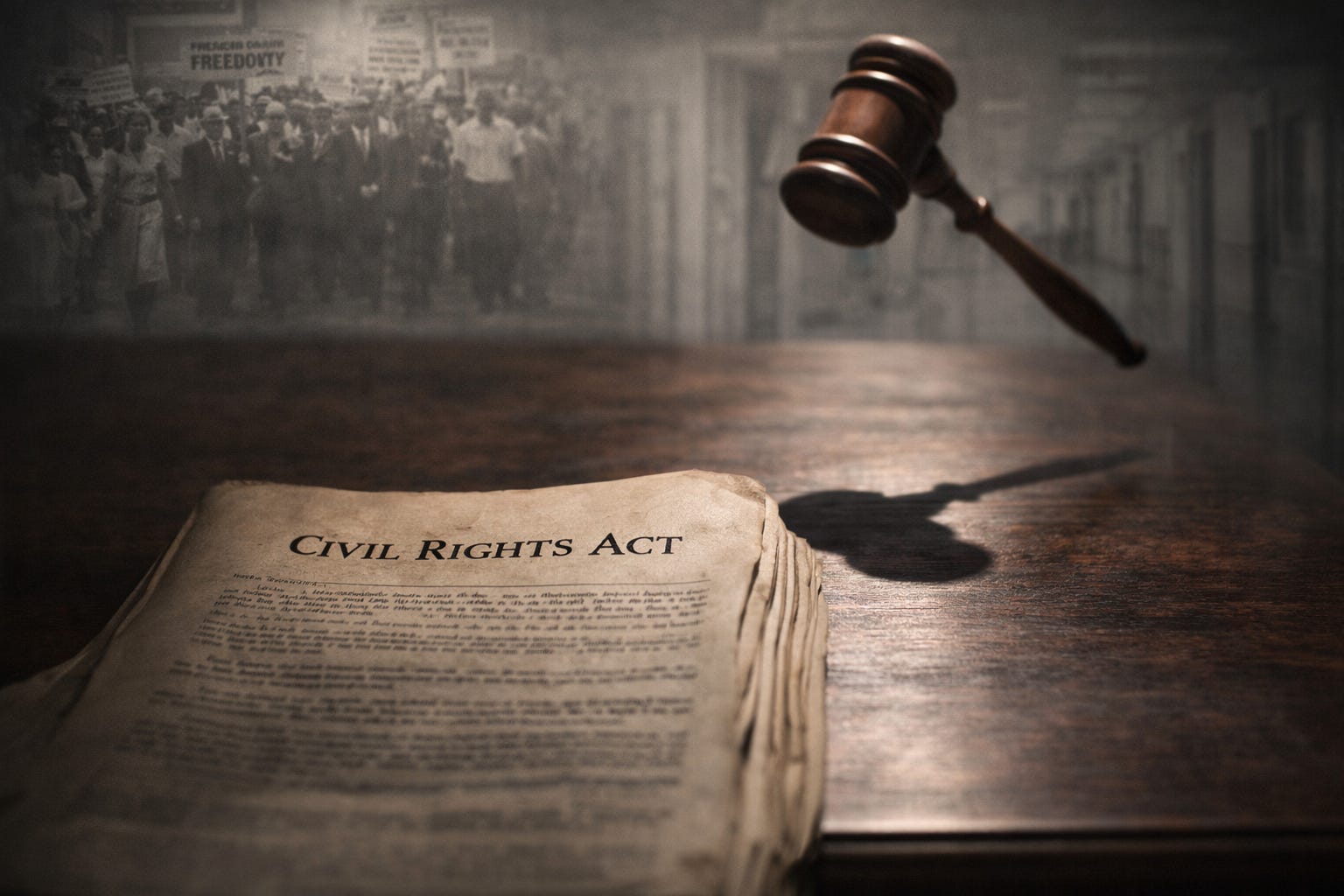
Donald Trump—petulant and bigoted—has a rather peculiar grievance. He believes white people have been “very badly treated” under civil rights laws. And since he is president, he is doing something about it. He is turning the U.S. Equal Employment Opportunity Commission (EEOC) inside out, calling on white men—whom he claims are the true victims of racism—to come forward with their tales of suffering.
“White people were very badly treated when they did extremely well, and they were not invited to go into a university or college,” Trump told The New York Times recently.
“So I would say, in that way, I think it was unfair in certain cases.”
Trump is talking about affirmative action programs that once gave minority applicants for jobs and education a small amount of help. These programs no longer apply to school admissions, but they do still affect government contractors. Their intent was simple: to begin—however imperfectly—to address the discrimination and racism inflicted on Black and brown Americans for as long as they have lived in this country.
The “certain cases” Trump refers to involve white and minority applicants competing for government-related jobs. If, at the cutoff point, two candidates were equally qualified and one was Black, that candidate might get the position. Was this unfair to a very small number of white applicants? Perhaps. But was it worth it for the nation to begin correcting generations of exclusion? Absolutely.
Understanding why affirmative action was necessary requires only a basic grasp of American history. Brought here in chains, many of the ancestors of today’s Black Americans were enslaved, and even after emancipation, they faced crushing barriers to economic opportunity. Jim Crow laws—still in effect in parts of the country into the 1970s—denied their descendants access to education, housing, mortgages, and even the vote. The last racist lynching occurred in 1981. “Back of the bus” treatment was not a metaphor; it was reality. And its consequences were reflected in employment rates, wages, and household wealth.
The Civil Rights Movement of the 1960s—when a young Donald Trump was coming of age—shook the nation as Black Americans and other minorities demanded equal treatment under the law. Congress responded. Presidents signed landmark legislation. On paper, at least, equality was finally acknowledged as a national value.
So why does Trump care so much about undoing it?
I believe it’s personal. As a young man, Trump was denied admission to his Ivy League school of choice. It has long been convenient for him—and others like him—to blame affirmative action for that disappointment. Though he eventually transferred, it’s not hard to imagine that resentment lingering. In 1989, he complained publicly that “a well-educated Black has a tremendous advantage over a well-educated white, in terms of the job market.”
Trump, of course, was never actually in the job market. Even before graduating from the University of Pennsylvania, he worked in his family’s real estate business—an enterprise that barred Black and Hispanic tenants from renting in Trump-owned buildings. The Trump Organization was caught violating the law. When sued, it countersued, alleging—predictably—reverse discrimination. It escaped serious consequences through a settlement with the federal government.
After that scandal, Trump’s record of bigotry only grew. When Native American tribes sought to compete with his casinos, he smeared them as criminals. When Black employees handled cash at his gambling operations, he complained and demanded that only Jews be trusted with the money. When five innocent teenagers—the Central Park Five—were falsely accused of a brutal crime, Trump inflamed racial hatred by publicly calling for their execution.
In the run-up to his 2016 campaign, Trump became the leading voice behind “birtherism,” the racist lie that Barack Obama—the nation’s first Black president—was not born in the United States. He routinely amplified content from neo-Nazis and white supremacists online.
As both president and candidate, Trump has described countries with predominantly Black populations as “shithole” nations. He has falsely accused Haitian immigrants of eating pets, smeared Hispanic immigrants as violent criminals, and recently opened American borders to white South Africans, claiming—without evidence—that they are victims of racism, while barring immigration from Black African nations.
Throughout his career, Trump has appealed to a segment of the white population that feels aggrieved and displaced. His crusade against affirmative action is both a sop and an incitement. It ignores persistent racial inequality—just look at the wealth and employment gaps—and rests on ignorance dressed up as grievance.
So far, the EEOC has not been inundated with credible claims from white Americans alleging discrimination. But it has stopped pursuing cases on behalf of minority complainants. That is the real consequence of Trump’s rhetoric. His administration is devoted to correcting “reverse discrimination” that does not, in fact, exist—even if our openly racist president insists otherwise.
The good news is this: America does not have to accept this backward slide. Civil rights were not handed down out of generosity; they were fought for, defended, and expanded by citizens who refused to surrender to fear or resentment. They can be defended again.
The call to action is simple and urgent. We must speak up. We must vote. We must reject the lie that equality is oppression and insist—again and again—that fairness strengthens this country rather than weakens it. Progress has never been inevitable, but neither is regression. The future still belongs to those willing to stand up for it.
Excellent column, as usual.
I often use my (white) dad vs the (Black) dad of a high school classmate as an example.
My dad was raised in a working class family in NJ. His dad drove a truck & his mom cleaned people's houses and worked in a bakery. After 3 years of college (on a basketball scholarship), my dad joined the Army. He knew he'd be drafted eventually (this was 1954), and the GI Bill would help him pay for law school. That all worked as planned, and he used the GI Bill also to get a low interest rate mortgage so he & my mom could buy their first, tiny home to raise us 3 girls.
My friend's dad also served in the US Army. But as a Black man in the south, with skill as a mechanic that he acquired during his service, he was denied the GI Bill loan that would have enabled him to open his own small business. He ultimately moved to NJ, but still was unable to get the veterans' support that he deserved. He and his wife raised 4 children, one of whom was my high school classmate. And while he has been quite successful, and his daughter even more so, he had to work extra hard every step of the way because his dad was held back from success.
My sisters and I benefited directly, both financially and socially, from the support that the government gave my dad. We got that leg up because we were white. That benefit carries directly forward, generation to generation.
This is part of the Great Replacement Theory. The very idea that whites have suffered racial discrimination if complete hogwash. I am 72 and remember how Black Americans,Native American adn Hispanic Americans were treated, how they were stereotyped in media, movies and in school. I did not have any black j kids in my school though there black families in town which I did not know about until I was a teen. I saw discrimination action. I witnessed the Civil Rights Movement. Even after that black were still discriminated against as well as other minorities. So poor sniffling white guys who think they were note treated fairly, boo hoo! Get a life.