

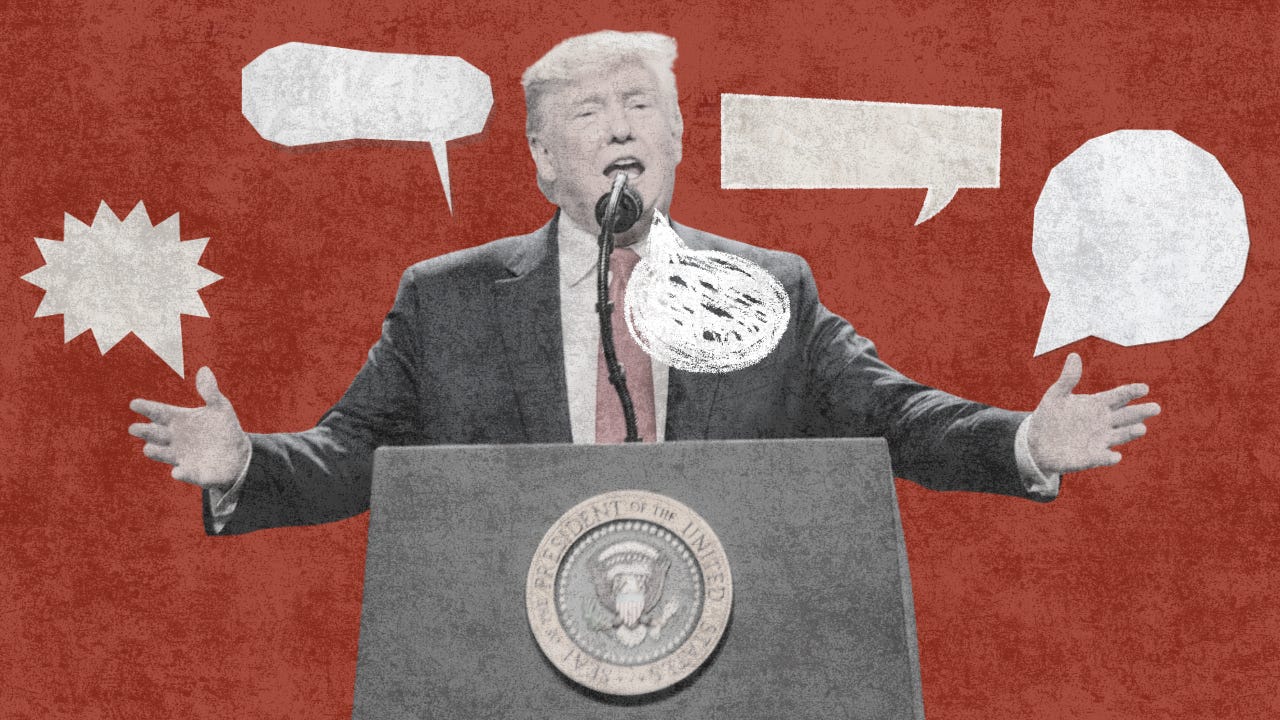
On Monday night in Grand Island, Nebraska, the president of the United States was trying to explain to a crowd why the price of gas shouldn’t worry them too much. The war with Iran, he told them, was worth whatever it was costing them at the pump. “It’s a small price to pay for keeping the world safe, keeping our country safe,” he said. And then he kept going. “They can take out a city. Let them take out Los Angeles. Let them take out San Diego.” This, he said, “is a very small price to pay, and it’s gonna be over very soon.”
By Tuesday morning, the familiar machinery had started up. The White House said he’d been misunderstood. And his defenders on television said it was obviously a joke, that the people objecting were acting in bad faith, and that anyone who heard it differently was ignoring the context.
I want to be fair about this. I don’t believe Donald Trump wants Iran to bomb Los Angeles. If you read the whole rambling passage, you can see roughly what he was reaching for: the war is worth it, the pain is temporary, hang in there. That’s a position a president is allowed to hold, even if I think he’s wrong about it.
But no American president should ever say what he said, not as a joke and not as a clumsy way of making some other point. And I think everybody knows that in their gut, including a lot of the people who rushed to defend him.
Please consider subscribing today to support my independent journalism. Nobody funds this work but you and paid subscribers keep it free for those who are struggling and cannot. With the impending midterms and threats to democracy on all sides, calling out the corruption and lawlessness is more important than ever. Thank you to those who are paid subscribers who keep this operation running. If you support this work and want the best for this country, I invite you to become a paid subscriber today!
A Small Price to Pay
San Diego isn’t an abstraction. It’s the home port of the USS Abraham Lincoln, the carrier whose crew has spent most of this year at sea fighting this very war, and it’s where a lot of their families are waiting for them. Somewhere in San Diego this week, a Navy spouse whose sailor has been gone since last November heard the commander in chief call her city a small price to pay. She knows he didn’t mean it literally. She also knows he chose to say it, and it got applause.
That’s the thing about the words that come from the presidential podium. They aren’t like the words the rest of us say. They carry the weight of the office, and the people who hold it have always understood that. Which is why the bar has always been higher for their words than for anybody else’s.
And with Donald Trump, this isn’t a one-time slip.
In July of 2016, at a press conference in Florida, candidate Trump looked into the cameras and said, “Russia, if you’re listening, I hope you’re able to find the 30,000 emails that are missing.” When people objected, he said he’d been sarcastic. Special Counsel Robert Mueller later found that within about five hours of that remark, Russian military intelligence officers sent malicious links to email accounts used by Hillary Clinton’s personal office, the first time they had targeted it.
And a year ago this week, standing in front of hundreds of America’s generals and admirals at Marine Corps Base Quantico, Trump said, “I told Pete, we should use some of these dangerous cities as training grounds for our military.” The cities he had in mind were run by Democrats. When people objected, they were told they were overreacting. Yet Trump had already sent the National Guard and the Marines into Los Angeles.
Every time, it’s the same sequence. Say the “joke.” Let people react. Then tell everyone who objects that they are the real problem for hearing it.
There’s a word for that, and it comes from an old movie. In the 1944 film Gaslight, a husband slowly tries to convince his wife she’s losing her mind. He dims the gas lamps in their house, and when she says the light is fading, he tells her she’s imagining it. Little by little, she stops trusting what she can see with her own eyes.
Jean-Paul Sartre described a version of this tactic eighty years ago. People who talk this way, he wrote, “know that their remarks are frivolous, open to challenge. But they are amusing themselves, for it is their adversary who is obliged to use words responsibly, since he believes in words.”
It’s a clever trap. The person who says the ugly thing gets to be playful. The people who object have to be serious, and then they get mocked for being so serious.
Heads he wins, tails you’re humorless.
Who Gets Talked Down To

For ten years, the MAGA movement has been built on a real grievance: regular Americans are tired of being talked down to by elites who think they know better. I heard versions of that from constituents for years, and a lot of the time they had a point.
But more than five million regular Americans live in Los Angeles and San Diego. Nurses, Marines, teachers, small business owners, people who get up early and work hard and pay their taxes like everybody else. Plenty of them voted for Donald Trump. And when they object to the president casually naming their hometowns as acceptable losses, they’re told they’re hysterical, humorless, deranged.
Suddenly they’re the problem.
In reality, that instinct is another form of elite contempt. It’s just coming from the most powerful man in the world instead of a faculty lounge.
Pretend it happened the other way and you’ll see what I mean. If a Democratic president had stood on a stage in Los Angeles and said Iran could take out Grand Island, Nebraska, and called it a small price to pay, the people telling us to lighten up this week would be calling for impeachment before breakfast. And they’d be right to be angry.
The president is supposed to be the one person in public life who speaks for the whole country, the parts that voted for him and the parts that didn’t, the small towns and the big cities alike. When he talks about any of them as expendable, even as a joke, he’s failing at the most basic part of the job.
So no, it isn’t funny. Stop telling us it is.
And to everyone who heard what he said on Monday, felt their stomach drop, and then spent the next day being told they were overreacting: you weren’t.
In the old movie Gaslight, the wife isn’t saved by finally winning an argument with her husband. She’s saved when someone else looks at the lamps and tells her he sees them dimming too.
So let me be that person today. We all saw it. You’re not crazy.
— Adam
I see all the comments about what Iran might or might not do!! This is the President of the United States 🇺🇸 of America committing Treason!!
Well said, Adam!💙🇺🇸💙