

Video for paid subscribers follows article
There is a moment in every negotiation — between nations, between rivals, between enemies — when credibility is the only currency that matters. Not military hardware. Not sanctions. Not treaties. Words backed by the demonstrated willingness to mean them.
This week, the United States ran out of that currency. And the world noticed.
Project Freedom: A Timeline of Collapse
On Sunday, President Trump announced “Project Freedom” — a U.S. military operation to escort stranded commercial vessels out of the Strait of Hormuz, where Iran’s effective blockade has trapped thousands of sailors from dozens of nations and sent global oil prices surging to levels not seen in decades. The announcement came with the full theatrical force the Trump administration specializes in: military assets deployed, cabinet members dispatched, ultimatums delivered.
Secretary of Defense Pete Hegseth stood at the Pentagon podium and delivered the warning to Iran with a straight face: attack American troops or innocent commercial shipping, and you will face “overwhelming and devastating American firepower.” Secretary of State Marco Rubio called it a humanitarian mission to rescue sailors “left for dead” by the Iranian regime — ten of whom had already died.
By Tuesday morning, the administration’s messaging machine was in full swing. Senior officials fanned out across Washington to defend and sell Project Freedom to the American people and to the world. The operation, Rubio said, was “the next phase of the war.”
Iran responded not with compliance but with ballistic missiles, cruise missiles, and drones aimed at the UAE. A South Korean cargo vessel caught fire in the Strait. The United Arab Emirates — a close American partner — reported strikes on its territory.
And then, within hours, Project Freedom was gone.
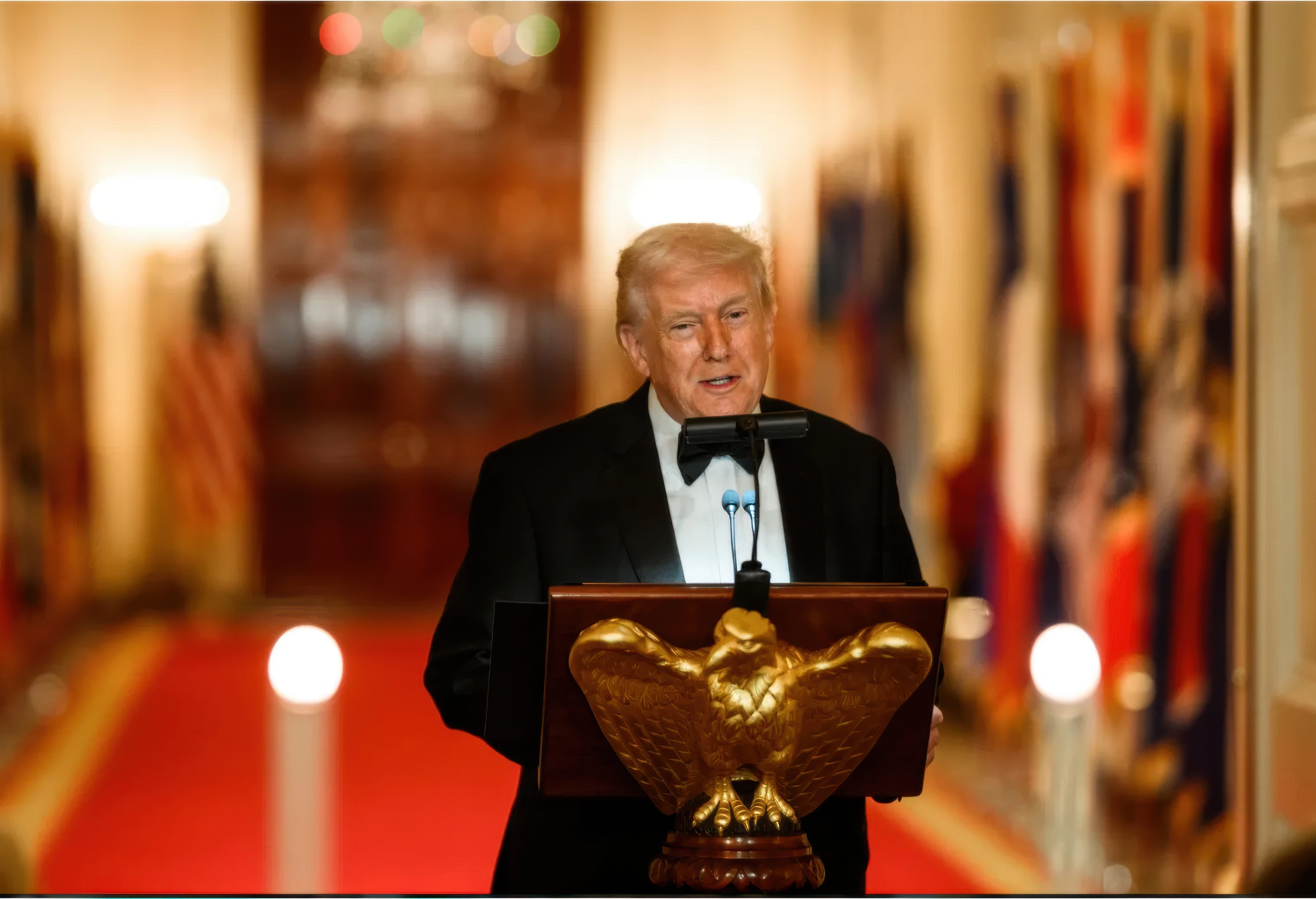
Trump posted to Truth Social that the operation would be “paused for a short period of time” due to — and this is worth reading slowly — “the tremendous Military Success that we have had during the Campaign” and “Great Progress” toward a deal. The same cabinet that had been sent out hours earlier to project strength was left to absorb the whiplash in silence.
The operation lasted approximately one day.
This is not an isolated incident. It is a pattern, and by now it is a deeply familiar one.
Trump warned Iran it would be “blown off the face of the Earth” if it attacked U.S. ships. He declared a deadline — reopen the Strait by Tuesday at 8 p.m. ET or face strikes on “Power Plants and Bridges.” He threatened to “bomb the hell out of them” at a “much higher level and intensity than before.” He told Iran they know “what to do, and what not to do, more importantly.”
Iran did what it wanted to do anyway.
And today, Trump is back to the same cycle — threatening devastating military action while simultaneously signaling a deal is on the table, sending oil markets into spasms as investors attempt to price the difference between a presidential bluff and a presidential promise. The pattern is so predictable at this point that it is functionally indistinguishable from market manipulation: threaten war, markets spike; hint at a deal, markets drop; repeat.
The question every adversary in the world is now asking is not whether Trump will act on his threats. They have their answer to that. The question is whether there is anything he says that should be taken seriously at all.
The Moment That Matters Beyond Iran
Here is what gets lost in the daily chaos of this coverage: the reputational damage being done right now is not primarily about Iran.
Iran is a regional power with a crippled military, a collapsing economy, and a leadership structure so paranoid and fragmented that American envoys are, by their own account, “carrying messages by hand to caves.” Iran is, in geopolitical terms, a manageable problem.
The unmanageable problem is what every other actor in the world is learning right now.
China’s leadership is watching American resolve dissolve in the Persian Gulf at the exact moment it is calculating whether to move on Taiwan. They are not watching to see if Trump will threaten them. He will. They are watching to see if American threats have consequences — and the answer being written in the Strait of Hormuz is: not necessarily.
Russia’s leadership — even a Putin reportedly now so paranoid about a coup that he has retreated to underground bunkers and stopped visiting military facilities — is watching America’s credibility erode in real time. A weaker America is a gift to a regime already on the defensive in Ukraine, already facing the economic and political weight of a war it cannot win cleanly. An America whose president’s words carry no weight is an America that cannot hold together the Western alliance structure that has made the war costly for Moscow. The timing could not be worse.
America’s partners in the Gulf — Saudi Arabia, the UAE, Qatar, Bahrain, Kuwait — co-authored a UN Security Council resolution at Washington’s request. They took a political stand alongside a superpower whose secretary of defense was threatening Iran at a podium on Tuesday morning and whose president had walked away from the operation by Tuesday afternoon. That is not a relationship-building exercise. That is a humiliation shared.
And America’s allies in Europe — already unnerved by years of doubt about Washington’s commitment to collective defense — are watching an administration that cannot maintain a military operation for 24 hours while demanding that they take American security guarantees on faith.
The Word “Credibility” Is Not Abstract
There is a tendency in commentary about foreign policy to treat “credibility” as an intangible — a soft concern for diplomats and think-tankers, something that dissolves in the face of hard military power. That framing is wrong, and it has always been wrong.
Credibility is what allows a superpower to deter conflict without firing a shot. It is the accumulated weight of decades of demonstrated follow-through — the understanding, internalized by adversaries and allies alike, that American threats and American promises both mean something.
When that credibility is spent, the cost is not abstract. It is paid in military deployments that would otherwise be unnecessary. It is paid in diplomatic arrangements that collapse because no one trusts the guarantor. It is paid in allies who quietly begin hedging their bets, building independent capabilities, or — in the worst case — accommodating adversaries because they have concluded that Washington cannot be relied upon.
The credibility being destroyed right now took generations to build.
This is the part that should concern every American regardless of how they feel about this war, this administration, or this president.
Reputational damage of this magnitude does not reset on Inauguration Day.
The next president — Republican or Democrat — will inherit a world that has spent years cataloguing the gap between American words and American actions. They will face adversaries who have recalibrated their risk tolerance accordingly. They will encounter allies who have already begun restructuring their security arrangements to reduce dependence on Washington. They will attempt to reassert American leadership into a vacuum that was not empty when it was abandoned.
The rebuilding of deterrence after it has been squandered is expensive — in treasure, in risk, and sometimes in blood. Countries that conclude the American security umbrella cannot be trusted do not wait passively for the next American president to convince them otherwise. They act. Some of those actions are irreversible.
There is an argument, popular in certain circles, that Trump’s unpredictability is itself a form of leverage — that no one knows what he will do, so everyone has to hedge. But unpredictability only works as leverage when the underlying question is uncertain. After a week in which a major military operation was announced, sold to the world by the entire cabinet, and then abandoned within twenty-four hours because Iran fired missiles at the UAE, the uncertainty is resolved. The question is no longer whether Trump will blink. The question is what comes after the blink.
A Final Note on the Record
It is worth saying plainly, without hedging: none of this is a critique of whether military action against Iran was or was not justified. That is a separate argument, with serious people on both sides.
What is not a matter of serious debate is the execution. When a government sends its secretary of state, its secretary of defense, and its entire communications apparatus to sell a military operation to the world on a Tuesday morning, and that operation is abandoned by Tuesday evening because the adversary responded adversarially — as adversaries do — something has gone wrong at a fundamental level.
When a president’s threats have become so routine and so unmoored from action that global oil markets function as a real-time betting market on whether he means it this time, something has gone wrong at a fundamental level.
When allies who signed onto a UN resolution at American request watch that same America fold within hours, something has gone wrong at a fundamental level.
History will record this period. Future administrations will inherit it. And the countries watching all of this — in Beijing, in Moscow, in Tehran, in Pyongyang, in the capitals of nervous allies from Seoul to Warsaw to Tallinn — are already drawing their conclusions.
The words of the United States of America used to mean something.
That is the thing being lost. And it will not come back easily. It will take some necessary and serious work.
Video for paid subscribers:
